Event submissions
Published
This submission belongs to the session S2. Antimicrobials, Antimicrobial Resistance, and One Health of the event Antibiotics 2026—Advances in Antimicrobial Action and Resistance
Published date
04 May, 2026
Academic Editor
'%3e%3cpath%20d='M12.6657%2010.9104C12.4185%2010.325%2012.0599%209.79327%2011.6097%209.34482C11.1609%208.89508%2010.6293%208.5365%2010.0442%208.28888C10.0389%208.28626%2010.0337%208.28495%2010.0285%208.28233C10.8446%207.69279%2011.3752%206.73249%2011.3752%205.64904C11.3752%203.8542%209.92103%202.39999%208.1262%202.39999C6.33136%202.39999%204.87715%203.8542%204.87715%205.64904C4.87715%206.73249%205.40774%207.69279%206.22393%208.28364C6.21869%208.28626%206.21345%208.28757%206.20821%208.29019C5.62129%208.5378%205.09463%208.89284%204.64265%209.34613C4.1929%209.79493%203.83432%2010.3266%203.58671%2010.9117C3.34345%2011.4845%203.21226%2012.0987%203.20023%2012.7209C3.19988%2012.7349%203.20233%2012.7488%203.20744%2012.7619C3.21255%2012.7749%203.22022%2012.7867%203.22998%2012.7968C3.23975%2012.8068%203.25142%2012.8147%203.26431%2012.8202C3.2772%2012.8256%203.29105%2012.8284%203.30504%2012.8284H4.09109C4.14874%2012.8284%204.19459%2012.7825%204.1959%2012.7262C4.2221%2011.7148%204.62823%2010.7676%205.34617%2010.0497C6.08899%209.30683%207.0755%208.89808%208.1262%208.89808C9.17689%208.89808%2010.1634%209.30683%2010.9062%2010.0497C11.6242%2010.7676%2012.0303%2011.7148%2012.0565%2012.7262C12.0578%2012.7838%2012.1037%2012.8284%2012.1613%2012.8284H12.9474C12.9613%2012.8284%2012.9752%2012.8256%2012.9881%2012.8202C13.001%2012.8147%2013.0126%2012.8068%2013.0224%2012.7968C13.0322%2012.7867%2013.0398%2012.7749%2013.0449%2012.7619C13.0501%2012.7488%2013.0525%2012.7349%2013.0522%2012.7209C13.0391%2012.0947%2012.9094%2011.4855%2012.6657%2010.9104ZM8.1262%207.9024C7.52486%207.9024%206.9589%207.6679%206.53312%207.24211C6.10733%206.81633%205.87283%206.25037%205.87283%205.64904C5.87283%205.0477%206.10733%204.48174%206.53312%204.05596C6.9589%203.63018%207.52486%203.39567%208.1262%203.39567C8.72753%203.39567%209.29349%203.63018%209.71927%204.05596C10.1451%204.48174%2010.3796%205.0477%2010.3796%205.64904C10.3796%206.25037%2010.1451%206.81633%209.71927%207.24211C9.29349%207.6679%208.72753%207.9024%208.1262%207.9024Z'%20fill='%235D1EE1'/%3e%3c/g%3e%3c/svg%3e) Jordi Vila
Jordi VilaCitation
Wan Munira binti Wan Jaafar, Natrah Fatin binti Mohd Ikhsan, Nik Ahmad Sufian bin Burhan, Nurul Nadia binti Ramli, Mohamad Mujaheed bin Hassan, Gender and Equity as Social Determinants of Antimicrobial Resistance (AMR) in Malaysian Shrimp Aquaculture: A One Health Study, in Proceedings of Antibiotics 2026—Advances in Antimicrobial Action and Resistance, Barcelona, 11 May–14 May 2026, MDPI: Basel, Switzerland
Share
Email
Facebook
Twitter
LinkedIn
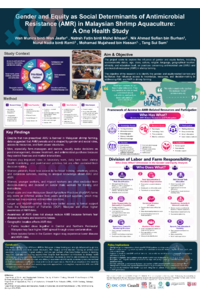
Gender and Equity as Social Determinants of Antimicrobial Resistance (AMR) in Malaysian Shrimp Aquaculture: A One Health Study
'%3e%3cpath%20d='M12.6647%2010.9104C12.4176%2010.325%2012.0589%209.7933%2011.6088%209.34485C11.16%208.89511%2010.6283%208.53653%2010.0432%208.28891C10.038%208.28629%2010.0327%208.28498%2010.0275%208.28236C10.8437%207.69282%2011.3743%206.73252%2011.3743%205.64907C11.3743%203.85423%209.92005%202.40002%208.12522%202.40002C6.33038%202.40002%204.87618%203.85423%204.87618%205.64907C4.87618%206.73252%205.40677%207.69282%206.22296%208.28367C6.21772%208.28629%206.21248%208.2876%206.20724%208.29022C5.62031%208.53783%205.09365%208.89287%204.64167%209.34616C4.19192%209.79496%203.83334%2010.3266%203.58573%2010.9117C3.34247%2011.4846%203.21128%2012.0987%203.19925%2012.721C3.1989%2012.735%203.20135%2012.7489%203.20646%2012.7619C3.21157%2012.7749%203.21924%2012.7868%203.22901%2012.7968C3.23877%2012.8068%203.25045%2012.8148%203.26334%2012.8202C3.27623%2012.8256%203.29007%2012.8284%203.30406%2012.8284H4.09012C4.14776%2012.8284%204.19362%2012.7825%204.19493%2012.7262C4.22113%2011.7148%204.62726%2010.7676%205.34519%2010.0497C6.08802%209.30686%207.07452%208.89811%208.12522%208.89811C9.17592%208.89811%2010.1624%209.30686%2010.9052%2010.0497C11.6232%2010.7676%2012.0293%2011.7148%2012.0555%2012.7262C12.0568%2012.7839%2012.1027%2012.8284%2012.1603%2012.8284H12.9464C12.9604%2012.8284%2012.9742%2012.8256%2012.9871%2012.8202C13%2012.8148%2013.0117%2012.8068%2013.0214%2012.7968C13.0312%2012.7868%2013.0389%2012.7749%2013.044%2012.7619C13.0491%2012.7489%2013.0515%2012.735%2013.0512%2012.721C13.0381%2012.0947%2012.9084%2011.4856%2012.6647%2010.9104ZM8.12522%207.90243C7.52388%207.90243%206.95792%207.66793%206.53214%207.24215C6.10636%206.81636%205.87185%206.2504%205.87185%205.64907C5.87185%205.04773%206.10636%204.48177%206.53214%204.05599C6.95792%203.63021%207.52388%203.3957%208.12522%203.3957C8.72655%203.3957%209.29252%203.63021%209.7183%204.05599C10.1441%204.48177%2010.3786%205.04773%2010.3786%205.64907C10.3786%206.2504%2010.1441%206.81636%209.7183%207.24215C9.29252%207.66793%208.72655%207.90243%208.12522%207.90243Z'%20fill='%235D1EE1'/%3e%3c/g%3e%3c/svg%3e)
Wan Munira binti Wan Jaafar 1
Natrah Fatin binti Mohd Ikhsan 2
Nik Ahmad Sufian bin Burhan 1
Nurul Nadia binti Ramli 3
Mohamad Mujaheed bin Hassan 1
1. Department of Social and Development Sciences, Faculty of Human Ecology, Universiti Putra Malaysia (UPM), Serdang 43400 Selangor, MALAYSIA
2. Department of Aquaculture, Faculty of Agriculture, Universiti Putra Malaysia (UPM), 43400 Serdang, Selangor, MALAYSIA
3. Department of Agribusiness and Resources, Faculty of Agriculture, Universiti Putra Malaysia (UPM), 43400 Serdang, Selangor, MALAYSIA
Abstract
Shrimp aquaculture is one of Malaysia’s most rapidly expanding food production sectors, contributing significantly to national food security and export revenue. Despite its economic importance, the industry faces persistent challenges related to disease outbreaks, environmental degradation, and inappropriate antimicrobial use (AMU), which contributes to the global threat of antimicrobial resistance (AMR). Existing interventions have largely emphasized technical and regulatory solutions, with limited attention to the social dynamics shaping farm-level antimicrobial practices. This study addresses this gap by examining how gender and equity-related factors influence AMU and biosecurity practices in Malaysian shrimp aquaculture. Using a qualitative research design and data triangulation, the study draws on semi-structured interviews and focus group discussions conducted across 18 shrimp farms of varying scales (small, medium, and large) in six regions of Malaysia, including East Malaysia (Sabah and Sarawak). Participants included 18 farm owners and managers and 36 farm workers, selected to reflect diverse sociocultural, geographic, and organizational contexts. Analysis focused on the intersection of gender, socioeconomic status, education, nationality, seniority, and cultural norms in shaping AMR-related practices. The findings reveal that farm tasks and decision-making processes are strongly gendered and hierarchical. Men typically dominate decisions regarding antimicrobial application, while women and interns are often relegated to administrative or supportive roles with limited authority. Migrant workers, who comprise a substantial portion of the workforce, face restricted access to training, information, and decision-making power related to AMU and biosecurity. These social inequities significantly influence antimicrobial practices, exposure risks, and the distribution of benefits and responsibilities. The study demonstrates that integrating gender and equity perspectives is essential for developing inclusive, context-sensitive, and sustainable AMR mitigation strategies aligned with Malaysia’s national AMR framework.
Keywords
Antimicrobial resistance
One Health
shrimp aquaculture
antimicrobial use
gender and equity
Poster
sciforum-166681_poster.pdf
One Health surveillance of environmental Escherichia coli and antimicrobial
resistance in broiler production systems in Morocco
resistance in broiler production systems in Morocco
Isolation of Multi-Resistant Bacteria to Antibiotics of the ESKAPE Group from Hospital Wastewater and the WWTP of Panama