Event submissions
Published
This submission belongs to the session S4. Conventional and Novel Approaches in the Discovery of New Antimicrobial Agents of the event Antibiotics 2026—Advances in Antimicrobial Action and Resistance
Published date
04 May, 2026
Academic Editor
'%3e%3cpath%20d='M12.6657%2010.9104C12.4185%2010.325%2012.0599%209.79327%2011.6097%209.34482C11.1609%208.89508%2010.6293%208.5365%2010.0442%208.28888C10.0389%208.28626%2010.0337%208.28495%2010.0285%208.28233C10.8446%207.69279%2011.3752%206.73249%2011.3752%205.64904C11.3752%203.8542%209.92103%202.39999%208.1262%202.39999C6.33136%202.39999%204.87715%203.8542%204.87715%205.64904C4.87715%206.73249%205.40774%207.69279%206.22393%208.28364C6.21869%208.28626%206.21345%208.28757%206.20821%208.29019C5.62129%208.5378%205.09463%208.89284%204.64265%209.34613C4.1929%209.79493%203.83432%2010.3266%203.58671%2010.9117C3.34345%2011.4845%203.21226%2012.0987%203.20023%2012.7209C3.19988%2012.7349%203.20233%2012.7488%203.20744%2012.7619C3.21255%2012.7749%203.22022%2012.7867%203.22998%2012.7968C3.23975%2012.8068%203.25142%2012.8147%203.26431%2012.8202C3.2772%2012.8256%203.29105%2012.8284%203.30504%2012.8284H4.09109C4.14874%2012.8284%204.19459%2012.7825%204.1959%2012.7262C4.2221%2011.7148%204.62823%2010.7676%205.34617%2010.0497C6.08899%209.30683%207.0755%208.89808%208.1262%208.89808C9.17689%208.89808%2010.1634%209.30683%2010.9062%2010.0497C11.6242%2010.7676%2012.0303%2011.7148%2012.0565%2012.7262C12.0578%2012.7838%2012.1037%2012.8284%2012.1613%2012.8284H12.9474C12.9613%2012.8284%2012.9752%2012.8256%2012.9881%2012.8202C13.001%2012.8147%2013.0126%2012.8068%2013.0224%2012.7968C13.0322%2012.7867%2013.0398%2012.7749%2013.0449%2012.7619C13.0501%2012.7488%2013.0525%2012.7349%2013.0522%2012.7209C13.0391%2012.0947%2012.9094%2011.4855%2012.6657%2010.9104ZM8.1262%207.9024C7.52486%207.9024%206.9589%207.6679%206.53312%207.24211C6.10733%206.81633%205.87283%206.25037%205.87283%205.64904C5.87283%205.0477%206.10733%204.48174%206.53312%204.05596C6.9589%203.63018%207.52486%203.39567%208.1262%203.39567C8.72753%203.39567%209.29349%203.63018%209.71927%204.05596C10.1451%204.48174%2010.3796%205.0477%2010.3796%205.64904C10.3796%206.25037%2010.1451%206.81633%209.71927%207.24211C9.29349%207.6679%208.72753%207.9024%208.1262%207.9024Z'%20fill='%235D1EE1'/%3e%3c/g%3e%3c/svg%3e) Marc Maresca
Marc MarescaCitation
Bruna Negrisoli, Adriano Goncalves, Isabel Cristina Periquito, New insights into peptide Docking and Molecular Dynamics for β-lactamase inhibitor discovery., in Proceedings of Antibiotics 2026—Advances in Antimicrobial Action and Resistance, Barcelona, 11 May–14 May 2026, MDPI: Basel, Switzerland
Share
Email
Facebook
Twitter
LinkedIn
New insights into peptide Docking and Molecular Dynamics for β-lactamase inhibitor discovery.
'%3e%3cpath%20d='M12.6647%2010.9104C12.4176%2010.325%2012.0589%209.7933%2011.6088%209.34485C11.16%208.89511%2010.6283%208.53653%2010.0432%208.28891C10.038%208.28629%2010.0327%208.28498%2010.0275%208.28236C10.8437%207.69282%2011.3743%206.73252%2011.3743%205.64907C11.3743%203.85423%209.92005%202.40002%208.12522%202.40002C6.33038%202.40002%204.87618%203.85423%204.87618%205.64907C4.87618%206.73252%205.40677%207.69282%206.22296%208.28367C6.21772%208.28629%206.21248%208.2876%206.20724%208.29022C5.62031%208.53783%205.09365%208.89287%204.64167%209.34616C4.19192%209.79496%203.83334%2010.3266%203.58573%2010.9117C3.34247%2011.4846%203.21128%2012.0987%203.19925%2012.721C3.1989%2012.735%203.20135%2012.7489%203.20646%2012.7619C3.21157%2012.7749%203.21924%2012.7868%203.22901%2012.7968C3.23877%2012.8068%203.25045%2012.8148%203.26334%2012.8202C3.27623%2012.8256%203.29007%2012.8284%203.30406%2012.8284H4.09012C4.14776%2012.8284%204.19362%2012.7825%204.19493%2012.7262C4.22113%2011.7148%204.62726%2010.7676%205.34519%2010.0497C6.08802%209.30686%207.07452%208.89811%208.12522%208.89811C9.17592%208.89811%2010.1624%209.30686%2010.9052%2010.0497C11.6232%2010.7676%2012.0293%2011.7148%2012.0555%2012.7262C12.0568%2012.7839%2012.1027%2012.8284%2012.1603%2012.8284H12.9464C12.9604%2012.8284%2012.9742%2012.8256%2012.9871%2012.8202C13%2012.8148%2013.0117%2012.8068%2013.0214%2012.7968C13.0312%2012.7868%2013.0389%2012.7749%2013.044%2012.7619C13.0491%2012.7489%2013.0515%2012.735%2013.0512%2012.721C13.0381%2012.0947%2012.9084%2011.4856%2012.6647%2010.9104ZM8.12522%207.90243C7.52388%207.90243%206.95792%207.66793%206.53214%207.24215C6.10636%206.81636%205.87185%206.2504%205.87185%205.64907C5.87185%205.04773%206.10636%204.48177%206.53214%204.05599C6.95792%203.63021%207.52388%203.3957%208.12522%203.3957C8.72655%203.3957%209.29252%203.63021%209.7183%204.05599C10.1441%204.48177%2010.3786%205.04773%2010.3786%205.64907C10.3786%206.2504%2010.1441%206.81636%209.7183%207.24215C9.29252%207.66793%208.72655%207.90243%208.12522%207.90243Z'%20fill='%235D1EE1'/%3e%3c/g%3e%3c/svg%3e)
Bruna Negrisoli 1
Adriano Goncalves 1,2
Isabel Cristina Periquito 1
1. USP- University of Sao Paulo
2. Uniara- University of Araraquara
Abstract
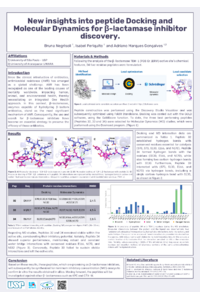
Since the clinical introduction of antibiotics, antimicrobial resistance (AMR) has emerged as a global challenge. AMR has been recognized as one of the leading causes of mortality worldwide, impacting human, animal, and environmental health, thereby necessitating an integrated One Health approach. In this context, β-lactamases, enzymes capable of hydrolyzing β-lactam antibiotics, stand as the most significant mechanism of AMR. Consequently, the use and search for β-lactamase inhibitors have become an essential strategy to preserve the efficacy of these antibiotics. Following the analysis of the β-lactamase TEM-1 (PDB ID: 1ERM) active site's chemical features, 34 five-residue peptides were formulated. Peptide construction was performed using the Discovery Studio Visualizer and was subsequently optimized using Foldit Standalone. Docking was carried out with the GOLD software, using the GoldScore function. To date, the three best performing peptides (Peptides 32, 33 and 34) were selected for Molecular Dynamics (MD) studies, which were performed using the Desmond program. Peptide 32 established hydrogen bonds with the conserved residues essential for catalysis (S70, S130, K73, E166, N170). Peptide 34 formed hydrogen bonds with the residues (S130, E166, N170). Furthermore, Peptide 33 exhibited hydrogen bonds with (S130, K73, E166, N170). Considering the MD studies, it was observed that two of the three peptides (Peptides 32 and 34) demonstrated stability in the active site, remaining bound throughout the simulation, which corroborates the prediction of a probable inhibition. Conversely, Peptide 33 did not maintain stable interactions and failed to remain in the active site. Specific analyses of the interactions observed during the simulation time are currently being conducted. Based on these results, these peptides, which are promising as b-lactamase inhibitors, will subsequently be synthesized for minimum inhibitory concentration (MIC) assays to confirm in vitro the results obtained in silico. Moving forward, the peptides will be investigated against other β-lactamases such as KPC and CTX-M.
Keywords
Antimicrobial resistance
Peptides
One Health
Molecular dynamics
Molecular docking
β-lactamases.
Poster
poster_bruna_negrisoli.pdf
Assessment of the Synergistic Activity of Imipenem/Relebactam in Combination with Meropenem and Tigecycline Against Burkholderia cepacia Complex Isolates
Cefiderocol and mortality outcomes in carbapenem-resistant Acinetobacter baumannii Infections, a narrative evidence review.