Event submissions
Published
This submission belongs to the session S4. Conventional and Novel Approaches in the Discovery of New Antimicrobial Agents of the event Antibiotics 2026—Advances in Antimicrobial Action and Resistance
Published date
04 May, 2026
Academic Editor
'%3e%3cpath%20d='M12.6657%2010.9104C12.4185%2010.325%2012.0599%209.79327%2011.6097%209.34482C11.1609%208.89508%2010.6293%208.5365%2010.0442%208.28888C10.0389%208.28626%2010.0337%208.28495%2010.0285%208.28233C10.8446%207.69279%2011.3752%206.73249%2011.3752%205.64904C11.3752%203.8542%209.92103%202.39999%208.1262%202.39999C6.33136%202.39999%204.87715%203.8542%204.87715%205.64904C4.87715%206.73249%205.40774%207.69279%206.22393%208.28364C6.21869%208.28626%206.21345%208.28757%206.20821%208.29019C5.62129%208.5378%205.09463%208.89284%204.64265%209.34613C4.1929%209.79493%203.83432%2010.3266%203.58671%2010.9117C3.34345%2011.4845%203.21226%2012.0987%203.20023%2012.7209C3.19988%2012.7349%203.20233%2012.7488%203.20744%2012.7619C3.21255%2012.7749%203.22022%2012.7867%203.22998%2012.7968C3.23975%2012.8068%203.25142%2012.8147%203.26431%2012.8202C3.2772%2012.8256%203.29105%2012.8284%203.30504%2012.8284H4.09109C4.14874%2012.8284%204.19459%2012.7825%204.1959%2012.7262C4.2221%2011.7148%204.62823%2010.7676%205.34617%2010.0497C6.08899%209.30683%207.0755%208.89808%208.1262%208.89808C9.17689%208.89808%2010.1634%209.30683%2010.9062%2010.0497C11.6242%2010.7676%2012.0303%2011.7148%2012.0565%2012.7262C12.0578%2012.7838%2012.1037%2012.8284%2012.1613%2012.8284H12.9474C12.9613%2012.8284%2012.9752%2012.8256%2012.9881%2012.8202C13.001%2012.8147%2013.0126%2012.8068%2013.0224%2012.7968C13.0322%2012.7867%2013.0398%2012.7749%2013.0449%2012.7619C13.0501%2012.7488%2013.0525%2012.7349%2013.0522%2012.7209C13.0391%2012.0947%2012.9094%2011.4855%2012.6657%2010.9104ZM8.1262%207.9024C7.52486%207.9024%206.9589%207.6679%206.53312%207.24211C6.10733%206.81633%205.87283%206.25037%205.87283%205.64904C5.87283%205.0477%206.10733%204.48174%206.53312%204.05596C6.9589%203.63018%207.52486%203.39567%208.1262%203.39567C8.72753%203.39567%209.29349%203.63018%209.71927%204.05596C10.1451%204.48174%2010.3796%205.0477%2010.3796%205.64904C10.3796%206.25037%2010.1451%206.81633%209.71927%207.24211C9.29349%207.6679%208.72753%207.9024%208.1262%207.9024Z'%20fill='%235D1EE1'/%3e%3c/g%3e%3c/svg%3e) Marc Maresca
Marc MarescaCitation
Cristina Cantallops Vilà, Ana-Marija Milisav, Franck Bouchart, Sophie Cazalbou, Anne Leriche, Maja Dutour Sikirić, Edwige Meurice, In Situ Mineralization of Alginate Hydrogels with Nisin: A Bioactive Material for Bone Applications, in Proceedings of Antibiotics 2026—Advances in Antimicrobial Action and Resistance, Barcelona, 11 May–14 May 2026, MDPI: Basel, Switzerland
Share
Email
Facebook
Twitter
LinkedIn
In Situ Mineralization of Alginate Hydrogels with Nisin: A Bioactive Material for Bone Applications
'%3e%3cpath%20d='M12.6647%2010.9104C12.4176%2010.325%2012.0589%209.7933%2011.6088%209.34485C11.16%208.89511%2010.6283%208.53653%2010.0432%208.28891C10.038%208.28629%2010.0327%208.28498%2010.0275%208.28236C10.8437%207.69282%2011.3743%206.73252%2011.3743%205.64907C11.3743%203.85423%209.92005%202.40002%208.12522%202.40002C6.33038%202.40002%204.87618%203.85423%204.87618%205.64907C4.87618%206.73252%205.40677%207.69282%206.22296%208.28367C6.21772%208.28629%206.21248%208.2876%206.20724%208.29022C5.62031%208.53783%205.09365%208.89287%204.64167%209.34616C4.19192%209.79496%203.83334%2010.3266%203.58573%2010.9117C3.34247%2011.4846%203.21128%2012.0987%203.19925%2012.721C3.1989%2012.735%203.20135%2012.7489%203.20646%2012.7619C3.21157%2012.7749%203.21924%2012.7868%203.22901%2012.7968C3.23877%2012.8068%203.25045%2012.8148%203.26334%2012.8202C3.27623%2012.8256%203.29007%2012.8284%203.30406%2012.8284H4.09012C4.14776%2012.8284%204.19362%2012.7825%204.19493%2012.7262C4.22113%2011.7148%204.62726%2010.7676%205.34519%2010.0497C6.08802%209.30686%207.07452%208.89811%208.12522%208.89811C9.17592%208.89811%2010.1624%209.30686%2010.9052%2010.0497C11.6232%2010.7676%2012.0293%2011.7148%2012.0555%2012.7262C12.0568%2012.7839%2012.1027%2012.8284%2012.1603%2012.8284H12.9464C12.9604%2012.8284%2012.9742%2012.8256%2012.9871%2012.8202C13%2012.8148%2013.0117%2012.8068%2013.0214%2012.7968C13.0312%2012.7868%2013.0389%2012.7749%2013.044%2012.7619C13.0491%2012.7489%2013.0515%2012.735%2013.0512%2012.721C13.0381%2012.0947%2012.9084%2011.4856%2012.6647%2010.9104ZM8.12522%207.90243C7.52388%207.90243%206.95792%207.66793%206.53214%207.24215C6.10636%206.81636%205.87185%206.2504%205.87185%205.64907C5.87185%205.04773%206.10636%204.48177%206.53214%204.05599C6.95792%203.63021%207.52388%203.3957%208.12522%203.3957C8.72655%203.3957%209.29252%203.63021%209.7183%204.05599C10.1441%204.48177%2010.3786%205.04773%2010.3786%205.64907C10.3786%206.2504%2010.1441%206.81636%209.7183%207.24215C9.29252%207.66793%208.72655%207.90243%208.12522%207.90243Z'%20fill='%235D1EE1'/%3e%3c/g%3e%3c/svg%3e)
Cristina Cantallops Vilà 1
Ana-Marija Milisav 2
Franck Bouchart 1
Sophie Cazalbou 3
Anne Leriche 1

Maja Dutour Sikirić 2
Edwige Meurice 1
1. Université Polytechnique Hauts-de-France (UPHF), CERAMATHS, 59313 Valenciennes, France
2. Ruđer Bošković Institute, 10000 Zagreb, Croatia
3. Université Paul Sabatier Toulouse III (UPS), CIRIMAT, 31062 Toulouse, France
Abstract
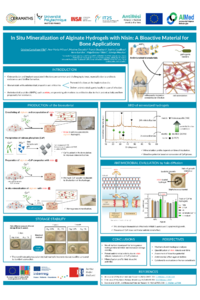
The rise of antibiotic‑resistant pathogens in osteoarticular infections underscores the need for alternative antimicrobial strategies acting locally within bone tissue. Antimicrobial peptides (AMPs) such as nisin offer broad‑spectrum activity and low resistance potential, yet their clinical use is limited by rapid degradation and systemic clearance in vivo. To address this limitation, we developed alginate hydrogels capable of encapsulating and protecting nisin while enabling localized antimicrobial action. These hydrogels exhibited clear antibacterial activity against Staphylococcus aureus and S. epidermidis in a 3D agar diffusion assay, generating inhibition halos of 1.84 ± 0.34 mm in width. They also achieved complete eradication of planktonic cultures, corresponding to a ≥5-log reduction in CFU.
To enhance the bone related properties of the system, the hydrogels were mineralized using complementary strategies: (i) encapsulation of preformed calcium phosphate (CaP) powders (hydroxyapatite and β-TCP), and (ii) a novel in situ alginate mineralization method designed to improve the stability and homogeneity of crosslinking and CaP distribution throughout the hydrogel. Notably, hydrogels prepared with our novel method showed enhanced storage stability, remaining active for at least two additional weeks compared to standard preparations. Varying the duration of in situ mineralization enabled the formation of distinct CaP phases, such as hydroxyapatite and brushite, as confirmed by XRD. Importantly, CaP functionalization did not compromise antimicrobial performance, with average halo widths of 1.71 ± 0.30 mm. Preliminary analyses indicate that mineralization increases the mechanical robustness of the hydrogels, with further mechanical, rheological, and stability studies underway. These characterizations will guide the selection of the final application format (injectable, mouldable, or scaffold-like). Ongoing work also focuses on assessing bioactivity through ion release profiling and apatite formation in SBF.
Overall, this work presents a promising antimicrobial and bioactive hydrogel platform that integrates AMP delivery with CaP mineralization, offering potential for localized infection control and bone regeneration in osteoarticular applications.
Keywords
AMP
hydrogel
CaP
antimicrobial
biomaterial
Poster
C.Cantallops - poster Antibiotics BCN (may 2026)_Cristina Cantallops Vilà.pdf
Cefiderocol and mortality outcomes in carbapenem-resistant Acinetobacter baumannii Infections, a narrative evidence review.
Study of the Behavior of the pair Klebsiella pneumoniae | Carbapenems in several European Countries by CLUSTERING HEALTH DATA TIME SERIES WITH THE GENERALIZED AFFINITY COEFFICIENT