Event submissions
Published
This submission belongs to the session S4. Conventional and Novel Approaches in the Discovery of New Antimicrobial Agents of the event Antibiotics 2026—Advances in Antimicrobial Action and Resistance
Published date
04 May, 2026
Academic Editor
'%3e%3cpath%20d='M12.6657%2010.9104C12.4185%2010.325%2012.0599%209.79327%2011.6097%209.34482C11.1609%208.89508%2010.6293%208.5365%2010.0442%208.28888C10.0389%208.28626%2010.0337%208.28495%2010.0285%208.28233C10.8446%207.69279%2011.3752%206.73249%2011.3752%205.64904C11.3752%203.8542%209.92103%202.39999%208.1262%202.39999C6.33136%202.39999%204.87715%203.8542%204.87715%205.64904C4.87715%206.73249%205.40774%207.69279%206.22393%208.28364C6.21869%208.28626%206.21345%208.28757%206.20821%208.29019C5.62129%208.5378%205.09463%208.89284%204.64265%209.34613C4.1929%209.79493%203.83432%2010.3266%203.58671%2010.9117C3.34345%2011.4845%203.21226%2012.0987%203.20023%2012.7209C3.19988%2012.7349%203.20233%2012.7488%203.20744%2012.7619C3.21255%2012.7749%203.22022%2012.7867%203.22998%2012.7968C3.23975%2012.8068%203.25142%2012.8147%203.26431%2012.8202C3.2772%2012.8256%203.29105%2012.8284%203.30504%2012.8284H4.09109C4.14874%2012.8284%204.19459%2012.7825%204.1959%2012.7262C4.2221%2011.7148%204.62823%2010.7676%205.34617%2010.0497C6.08899%209.30683%207.0755%208.89808%208.1262%208.89808C9.17689%208.89808%2010.1634%209.30683%2010.9062%2010.0497C11.6242%2010.7676%2012.0303%2011.7148%2012.0565%2012.7262C12.0578%2012.7838%2012.1037%2012.8284%2012.1613%2012.8284H12.9474C12.9613%2012.8284%2012.9752%2012.8256%2012.9881%2012.8202C13.001%2012.8147%2013.0126%2012.8068%2013.0224%2012.7968C13.0322%2012.7867%2013.0398%2012.7749%2013.0449%2012.7619C13.0501%2012.7488%2013.0525%2012.7349%2013.0522%2012.7209C13.0391%2012.0947%2012.9094%2011.4855%2012.6657%2010.9104ZM8.1262%207.9024C7.52486%207.9024%206.9589%207.6679%206.53312%207.24211C6.10733%206.81633%205.87283%206.25037%205.87283%205.64904C5.87283%205.0477%206.10733%204.48174%206.53312%204.05596C6.9589%203.63018%207.52486%203.39567%208.1262%203.39567C8.72753%203.39567%209.29349%203.63018%209.71927%204.05596C10.1451%204.48174%2010.3796%205.0477%2010.3796%205.64904C10.3796%206.25037%2010.1451%206.81633%209.71927%207.24211C9.29349%207.6679%208.72753%207.9024%208.1262%207.9024Z'%20fill='%235D1EE1'/%3e%3c/g%3e%3c/svg%3e) Marc Maresca
Marc MarescaCitation
Ana Paula Nascimento, Mónica Vieira, Cristina Prudêncio, Helena Bacelar-Nicolau, Study of the Behavior of the pair Klebsiella pneumoniae | Carbapenems in several European Countries by CLUSTERING HEALTH DATA TIME SERIES WITH THE GENERALIZED AFFINITY COEFFICIENT, in Proceedings of Antibiotics 2026—Advances in Antimicrobial Action and Resistance, Barcelona, 11 May–14 May 2026, MDPI: Basel, Switzerland
Share
Email
Facebook
Twitter
LinkedIn
Study of the Behavior of the pair Klebsiella pneumoniae | Carbapenems in several European Countries by CLUSTERING HEALTH DATA TIME SERIES WITH THE GENERALIZED AFFINITY COEFFICIENT
'%3e%3cpath%20d='M12.6647%2010.9104C12.4176%2010.325%2012.0589%209.7933%2011.6088%209.34485C11.16%208.89511%2010.6283%208.53653%2010.0432%208.28891C10.038%208.28629%2010.0327%208.28498%2010.0275%208.28236C10.8437%207.69282%2011.3743%206.73252%2011.3743%205.64907C11.3743%203.85423%209.92005%202.40002%208.12522%202.40002C6.33038%202.40002%204.87618%203.85423%204.87618%205.64907C4.87618%206.73252%205.40677%207.69282%206.22296%208.28367C6.21772%208.28629%206.21248%208.2876%206.20724%208.29022C5.62031%208.53783%205.09365%208.89287%204.64167%209.34616C4.19192%209.79496%203.83334%2010.3266%203.58573%2010.9117C3.34247%2011.4846%203.21128%2012.0987%203.19925%2012.721C3.1989%2012.735%203.20135%2012.7489%203.20646%2012.7619C3.21157%2012.7749%203.21924%2012.7868%203.22901%2012.7968C3.23877%2012.8068%203.25045%2012.8148%203.26334%2012.8202C3.27623%2012.8256%203.29007%2012.8284%203.30406%2012.8284H4.09012C4.14776%2012.8284%204.19362%2012.7825%204.19493%2012.7262C4.22113%2011.7148%204.62726%2010.7676%205.34519%2010.0497C6.08802%209.30686%207.07452%208.89811%208.12522%208.89811C9.17592%208.89811%2010.1624%209.30686%2010.9052%2010.0497C11.6232%2010.7676%2012.0293%2011.7148%2012.0555%2012.7262C12.0568%2012.7839%2012.1027%2012.8284%2012.1603%2012.8284H12.9464C12.9604%2012.8284%2012.9742%2012.8256%2012.9871%2012.8202C13%2012.8148%2013.0117%2012.8068%2013.0214%2012.7968C13.0312%2012.7868%2013.0389%2012.7749%2013.044%2012.7619C13.0491%2012.7489%2013.0515%2012.735%2013.0512%2012.721C13.0381%2012.0947%2012.9084%2011.4856%2012.6647%2010.9104ZM8.12522%207.90243C7.52388%207.90243%206.95792%207.66793%206.53214%207.24215C6.10636%206.81636%205.87185%206.2504%205.87185%205.64907C5.87185%205.04773%206.10636%204.48177%206.53214%204.05599C6.95792%203.63021%207.52388%203.3957%208.12522%203.3957C8.72655%203.3957%209.29252%203.63021%209.7183%204.05599C10.1441%204.48177%2010.3786%205.04773%2010.3786%205.64907C10.3786%206.2504%2010.1441%206.81636%209.7183%207.24215C9.29252%207.66793%208.72655%207.90243%208.12522%207.90243Z'%20fill='%235D1EE1'/%3e%3c/g%3e%3c/svg%3e)
Ana Paula Nascimento 1,2
Mónica Vieira 1,2
Cristina Prudêncio 1,2
Helena Bacelar-Nicolau 3,4
1. TBIO/RISE-HEALTH
2. Escola Superior de Saúde, P. Porto, Portugal
3. Faculdade de Psicologia da Universidade de Lisboa, Portugal
4. Instituto de Saúde Ambiental, da Faculdade de Medicina da Universidade de Lisboa, Portugal
Abstract
Antimicrobial resistance (AMR) constitutes a major public health and economic burden in contemporary society. The aim of this work is to identify patterns and trends associated with the resistance behavior of Klebsiella pneumoniae to carbapenems across several European countries in order to better understand its dynamics and public health implications, since it’s a pair considered by the WHO as a critical priority. Variables: The dataset resistance values of K.pneumoniae|Carbapenems for several countries from 2005 to 2021(data available up to 2023) were obtained from the public website of ECDC. Methods: Agglomerative Hierarchical Cluster Analysis (HCA) was based on the generalized Affinity coefficient applied to the estimated ARIMA models. Results:The dendrogram at the cut-off presented four clusters: the first cluster was Slovenia, Luxembourg, Italy, and Estonia; the second cluster was Romania, Malta, Greece, Portugal, and Spain; the third cluster was Denmark, France, and Czechia; and finally, the fourth cluster was Lithuania, Cyprus, Finland, Austria, Belgium, and Slovakia. Although the resistance values show a more visible increasing trend over the years in Clusters II and III, the increase is more pronounced. Data were standardized, and the slopes of the lines obtained between the years 2012 and 2020 were calculated for Clusters II and III. For Clusters I and IV, this was not possible due to the irregularity of the curves. The slopes are higher in the countries belonging to Cluster II. Specifically, the slopes for Cluster II’s countries are m=0.29, m=1.5, m=0.06, m=0.11, and m=0.26 for Portugal, Spain, Greece, Malta, andRomania, respectively, whereas for Cluster III’s countries, the slopes are m=0.02, m=0,08 and m=0.001 for France, Czechia, and Denmark, respectively. It is relevant that within Cluster II, Portugal and Spain show a steeper increase, with Spain showing the most pronounced growth. Conclusions: The application of data analysis, using HCA based on the generalized Affinity coefficient, allows the evaluation of patterns among different regions and gives the possibility to identify alarming groups that need urgent intervention
Keywords
Keywords: Hierarchical cluster analysis
Affinity coefficient
Time series
Antimicrobial resistance
ARIMA model
Poster
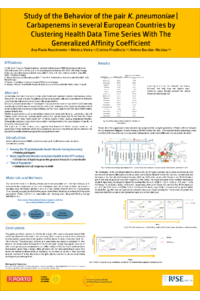
Poster Barcelona_13_May 2026_K. Pneumoniae_Cristina Prudêncio.pdf
In Situ Mineralization of Alginate Hydrogels with Nisin: A Bioactive Material for Bone Applications
Halobacteriovorax to kill Multi-Drug-Resistant Escherichia coli and Salmonella