Event submissions
Published
This submission belongs to the session S4. Conventional and Novel Approaches in the Discovery of New Antimicrobial Agents of the event Antibiotics 2026—Advances in Antimicrobial Action and Resistance
Published date
04 May, 2026
Academic Editor
'%3e%3cpath%20d='M12.6657%2010.9104C12.4185%2010.325%2012.0599%209.79327%2011.6097%209.34482C11.1609%208.89508%2010.6293%208.5365%2010.0442%208.28888C10.0389%208.28626%2010.0337%208.28495%2010.0285%208.28233C10.8446%207.69279%2011.3752%206.73249%2011.3752%205.64904C11.3752%203.8542%209.92103%202.39999%208.1262%202.39999C6.33136%202.39999%204.87715%203.8542%204.87715%205.64904C4.87715%206.73249%205.40774%207.69279%206.22393%208.28364C6.21869%208.28626%206.21345%208.28757%206.20821%208.29019C5.62129%208.5378%205.09463%208.89284%204.64265%209.34613C4.1929%209.79493%203.83432%2010.3266%203.58671%2010.9117C3.34345%2011.4845%203.21226%2012.0987%203.20023%2012.7209C3.19988%2012.7349%203.20233%2012.7488%203.20744%2012.7619C3.21255%2012.7749%203.22022%2012.7867%203.22998%2012.7968C3.23975%2012.8068%203.25142%2012.8147%203.26431%2012.8202C3.2772%2012.8256%203.29105%2012.8284%203.30504%2012.8284H4.09109C4.14874%2012.8284%204.19459%2012.7825%204.1959%2012.7262C4.2221%2011.7148%204.62823%2010.7676%205.34617%2010.0497C6.08899%209.30683%207.0755%208.89808%208.1262%208.89808C9.17689%208.89808%2010.1634%209.30683%2010.9062%2010.0497C11.6242%2010.7676%2012.0303%2011.7148%2012.0565%2012.7262C12.0578%2012.7838%2012.1037%2012.8284%2012.1613%2012.8284H12.9474C12.9613%2012.8284%2012.9752%2012.8256%2012.9881%2012.8202C13.001%2012.8147%2013.0126%2012.8068%2013.0224%2012.7968C13.0322%2012.7867%2013.0398%2012.7749%2013.0449%2012.7619C13.0501%2012.7488%2013.0525%2012.7349%2013.0522%2012.7209C13.0391%2012.0947%2012.9094%2011.4855%2012.6657%2010.9104ZM8.1262%207.9024C7.52486%207.9024%206.9589%207.6679%206.53312%207.24211C6.10733%206.81633%205.87283%206.25037%205.87283%205.64904C5.87283%205.0477%206.10733%204.48174%206.53312%204.05596C6.9589%203.63018%207.52486%203.39567%208.1262%203.39567C8.72753%203.39567%209.29349%203.63018%209.71927%204.05596C10.1451%204.48174%2010.3796%205.0477%2010.3796%205.64904C10.3796%206.25037%2010.1451%206.81633%209.71927%207.24211C9.29349%207.6679%208.72753%207.9024%208.1262%207.9024Z'%20fill='%235D1EE1'/%3e%3c/g%3e%3c/svg%3e) Marc Maresca
Marc MarescaCitation
Donatella Ottaviani, Giulia Talevi, Silvia Pieralisi, Gabriele Angelico, Sara Nardi, Francesca Leoni, Francesca Barchiesi, Elena Rocchegiani, Stefania Di Lullo, Halobacteriovorax to kill Multi-Drug-Resistant Escherichia coli and Salmonella, in Proceedings of Antibiotics 2026—Advances in Antimicrobial Action and Resistance, Barcelona, 11 May–14 May 2026, MDPI: Basel, Switzerland
Share
Email
Facebook
Twitter
LinkedIn
Halobacteriovorax to kill Multi-Drug-Resistant Escherichia coli and Salmonella
'%3e%3cpath%20d='M12.6647%2010.9104C12.4176%2010.325%2012.0589%209.7933%2011.6088%209.34485C11.16%208.89511%2010.6283%208.53653%2010.0432%208.28891C10.038%208.28629%2010.0327%208.28498%2010.0275%208.28236C10.8437%207.69282%2011.3743%206.73252%2011.3743%205.64907C11.3743%203.85423%209.92005%202.40002%208.12522%202.40002C6.33038%202.40002%204.87618%203.85423%204.87618%205.64907C4.87618%206.73252%205.40677%207.69282%206.22296%208.28367C6.21772%208.28629%206.21248%208.2876%206.20724%208.29022C5.62031%208.53783%205.09365%208.89287%204.64167%209.34616C4.19192%209.79496%203.83334%2010.3266%203.58573%2010.9117C3.34247%2011.4846%203.21128%2012.0987%203.19925%2012.721C3.1989%2012.735%203.20135%2012.7489%203.20646%2012.7619C3.21157%2012.7749%203.21924%2012.7868%203.22901%2012.7968C3.23877%2012.8068%203.25045%2012.8148%203.26334%2012.8202C3.27623%2012.8256%203.29007%2012.8284%203.30406%2012.8284H4.09012C4.14776%2012.8284%204.19362%2012.7825%204.19493%2012.7262C4.22113%2011.7148%204.62726%2010.7676%205.34519%2010.0497C6.08802%209.30686%207.07452%208.89811%208.12522%208.89811C9.17592%208.89811%2010.1624%209.30686%2010.9052%2010.0497C11.6232%2010.7676%2012.0293%2011.7148%2012.0555%2012.7262C12.0568%2012.7839%2012.1027%2012.8284%2012.1603%2012.8284H12.9464C12.9604%2012.8284%2012.9742%2012.8256%2012.9871%2012.8202C13%2012.8148%2013.0117%2012.8068%2013.0214%2012.7968C13.0312%2012.7868%2013.0389%2012.7749%2013.044%2012.7619C13.0491%2012.7489%2013.0515%2012.735%2013.0512%2012.721C13.0381%2012.0947%2012.9084%2011.4856%2012.6647%2010.9104ZM8.12522%207.90243C7.52388%207.90243%206.95792%207.66793%206.53214%207.24215C6.10636%206.81636%205.87185%206.2504%205.87185%205.64907C5.87185%205.04773%206.10636%204.48177%206.53214%204.05599C6.95792%203.63021%207.52388%203.3957%208.12522%203.3957C8.72655%203.3957%209.29252%203.63021%209.7183%204.05599C10.1441%204.48177%2010.3786%205.04773%2010.3786%205.64907C10.3786%206.2504%2010.1441%206.81636%209.7183%207.24215C9.29252%207.66793%208.72655%207.90243%208.12522%207.90243Z'%20fill='%235D1EE1'/%3e%3c/g%3e%3c/svg%3e)
Donatella Ottaviani 1
Giulia Talevi 1
Silvia Pieralisi 1

Gabriele Angelico 1
Sara Nardi 1
Francesca Leoni 1
Francesca Barchiesi 1
Elena Rocchegiani 1
Stefania Di Lullo 1
1. Istituto Zooprofilattico Sperimentale dell’Umbria e delle Marche “Togo Rosati” Ancona, Italy
Abstract
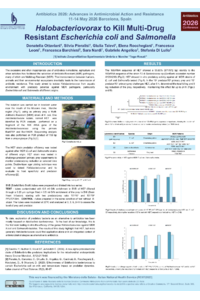
Background/Objectives: Due to the rising problem of antimicrobial resistance, there is increasing attention in the scientific community towards alternative approaches to combat Antimicrobial-Resistant (AMR) pathogens that do not involve the use of antibiotics. In this regard, the European Medicines Agency (EMA) and the European Food Safety Authority (EFSA) have promoted experimentation with predatory bacteria to fight antibiotic resistance. In this work we isolated a strain of Halobacteriovorax from an estuarine aquatic environment using a CTX-M-producing E. coli strain as prey and characterized it with respect to optimal physico-chemical parameters for growth and predation. Furthermore, we studied its predatory capacity against other E. coli strains and Multi-Drug-Resistant (MDR) Salmonella. Finally, we conducted challenge experiments to evaluate the growth of predator and prey over time. Methods: The Halobacteriovorax strain, designated HE7, was identified by 16S rRNA analysis. To isolate Halobacteriovorax and to evaluate its predatory ability towards different preys, the double-layer agar plating technique was applied. Results: HE7 showed in vitro predatory activity against all MDR strains of E. coli and Salmonella tested. In the 107 predator/103 prey and 107 predator/107 prey challenges, HE7 after 6 h achieved the total killing and a reduction of about 6 logs in the prey, respectively, maintaining this effect for up to 24 h. Conclusions: The results of this study highlight that HE7, but more generally Halobacteriovorax, could find application both alone and in an integrated context of antimicrobial strategies as an alternative to antibiotics.
This research was supported by the Italian Ministry of Health grant number RC IZS UM 07/23.
Keywords
Bdellovibrio and like organisms (BALOs)
Halobacteriovorax
Salmonella sp.
E. coli
Antimicrobial-Resistant (AMR) pathogens
biocontrol agents
Poster
Halobacteriovorax to kill Multi-Drug-Resistant Escherichia coli and Salmonella.pdf
Study of the Behavior of the pair Klebsiella pneumoniae | Carbapenems in several European Countries by CLUSTERING HEALTH DATA TIME SERIES WITH THE GENERALIZED AFFINITY COEFFICIENT
Exploring Antimicrobial Potential of Mytilus Genomic Resources