Event submissions
Published
This submission belongs to the session S5. Innovation in Antimicrobial Stewardship and Optimized Clinical Strategies of the event Antibiotics 2026—Advances in Antimicrobial Action and Resistance
Published date
04 May, 2026
Academic Editor
'%3e%3cpath%20d='M12.6657%2010.9104C12.4185%2010.325%2012.0599%209.79327%2011.6097%209.34482C11.1609%208.89508%2010.6293%208.5365%2010.0442%208.28888C10.0389%208.28626%2010.0337%208.28495%2010.0285%208.28233C10.8446%207.69279%2011.3752%206.73249%2011.3752%205.64904C11.3752%203.8542%209.92103%202.39999%208.1262%202.39999C6.33136%202.39999%204.87715%203.8542%204.87715%205.64904C4.87715%206.73249%205.40774%207.69279%206.22393%208.28364C6.21869%208.28626%206.21345%208.28757%206.20821%208.29019C5.62129%208.5378%205.09463%208.89284%204.64265%209.34613C4.1929%209.79493%203.83432%2010.3266%203.58671%2010.9117C3.34345%2011.4845%203.21226%2012.0987%203.20023%2012.7209C3.19988%2012.7349%203.20233%2012.7488%203.20744%2012.7619C3.21255%2012.7749%203.22022%2012.7867%203.22998%2012.7968C3.23975%2012.8068%203.25142%2012.8147%203.26431%2012.8202C3.2772%2012.8256%203.29105%2012.8284%203.30504%2012.8284H4.09109C4.14874%2012.8284%204.19459%2012.7825%204.1959%2012.7262C4.2221%2011.7148%204.62823%2010.7676%205.34617%2010.0497C6.08899%209.30683%207.0755%208.89808%208.1262%208.89808C9.17689%208.89808%2010.1634%209.30683%2010.9062%2010.0497C11.6242%2010.7676%2012.0303%2011.7148%2012.0565%2012.7262C12.0578%2012.7838%2012.1037%2012.8284%2012.1613%2012.8284H12.9474C12.9613%2012.8284%2012.9752%2012.8256%2012.9881%2012.8202C13.001%2012.8147%2013.0126%2012.8068%2013.0224%2012.7968C13.0322%2012.7867%2013.0398%2012.7749%2013.0449%2012.7619C13.0501%2012.7488%2013.0525%2012.7349%2013.0522%2012.7209C13.0391%2012.0947%2012.9094%2011.4855%2012.6657%2010.9104ZM8.1262%207.9024C7.52486%207.9024%206.9589%207.6679%206.53312%207.24211C6.10733%206.81633%205.87283%206.25037%205.87283%205.64904C5.87283%205.0477%206.10733%204.48174%206.53312%204.05596C6.9589%203.63018%207.52486%203.39567%208.1262%203.39567C8.72753%203.39567%209.29349%203.63018%209.71927%204.05596C10.1451%204.48174%2010.3796%205.0477%2010.3796%205.64904C10.3796%206.25037%2010.1451%206.81633%209.71927%207.24211C9.29349%207.6679%208.72753%207.9024%208.1262%207.9024Z'%20fill='%235D1EE1'/%3e%3c/g%3e%3c/svg%3e) Marc Maresca
Marc MarescaCitation
Isabel Cristina Conceição Periquito, Bruna Flôres Negrisoli, Adriano Marques Gonçalves, Docking-based screening and interaction analysis of β-Lactamase inhibitors targeting TEM-1, KPC-2 and BcII, in Proceedings of Antibiotics 2026—Advances in Antimicrobial Action and Resistance, Barcelona, 11 May–14 May 2026, MDPI: Basel, Switzerland
Share
Email
Facebook
Twitter
LinkedIn
Docking-based screening and interaction analysis of β-Lactamase inhibitors targeting TEM-1, KPC-2 and BcII
'%3e%3cpath%20d='M12.6647%2010.9104C12.4176%2010.325%2012.0589%209.7933%2011.6088%209.34485C11.16%208.89511%2010.6283%208.53653%2010.0432%208.28891C10.038%208.28629%2010.0327%208.28498%2010.0275%208.28236C10.8437%207.69282%2011.3743%206.73252%2011.3743%205.64907C11.3743%203.85423%209.92005%202.40002%208.12522%202.40002C6.33038%202.40002%204.87618%203.85423%204.87618%205.64907C4.87618%206.73252%205.40677%207.69282%206.22296%208.28367C6.21772%208.28629%206.21248%208.2876%206.20724%208.29022C5.62031%208.53783%205.09365%208.89287%204.64167%209.34616C4.19192%209.79496%203.83334%2010.3266%203.58573%2010.9117C3.34247%2011.4846%203.21128%2012.0987%203.19925%2012.721C3.1989%2012.735%203.20135%2012.7489%203.20646%2012.7619C3.21157%2012.7749%203.21924%2012.7868%203.22901%2012.7968C3.23877%2012.8068%203.25045%2012.8148%203.26334%2012.8202C3.27623%2012.8256%203.29007%2012.8284%203.30406%2012.8284H4.09012C4.14776%2012.8284%204.19362%2012.7825%204.19493%2012.7262C4.22113%2011.7148%204.62726%2010.7676%205.34519%2010.0497C6.08802%209.30686%207.07452%208.89811%208.12522%208.89811C9.17592%208.89811%2010.1624%209.30686%2010.9052%2010.0497C11.6232%2010.7676%2012.0293%2011.7148%2012.0555%2012.7262C12.0568%2012.7839%2012.1027%2012.8284%2012.1603%2012.8284H12.9464C12.9604%2012.8284%2012.9742%2012.8256%2012.9871%2012.8202C13%2012.8148%2013.0117%2012.8068%2013.0214%2012.7968C13.0312%2012.7868%2013.0389%2012.7749%2013.044%2012.7619C13.0491%2012.7489%2013.0515%2012.735%2013.0512%2012.721C13.0381%2012.0947%2012.9084%2011.4856%2012.6647%2010.9104ZM8.12522%207.90243C7.52388%207.90243%206.95792%207.66793%206.53214%207.24215C6.10636%206.81636%205.87185%206.2504%205.87185%205.64907C5.87185%205.04773%206.10636%204.48177%206.53214%204.05599C6.95792%203.63021%207.52388%203.3957%208.12522%203.3957C8.72655%203.3957%209.29252%203.63021%209.7183%204.05599C10.1441%204.48177%2010.3786%205.04773%2010.3786%205.64907C10.3786%206.2504%2010.1441%206.81636%209.7183%207.24215C9.29252%207.66793%208.72655%207.90243%208.12522%207.90243Z'%20fill='%235D1EE1'/%3e%3c/g%3e%3c/svg%3e)
Isabel Cristina Conceição Periquito 1
Bruna Flôres Negrisoli 2
Adriano Marques Gonçalves 3
1. University of São Paulo, Department of Veterinary Clinical Sciences, São Paulo, Brazil.
2. University of São Paulo, Department of Veterinary Clinical Sciences, São Paulo, Brazil
3. University of São Paulo, Department of Veterinary Clinical Sciences, São Paulo, Brazil.
University of Araraquara, Department of Biological and Health Sciences, Araraquara, Brazil
Abstract
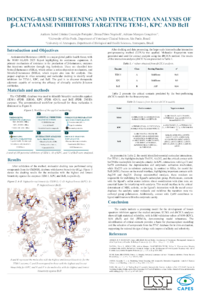
This study aims to identify and characterize, through in silico approaches, potential inhibitors of serine- and metallo-β-lactamases, enzymes directly associated with antimicrobial resistance (AMR). The ChEMBL database was screened to select molecules with reported bioactivity against TEM-1 (PDB ID: 1ERM) and KPC-2 (PDB ID: 6D15), both class A enzymes, and BcII (PDB ID: 2M5D), a class B enzyme. Based on IC₅₀ values, 200 molecules were selected for TEM-1, 89 for KPC-2, and 100 for BcII. The protonation states of the selected compounds at pH 7.4 were determined using MarvinSketch. Three-dimensional structures were built in Discovery Studio Visualizer and optimized using the semiempirical PM7 method implemented in MOPAC. Protocol validation was carried out by redocking the co-crystallized ligands, followed by molecular docking simulations of the selected compounds. Docking results were analyzed using dbCICA, which correlates binding affinity with interaction patterns in the enzyme active site. Post-processing of docking data enabled the identification of intermolecular interaction patterns that may assist the rational design of novel inhibitors. The most active ligands established multiple hydrogen bonds with conserved catalytic residues, including SER70, SER130, GLU166, ASN170, and LYS73. In contrast, less active compounds exhibited fewer interactions with these key residues. The dbCICA models showed limited predictive performance, with low coefficients of determination (r² = 0.24 for TEM-1, 0.37 for KPC-2, and 0.29 for BcII). Among the evaluated residues, GLU166 was consistently identified as relevant for both class A enzymes. Despite the modest statistical performance, the findings indicate that potent inhibitors tend to interact with essential catalytic residues, providing mechanistic insights. These interaction signatures will guide pharmacophore modeling and ZINC-based virtual screening, followed by in vitro validation to identify β-lactamase inhibitors as antibiotic adjuvants against AMR.
Keywords
Keywords: antimicrobial resistance
in silico screening
molecular docking
enzyme inhibitors.
Poster
sciforum-172407_poster file.pdf
Advance in Developing Antimicrobial Peptides with Systemic Efficacy
Functional characterization approach to identify novel antimicrobial resistance genes using cosmid libraries from Pseudomonas spp.