Event submissions
Published
This submission belongs to the session S5. Innovation in Antimicrobial Stewardship and Optimized Clinical Strategies of the event Antibiotics 2026—Advances in Antimicrobial Action and Resistance
Published date
04 May, 2026
Academic Editor
'%3e%3cpath%20d='M12.6657%2010.9104C12.4185%2010.325%2012.0599%209.79327%2011.6097%209.34482C11.1609%208.89508%2010.6293%208.5365%2010.0442%208.28888C10.0389%208.28626%2010.0337%208.28495%2010.0285%208.28233C10.8446%207.69279%2011.3752%206.73249%2011.3752%205.64904C11.3752%203.8542%209.92103%202.39999%208.1262%202.39999C6.33136%202.39999%204.87715%203.8542%204.87715%205.64904C4.87715%206.73249%205.40774%207.69279%206.22393%208.28364C6.21869%208.28626%206.21345%208.28757%206.20821%208.29019C5.62129%208.5378%205.09463%208.89284%204.64265%209.34613C4.1929%209.79493%203.83432%2010.3266%203.58671%2010.9117C3.34345%2011.4845%203.21226%2012.0987%203.20023%2012.7209C3.19988%2012.7349%203.20233%2012.7488%203.20744%2012.7619C3.21255%2012.7749%203.22022%2012.7867%203.22998%2012.7968C3.23975%2012.8068%203.25142%2012.8147%203.26431%2012.8202C3.2772%2012.8256%203.29105%2012.8284%203.30504%2012.8284H4.09109C4.14874%2012.8284%204.19459%2012.7825%204.1959%2012.7262C4.2221%2011.7148%204.62823%2010.7676%205.34617%2010.0497C6.08899%209.30683%207.0755%208.89808%208.1262%208.89808C9.17689%208.89808%2010.1634%209.30683%2010.9062%2010.0497C11.6242%2010.7676%2012.0303%2011.7148%2012.0565%2012.7262C12.0578%2012.7838%2012.1037%2012.8284%2012.1613%2012.8284H12.9474C12.9613%2012.8284%2012.9752%2012.8256%2012.9881%2012.8202C13.001%2012.8147%2013.0126%2012.8068%2013.0224%2012.7968C13.0322%2012.7867%2013.0398%2012.7749%2013.0449%2012.7619C13.0501%2012.7488%2013.0525%2012.7349%2013.0522%2012.7209C13.0391%2012.0947%2012.9094%2011.4855%2012.6657%2010.9104ZM8.1262%207.9024C7.52486%207.9024%206.9589%207.6679%206.53312%207.24211C6.10733%206.81633%205.87283%206.25037%205.87283%205.64904C5.87283%205.0477%206.10733%204.48174%206.53312%204.05596C6.9589%203.63018%207.52486%203.39567%208.1262%203.39567C8.72753%203.39567%209.29349%203.63018%209.71927%204.05596C10.1451%204.48174%2010.3796%205.0477%2010.3796%205.64904C10.3796%206.25037%2010.1451%206.81633%209.71927%207.24211C9.29349%207.6679%208.72753%207.9024%208.1262%207.9024Z'%20fill='%235D1EE1'/%3e%3c/g%3e%3c/svg%3e) Marc Maresca
Marc MarescaCitation
Marianno Franzini, Salvatore Chirumbolo, Giovanni Ricevuti, Luigi Valdenassi, SIOOT oxygen-ozone therapy against multidrug resistant bacteria. Perspectives and future remarks, in Proceedings of Antibiotics 2026—Advances in Antimicrobial Action and Resistance, Barcelona, 11 May–14 May 2026, MDPI: Basel, Switzerland
Share
Email
Facebook
Twitter
LinkedIn
SIOOT oxygen-ozone therapy against multidrug resistant bacteria. Perspectives and future remarks
'%3e%3cpath%20d='M12.6647%2010.9104C12.4176%2010.325%2012.0589%209.7933%2011.6088%209.34485C11.16%208.89511%2010.6283%208.53653%2010.0432%208.28891C10.038%208.28629%2010.0327%208.28498%2010.0275%208.28236C10.8437%207.69282%2011.3743%206.73252%2011.3743%205.64907C11.3743%203.85423%209.92005%202.40002%208.12522%202.40002C6.33038%202.40002%204.87618%203.85423%204.87618%205.64907C4.87618%206.73252%205.40677%207.69282%206.22296%208.28367C6.21772%208.28629%206.21248%208.2876%206.20724%208.29022C5.62031%208.53783%205.09365%208.89287%204.64167%209.34616C4.19192%209.79496%203.83334%2010.3266%203.58573%2010.9117C3.34247%2011.4846%203.21128%2012.0987%203.19925%2012.721C3.1989%2012.735%203.20135%2012.7489%203.20646%2012.7619C3.21157%2012.7749%203.21924%2012.7868%203.22901%2012.7968C3.23877%2012.8068%203.25045%2012.8148%203.26334%2012.8202C3.27623%2012.8256%203.29007%2012.8284%203.30406%2012.8284H4.09012C4.14776%2012.8284%204.19362%2012.7825%204.19493%2012.7262C4.22113%2011.7148%204.62726%2010.7676%205.34519%2010.0497C6.08802%209.30686%207.07452%208.89811%208.12522%208.89811C9.17592%208.89811%2010.1624%209.30686%2010.9052%2010.0497C11.6232%2010.7676%2012.0293%2011.7148%2012.0555%2012.7262C12.0568%2012.7839%2012.1027%2012.8284%2012.1603%2012.8284H12.9464C12.9604%2012.8284%2012.9742%2012.8256%2012.9871%2012.8202C13%2012.8148%2013.0117%2012.8068%2013.0214%2012.7968C13.0312%2012.7868%2013.0389%2012.7749%2013.044%2012.7619C13.0491%2012.7489%2013.0515%2012.735%2013.0512%2012.721C13.0381%2012.0947%2012.9084%2011.4856%2012.6647%2010.9104ZM8.12522%207.90243C7.52388%207.90243%206.95792%207.66793%206.53214%207.24215C6.10636%206.81636%205.87185%206.2504%205.87185%205.64907C5.87185%205.04773%206.10636%204.48177%206.53214%204.05599C6.95792%203.63021%207.52388%203.3957%208.12522%203.3957C8.72655%203.3957%209.29252%203.63021%209.7183%204.05599C10.1441%204.48177%2010.3786%205.04773%2010.3786%205.64907C10.3786%206.2504%2010.1441%206.81636%209.7183%207.24215C9.29252%207.66793%208.72655%207.90243%208.12522%207.90243Z'%20fill='%235D1EE1'/%3e%3c/g%3e%3c/svg%3e)
Marianno Franzini 1

Salvatore Chirumbolo 2

Giovanni Ricevuti 3
Luigi Valdenassi 1
1. Scientific Society of Oxygen Ozone Therapy (SIOOT), Bergamo, Italy
2. Department of Engineering for Innovation Medicine, University of Verona, Verona, Italy
3. Department of Drug Science, University of Pavia, Pavia, Italy
Abstract
Introduction
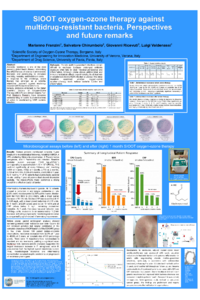
Antibiotic resistance is one of the most pressing global health threats, diminishing the effectiveness of standard antimicrobial therapies and contributing to increased morbidity, mortality, and healthcare costs. In response to this challenge, ozone therapy has emerged as a potential adjunctive treatment against multidrug-resistant (MDR) bacterial infections. Notably, protocols endorsed by the Italian Scientific Society of Oxygen-Ozone Therapy (SIOOT) and clinical insights from Prof. Marianno Franzini, have advanced understanding of ozone dual mechanisms of action in infection control.
Methods
This review synthesizes data from experimental studies, modelling analyses, and clinical reports on the use of medical ozone in MDR infections. Mechanistic insights focus on two principal modes: (1) direct bactericidal activity of ozone and its reactive species through oxidative damage to microbial membranes and thiol groups, and (2) systemic immunomodulation via low-dose ozone exposure. The latter is mediated by secondary messengers such as 4-hydroxynonenal, which activate Nrf2 signaling, regulate inflammasomes, promote macrophage activity, and enhance mitochondrial function.
Results
Evidence indicates that ozone exerts rapid, broad-spectrum bactericidal effects largely independent of classical resistance mechanisms. When administered systemically within a hormetic dose range, ozone enhances host innate immunity through redox-sensitive signaling pathways and promotes tissue-level resilience. Modelling studies suggest synergistic effects when ozone is combined with antibiotics, accelerating pathogen clearance compared to antibiotic monotherapy. Clinically, ozone has demonstrated efficacy as an adjunct in treating chronic wounds and necrotizing infections caused by MDR pathogens.
Conclusions
Ozone therapy, when precisely dosed and integrated into standardized medical protocols, offers a compelling adjunctive approach in the management of antibiotic-resistant infections. Rather than replacing antibiotics, ozone augments their effectiveness and may reduce the selective pressure driving resistance. Future integration of ozone into antimicrobial stewardship programs could support more sustainable, system-based infection control strategies aligned with global health imperatives.
Keywords
ozone therapy
multidrug resistant bacteria
Poster
Poster Barcellona Inviato.pdf
Structural Determinants of Systemic Antibiotic Use in Hungary, 2010 to 2022: Empirical Evidence for Policy Action
Phage- loaded biomimetic apatite powder and biofilms