Event submissions
Published
This submission belongs to the session S4. Conventional and Novel Approaches in the Discovery of New Antimicrobial Agents of the event Antibiotics 2026—Advances in Antimicrobial Action and Resistance
Published date
04 May, 2026
Academic Editor
'%3e%3cpath%20d='M12.6657%2010.9104C12.4185%2010.325%2012.0599%209.79327%2011.6097%209.34482C11.1609%208.89508%2010.6293%208.5365%2010.0442%208.28888C10.0389%208.28626%2010.0337%208.28495%2010.0285%208.28233C10.8446%207.69279%2011.3752%206.73249%2011.3752%205.64904C11.3752%203.8542%209.92103%202.39999%208.1262%202.39999C6.33136%202.39999%204.87715%203.8542%204.87715%205.64904C4.87715%206.73249%205.40774%207.69279%206.22393%208.28364C6.21869%208.28626%206.21345%208.28757%206.20821%208.29019C5.62129%208.5378%205.09463%208.89284%204.64265%209.34613C4.1929%209.79493%203.83432%2010.3266%203.58671%2010.9117C3.34345%2011.4845%203.21226%2012.0987%203.20023%2012.7209C3.19988%2012.7349%203.20233%2012.7488%203.20744%2012.7619C3.21255%2012.7749%203.22022%2012.7867%203.22998%2012.7968C3.23975%2012.8068%203.25142%2012.8147%203.26431%2012.8202C3.2772%2012.8256%203.29105%2012.8284%203.30504%2012.8284H4.09109C4.14874%2012.8284%204.19459%2012.7825%204.1959%2012.7262C4.2221%2011.7148%204.62823%2010.7676%205.34617%2010.0497C6.08899%209.30683%207.0755%208.89808%208.1262%208.89808C9.17689%208.89808%2010.1634%209.30683%2010.9062%2010.0497C11.6242%2010.7676%2012.0303%2011.7148%2012.0565%2012.7262C12.0578%2012.7838%2012.1037%2012.8284%2012.1613%2012.8284H12.9474C12.9613%2012.8284%2012.9752%2012.8256%2012.9881%2012.8202C13.001%2012.8147%2013.0126%2012.8068%2013.0224%2012.7968C13.0322%2012.7867%2013.0398%2012.7749%2013.0449%2012.7619C13.0501%2012.7488%2013.0525%2012.7349%2013.0522%2012.7209C13.0391%2012.0947%2012.9094%2011.4855%2012.6657%2010.9104ZM8.1262%207.9024C7.52486%207.9024%206.9589%207.6679%206.53312%207.24211C6.10733%206.81633%205.87283%206.25037%205.87283%205.64904C5.87283%205.0477%206.10733%204.48174%206.53312%204.05596C6.9589%203.63018%207.52486%203.39567%208.1262%203.39567C8.72753%203.39567%209.29349%203.63018%209.71927%204.05596C10.1451%204.48174%2010.3796%205.0477%2010.3796%205.64904C10.3796%206.25037%2010.1451%206.81633%209.71927%207.24211C9.29349%207.6679%208.72753%207.9024%208.1262%207.9024Z'%20fill='%235D1EE1'/%3e%3c/g%3e%3c/svg%3e) Marc Maresca
Marc MarescaCitation
Weronika Czekała, Adam Kawałek, Barbara Domańska, Luis Felipe Padilla Martinez, Jan Gawor, Karolina Zuchniewicz, Aneta Bartosik, Xue Liu, Raymi Edgar Goitia Camacho, Genome-wide CRISPRi-seq identifies essential genes modulating antibiotic resistance in Pseudomonas aeruginosa, in Proceedings of Antibiotics 2026—Advances in Antimicrobial Action and Resistance, Barcelona, 11 May–14 May 2026, MDPI: Basel, Switzerland
Share
Email
Facebook
Twitter
LinkedIn
Genome-wide CRISPRi-seq identifies essential genes modulating antibiotic resistance in Pseudomonas aeruginosa
'%3e%3cpath%20d='M12.6647%2010.9104C12.4176%2010.325%2012.0589%209.7933%2011.6088%209.34485C11.16%208.89511%2010.6283%208.53653%2010.0432%208.28891C10.038%208.28629%2010.0327%208.28498%2010.0275%208.28236C10.8437%207.69282%2011.3743%206.73252%2011.3743%205.64907C11.3743%203.85423%209.92005%202.40002%208.12522%202.40002C6.33038%202.40002%204.87618%203.85423%204.87618%205.64907C4.87618%206.73252%205.40677%207.69282%206.22296%208.28367C6.21772%208.28629%206.21248%208.2876%206.20724%208.29022C5.62031%208.53783%205.09365%208.89287%204.64167%209.34616C4.19192%209.79496%203.83334%2010.3266%203.58573%2010.9117C3.34247%2011.4846%203.21128%2012.0987%203.19925%2012.721C3.1989%2012.735%203.20135%2012.7489%203.20646%2012.7619C3.21157%2012.7749%203.21924%2012.7868%203.22901%2012.7968C3.23877%2012.8068%203.25045%2012.8148%203.26334%2012.8202C3.27623%2012.8256%203.29007%2012.8284%203.30406%2012.8284H4.09012C4.14776%2012.8284%204.19362%2012.7825%204.19493%2012.7262C4.22113%2011.7148%204.62726%2010.7676%205.34519%2010.0497C6.08802%209.30686%207.07452%208.89811%208.12522%208.89811C9.17592%208.89811%2010.1624%209.30686%2010.9052%2010.0497C11.6232%2010.7676%2012.0293%2011.7148%2012.0555%2012.7262C12.0568%2012.7839%2012.1027%2012.8284%2012.1603%2012.8284H12.9464C12.9604%2012.8284%2012.9742%2012.8256%2012.9871%2012.8202C13%2012.8148%2013.0117%2012.8068%2013.0214%2012.7968C13.0312%2012.7868%2013.0389%2012.7749%2013.044%2012.7619C13.0491%2012.7489%2013.0515%2012.735%2013.0512%2012.721C13.0381%2012.0947%2012.9084%2011.4856%2012.6647%2010.9104ZM8.12522%207.90243C7.52388%207.90243%206.95792%207.66793%206.53214%207.24215C6.10636%206.81636%205.87185%206.2504%205.87185%205.64907C5.87185%205.04773%206.10636%204.48177%206.53214%204.05599C6.95792%203.63021%207.52388%203.3957%208.12522%203.3957C8.72655%203.3957%209.29252%203.63021%209.7183%204.05599C10.1441%204.48177%2010.3786%205.04773%2010.3786%205.64907C10.3786%206.2504%2010.1441%206.81636%209.7183%207.24215C9.29252%207.66793%208.72655%207.90243%208.12522%207.90243Z'%20fill='%235D1EE1'/%3e%3c/g%3e%3c/svg%3e)
Weronika Czekała 1,2
Adam Kawałek 1
Barbara Domańska 1
Luis Felipe Padilla Martinez 1
Jan Gawor 1
Karolina Zuchniewicz 1
Aneta Bartosik 1
Xue Liu 3
Raymi Edgar Goitia Camacho 1,2
1. Institute of Biochemistry and Biophysics of the Polish Academy of Sciences, Warsaw, Poland
2. Doctoral School of Molecular Biology and Biological Chemistry at IBB PAS, Warsaw, Poland
3. Guangdong Provincial Key Laboratory of Regional Immunity and Diseases, Department of Pathogen Biology, Shenzhen University Medical School, Shenzhen, Guangdong, China
Abstract
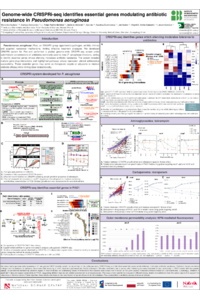
Pseudomonas aeruginosa (Pae) is a major opportunistic human pathogen, classified by the WHO in 2024 as a high-priority antibiotic resistant threat. It causes severe infections in immunocompromised individuals and patients with cystic fibrosis, largely due to a combination of intrinsic and acquired resistance mechanisms. CRISPR interference (CRISPRi) enables programmable, transcriptional repression of target genes and is well-suited for genome-wide interrogation of gene-drug interactions, allowing identification of essential pathways that become particularly vulnerable under antibiotic pressure. In CRISPRi, a single guide RNA (sgRNA) directs a catalytically inactive Cas9 protein (dCas9) to a target sequence adjacent to a PAM site, blocking RNA polymerase binding or elongation.
Here, we performed a genome-wide CRISPRi screen in the P. aeruginosa PAO1 reference strain, using an sgRNA pooled library exposed to sub-inhibitory concentrations of 12 antibiotics commonly used against Pae: aminoglycosides, β-lactams (including carbapenems), fluoroquinolones, and polymyxins. The analysis identified essential gene-drug interactions and pinpointed pathways (e.g., cell wall synthesis, cell division, fatty acids and lipopolysaccharide biosynthesis) whose repression altered antibiotic susceptibility. These genes represent potential therapeutic targets or adjuvant candidates to enhance existing antimicrobial efficacy while reducing toxicity associated with high drug doses. Overall, this platform provides a robust approach for investigating essential genes and their role in resistance, offering a promising strategy to identify pathogen vulnerabilities.
This work is supported by the Polish National Science Centre grant 2021/43/D/NZ2/02151.
Keywords
Pseudomonas aeruginosa
CRISPRi
antibiotic resistance
Poster
Antibiotics2026_weronika.pdf
Isolation and characterization of bacteriophages active against Pseudomonas aeruginosa strains isolated from ocular infection
Where Resistance Meets Drug Development: Lessons from 20 Years of Antimicrobial Research