Event submissions
Published
This submission belongs to the session S2. Antimicrobials, Antimicrobial Resistance, and One Health of the event Antibiotics 2026—Advances in Antimicrobial Action and Resistance
Published date
04 May, 2026
Academic Editor
'%3e%3cpath%20d='M12.6657%2010.9104C12.4185%2010.325%2012.0599%209.79327%2011.6097%209.34482C11.1609%208.89508%2010.6293%208.5365%2010.0442%208.28888C10.0389%208.28626%2010.0337%208.28495%2010.0285%208.28233C10.8446%207.69279%2011.3752%206.73249%2011.3752%205.64904C11.3752%203.8542%209.92103%202.39999%208.1262%202.39999C6.33136%202.39999%204.87715%203.8542%204.87715%205.64904C4.87715%206.73249%205.40774%207.69279%206.22393%208.28364C6.21869%208.28626%206.21345%208.28757%206.20821%208.29019C5.62129%208.5378%205.09463%208.89284%204.64265%209.34613C4.1929%209.79493%203.83432%2010.3266%203.58671%2010.9117C3.34345%2011.4845%203.21226%2012.0987%203.20023%2012.7209C3.19988%2012.7349%203.20233%2012.7488%203.20744%2012.7619C3.21255%2012.7749%203.22022%2012.7867%203.22998%2012.7968C3.23975%2012.8068%203.25142%2012.8147%203.26431%2012.8202C3.2772%2012.8256%203.29105%2012.8284%203.30504%2012.8284H4.09109C4.14874%2012.8284%204.19459%2012.7825%204.1959%2012.7262C4.2221%2011.7148%204.62823%2010.7676%205.34617%2010.0497C6.08899%209.30683%207.0755%208.89808%208.1262%208.89808C9.17689%208.89808%2010.1634%209.30683%2010.9062%2010.0497C11.6242%2010.7676%2012.0303%2011.7148%2012.0565%2012.7262C12.0578%2012.7838%2012.1037%2012.8284%2012.1613%2012.8284H12.9474C12.9613%2012.8284%2012.9752%2012.8256%2012.9881%2012.8202C13.001%2012.8147%2013.0126%2012.8068%2013.0224%2012.7968C13.0322%2012.7867%2013.0398%2012.7749%2013.0449%2012.7619C13.0501%2012.7488%2013.0525%2012.7349%2013.0522%2012.7209C13.0391%2012.0947%2012.9094%2011.4855%2012.6657%2010.9104ZM8.1262%207.9024C7.52486%207.9024%206.9589%207.6679%206.53312%207.24211C6.10733%206.81633%205.87283%206.25037%205.87283%205.64904C5.87283%205.0477%206.10733%204.48174%206.53312%204.05596C6.9589%203.63018%207.52486%203.39567%208.1262%203.39567C8.72753%203.39567%209.29349%203.63018%209.71927%204.05596C10.1451%204.48174%2010.3796%205.0477%2010.3796%205.64904C10.3796%206.25037%2010.1451%206.81633%209.71927%207.24211C9.29349%207.6679%208.72753%207.9024%208.1262%207.9024Z'%20fill='%235D1EE1'/%3e%3c/g%3e%3c/svg%3e) Jordi Vila
Jordi VilaCitation
Katarina Novovic, Milka Malesevic, Danka Matijasevic, Nemanja Kljajevic, Lazar Gardijan, Stefan Stanovcic, Seasonal Dynamics of the Airborne Resistome and Mobilome across Diverse Environments in the Belgrade Metropolitan Area, in Proceedings of Antibiotics 2026—Advances in Antimicrobial Action and Resistance, Barcelona, 11 May–14 May 2026, MDPI: Basel, Switzerland
Share
Email
Facebook
Twitter
LinkedIn
Seasonal Dynamics of the Airborne Resistome and Mobilome across Diverse Environments in the Belgrade Metropolitan Area
'%3e%3cpath%20d='M12.6647%2010.9104C12.4176%2010.325%2012.0589%209.7933%2011.6088%209.34485C11.16%208.89511%2010.6283%208.53653%2010.0432%208.28891C10.038%208.28629%2010.0327%208.28498%2010.0275%208.28236C10.8437%207.69282%2011.3743%206.73252%2011.3743%205.64907C11.3743%203.85423%209.92005%202.40002%208.12522%202.40002C6.33038%202.40002%204.87618%203.85423%204.87618%205.64907C4.87618%206.73252%205.40677%207.69282%206.22296%208.28367C6.21772%208.28629%206.21248%208.2876%206.20724%208.29022C5.62031%208.53783%205.09365%208.89287%204.64167%209.34616C4.19192%209.79496%203.83334%2010.3266%203.58573%2010.9117C3.34247%2011.4846%203.21128%2012.0987%203.19925%2012.721C3.1989%2012.735%203.20135%2012.7489%203.20646%2012.7619C3.21157%2012.7749%203.21924%2012.7868%203.22901%2012.7968C3.23877%2012.8068%203.25045%2012.8148%203.26334%2012.8202C3.27623%2012.8256%203.29007%2012.8284%203.30406%2012.8284H4.09012C4.14776%2012.8284%204.19362%2012.7825%204.19493%2012.7262C4.22113%2011.7148%204.62726%2010.7676%205.34519%2010.0497C6.08802%209.30686%207.07452%208.89811%208.12522%208.89811C9.17592%208.89811%2010.1624%209.30686%2010.9052%2010.0497C11.6232%2010.7676%2012.0293%2011.7148%2012.0555%2012.7262C12.0568%2012.7839%2012.1027%2012.8284%2012.1603%2012.8284H12.9464C12.9604%2012.8284%2012.9742%2012.8256%2012.9871%2012.8202C13%2012.8148%2013.0117%2012.8068%2013.0214%2012.7968C13.0312%2012.7868%2013.0389%2012.7749%2013.044%2012.7619C13.0491%2012.7489%2013.0515%2012.735%2013.0512%2012.721C13.0381%2012.0947%2012.9084%2011.4856%2012.6647%2010.9104ZM8.12522%207.90243C7.52388%207.90243%206.95792%207.66793%206.53214%207.24215C6.10636%206.81636%205.87185%206.2504%205.87185%205.64907C5.87185%205.04773%206.10636%204.48177%206.53214%204.05599C6.95792%203.63021%207.52388%203.3957%208.12522%203.3957C8.72655%203.3957%209.29252%203.63021%209.7183%204.05599C10.1441%204.48177%2010.3786%205.04773%2010.3786%205.64907C10.3786%206.2504%2010.1441%206.81636%209.7183%207.24215C9.29252%207.66793%208.72655%207.90243%208.12522%207.90243Z'%20fill='%235D1EE1'/%3e%3c/g%3e%3c/svg%3e)
Katarina Novovic 1
Milka Malesevic 1
Danka Matijasevic 1
Nemanja Kljajevic 1
Lazar Gardijan 1
Stefan Stanovcic 1
1. Institute of Molecular Genetics and Genetic Engineering, University of Belgrade, Serbia
Abstract
Introduction
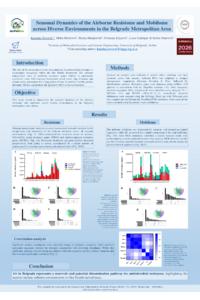
The role of the environment in the dissemination of antimicrobial resistance is increasingly recognized within the One Health framework. The airborne transmission route of antibiotic resistance genes (ARGs) is particularly significant since ARG-carrying bioaerosols could travel long distances and remain in the atmosphere for a long period of time. In addition, mobile genetic elements (MGEs) can promote the spread of ARGs in the environment.
Objective
This study aimed to characterize the seasonal dynamics of the airborne resistome and mobilome across diverse environments in the Belgrade metropolitan area, Serbia.
Methods
Outdoor air samples were collected at several urban, suburban, and rural locations across four seasons. Airborne DNA was subjected to shotgun metagenomic sequencing (Illumina NovaSeq X Plus), followed by bioinformatic analysis. Resistance genes were annotated using MEGARes, while integrons, insertion sequences (ISs), and plasmids were identified using Integrall, ISfinder, and PLSDB, respectively.
Findings
Shotgun metagenomic analysis revealed pronounced seasonal variation in the composition and abundance of the airborne resistome across all sampled environments. ARGs dominated the resistome across all seasons, followed by metal resistance genes (MRGs) and multi-compound resistance genes (MCRGs). Resistome abundance and gene richness increased progressively from spring to winter, accompanied by a higher number of season-specific resistance genes during autumn and winter. In addition, the airborne mobilome was dominated by integron- and plasmid-associated sequences, while ISs accounted for a smaller proportion of the total mobilome. Total MGE abundance exhibited a modest seasonal trend, with winter tending to show higher levels than other seasons. MGE diversity and the number of season-specific elements increased toward winter, driven mainly by plasmid-derived sequences.
Conclusion
Our results demonstrate that air represents a dynamic environmental reservoir and potential dissemination pathway for antimicrobial resistance across the Belgrade metropolitan area, emphasizing the importance of incorporating airborne environments into One Health surveillance strategies.
Keywords
antimicrobial resistance
resistome
mobilome
shotgun metagenomics
seasonal dynamics
One Health
environment
Poster
Poster Antibiotics 2026 - Katarina Novović.pdf
Bacteriophage depolymerases as a novel alternative to antibiotics: their promises and challenges
Integrating Competitive Bioassays and Mechanistic Models to Assess Environmental AMR Selection