Event submissions
Published
This submission belongs to the session S2. Antimicrobials, Antimicrobial Resistance, and One Health of the event Antibiotics 2026—Advances in Antimicrobial Action and Resistance
Published date
04 May, 2026
Academic Editor
'%3e%3cpath%20d='M12.6657%2010.9104C12.4185%2010.325%2012.0599%209.79327%2011.6097%209.34482C11.1609%208.89508%2010.6293%208.5365%2010.0442%208.28888C10.0389%208.28626%2010.0337%208.28495%2010.0285%208.28233C10.8446%207.69279%2011.3752%206.73249%2011.3752%205.64904C11.3752%203.8542%209.92103%202.39999%208.1262%202.39999C6.33136%202.39999%204.87715%203.8542%204.87715%205.64904C4.87715%206.73249%205.40774%207.69279%206.22393%208.28364C6.21869%208.28626%206.21345%208.28757%206.20821%208.29019C5.62129%208.5378%205.09463%208.89284%204.64265%209.34613C4.1929%209.79493%203.83432%2010.3266%203.58671%2010.9117C3.34345%2011.4845%203.21226%2012.0987%203.20023%2012.7209C3.19988%2012.7349%203.20233%2012.7488%203.20744%2012.7619C3.21255%2012.7749%203.22022%2012.7867%203.22998%2012.7968C3.23975%2012.8068%203.25142%2012.8147%203.26431%2012.8202C3.2772%2012.8256%203.29105%2012.8284%203.30504%2012.8284H4.09109C4.14874%2012.8284%204.19459%2012.7825%204.1959%2012.7262C4.2221%2011.7148%204.62823%2010.7676%205.34617%2010.0497C6.08899%209.30683%207.0755%208.89808%208.1262%208.89808C9.17689%208.89808%2010.1634%209.30683%2010.9062%2010.0497C11.6242%2010.7676%2012.0303%2011.7148%2012.0565%2012.7262C12.0578%2012.7838%2012.1037%2012.8284%2012.1613%2012.8284H12.9474C12.9613%2012.8284%2012.9752%2012.8256%2012.9881%2012.8202C13.001%2012.8147%2013.0126%2012.8068%2013.0224%2012.7968C13.0322%2012.7867%2013.0398%2012.7749%2013.0449%2012.7619C13.0501%2012.7488%2013.0525%2012.7349%2013.0522%2012.7209C13.0391%2012.0947%2012.9094%2011.4855%2012.6657%2010.9104ZM8.1262%207.9024C7.52486%207.9024%206.9589%207.6679%206.53312%207.24211C6.10733%206.81633%205.87283%206.25037%205.87283%205.64904C5.87283%205.0477%206.10733%204.48174%206.53312%204.05596C6.9589%203.63018%207.52486%203.39567%208.1262%203.39567C8.72753%203.39567%209.29349%203.63018%209.71927%204.05596C10.1451%204.48174%2010.3796%205.0477%2010.3796%205.64904C10.3796%206.25037%2010.1451%206.81633%209.71927%207.24211C9.29349%207.6679%208.72753%207.9024%208.1262%207.9024Z'%20fill='%235D1EE1'/%3e%3c/g%3e%3c/svg%3e) Jordi Vila
Jordi VilaCitation
Renu Bisht, Rik Oldenkamp, Matti Gralka, Yuval Mulla, Timo Hamers, Peter Cenijn, Integrating Competitive Bioassays and Mechanistic Models to Assess Environmental AMR Selection, in Proceedings of Antibiotics 2026—Advances in Antimicrobial Action and Resistance, Barcelona, 11 May–14 May 2026, MDPI: Basel, Switzerland
Share
Email
Facebook
Twitter
LinkedIn
Integrating Competitive Bioassays and Mechanistic Models to Assess Environmental AMR Selection
'%3e%3cpath%20d='M12.6647%2010.9104C12.4176%2010.325%2012.0589%209.7933%2011.6088%209.34485C11.16%208.89511%2010.6283%208.53653%2010.0432%208.28891C10.038%208.28629%2010.0327%208.28498%2010.0275%208.28236C10.8437%207.69282%2011.3743%206.73252%2011.3743%205.64907C11.3743%203.85423%209.92005%202.40002%208.12522%202.40002C6.33038%202.40002%204.87618%203.85423%204.87618%205.64907C4.87618%206.73252%205.40677%207.69282%206.22296%208.28367C6.21772%208.28629%206.21248%208.2876%206.20724%208.29022C5.62031%208.53783%205.09365%208.89287%204.64167%209.34616C4.19192%209.79496%203.83334%2010.3266%203.58573%2010.9117C3.34247%2011.4846%203.21128%2012.0987%203.19925%2012.721C3.1989%2012.735%203.20135%2012.7489%203.20646%2012.7619C3.21157%2012.7749%203.21924%2012.7868%203.22901%2012.7968C3.23877%2012.8068%203.25045%2012.8148%203.26334%2012.8202C3.27623%2012.8256%203.29007%2012.8284%203.30406%2012.8284H4.09012C4.14776%2012.8284%204.19362%2012.7825%204.19493%2012.7262C4.22113%2011.7148%204.62726%2010.7676%205.34519%2010.0497C6.08802%209.30686%207.07452%208.89811%208.12522%208.89811C9.17592%208.89811%2010.1624%209.30686%2010.9052%2010.0497C11.6232%2010.7676%2012.0293%2011.7148%2012.0555%2012.7262C12.0568%2012.7839%2012.1027%2012.8284%2012.1603%2012.8284H12.9464C12.9604%2012.8284%2012.9742%2012.8256%2012.9871%2012.8202C13%2012.8148%2013.0117%2012.8068%2013.0214%2012.7968C13.0312%2012.7868%2013.0389%2012.7749%2013.044%2012.7619C13.0491%2012.7489%2013.0515%2012.735%2013.0512%2012.721C13.0381%2012.0947%2012.9084%2011.4856%2012.6647%2010.9104ZM8.12522%207.90243C7.52388%207.90243%206.95792%207.66793%206.53214%207.24215C6.10636%206.81636%205.87185%206.2504%205.87185%205.64907C5.87185%205.04773%206.10636%204.48177%206.53214%204.05599C6.95792%203.63021%207.52388%203.3957%208.12522%203.3957C8.72655%203.3957%209.29252%203.63021%209.7183%204.05599C10.1441%204.48177%2010.3786%205.04773%2010.3786%205.64907C10.3786%206.2504%2010.1441%206.81636%209.7183%207.24215C9.29252%207.66793%208.72655%207.90243%208.12522%207.90243Z'%20fill='%235D1EE1'/%3e%3c/g%3e%3c/svg%3e)
Renu Bisht 1
Rik Oldenkamp 1
Matti Gralka 2
Yuval Mulla 3
Timo Hamers 4
Peter Cenijn 1
1. Chemistry for Environment & Health, A-LIFE, Vrije Universiteit Amsterdam, Amsterdam, The Netherlands
2. Faculty of Science, Systems Biology, A-LIFE, Vrije Universiteit Amsterdam, Amsterdam, The Netherlands
3. Faculty of Science, Molecular microbiology, A-LIFE, Vrije Universiteit Amsterdam, Amsterdam, The Netherlands
4. Faculty of Science, Environmental Health & Toxicology, A-LIFE, Vrije Universiteit Amsterdam, Amsterdam, The Netherlands
Abstract
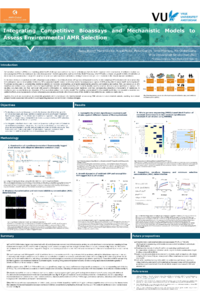
Antimicrobial resistance (AMR) is increasingly recognised as a significant health challenge, driven not only by the clinical use of antibiotics but also by the dissemination of antibiotic residues and resistance genes (ARGs) through wastewater systems and natural ecosystems. Spatially explicit exposure models, such as ePiE, quantify antibiotic concentrations in surface waters; however, current environmental AMR risk assessment methods rely on simplified assumptions about microbial community responses. Existing approaches, such as the 8-day SELECT bioassay, typically infer selection from growth inhibition thresholds without explicitly capturing differential growth dynamics between susceptible and resistant bacteria, offering limited mechanistic insight into how AMR selection emerges under realistic environmental exposure scenarios.
In this study, we aim to bridge this gap by integrating experimental and modelling approaches. First, we will adapt an in vitro growth inhibition bioassay into a co-culture competition assay that simultaneously exposes fluorescently labelled wild-type and ciprofloxacin-resistant Escherichia coli strains to antibiotics. By quantifying shifts in relative abundance, this assay will provide a direct and time-efficient measure of AMR selection pressure. Second, we will employ data from both current and adapted assays to develop mechanistic in silico models describing antibiotic-dependent growth inhibition for susceptible and resistant strains. These models will generate validated rules for bacterial growth and competition, supporting the development of agent-based simulations of environmental microbial communities.
Together, this work will establish an experimentally grounded and mechanistically informed framework for evaluating AMR selection in environmental contexts, enabling more robust prospective risk assessments for antibiotics and supporting stronger environmental protection strategies.
Keywords
Antibiotics
Antimicrobial resistance
Antibiotics resistance genes
Competition assays
Bioassays
In silico models
Antimicrobial selection
Antimicrobial risk assessments
Poster
Antibiotics2026_BishtR_06052026.pdf
Seasonal Dynamics of the Airborne Resistome and Mobilome across Diverse Environments in the Belgrade Metropolitan Area
AN APPLICATION OF CLUSTER ANALYSIS WITH THE AFFINITY COEFFICIENT AND EUCLIDEAN DISTANCE TO BACTERIA ANTIMICROBIAL RESISTANCE PROFILE