Event submissions
Published
This submission belongs to the session S2. Antimicrobials, Antimicrobial Resistance, and One Health of the event Antibiotics 2026—Advances in Antimicrobial Action and Resistance
Published date
06 May, 2026
Academic Editor
'%3e%3cpath%20d='M12.6657%2010.9104C12.4185%2010.325%2012.0599%209.79327%2011.6097%209.34482C11.1609%208.89508%2010.6293%208.5365%2010.0442%208.28888C10.0389%208.28626%2010.0337%208.28495%2010.0285%208.28233C10.8446%207.69279%2011.3752%206.73249%2011.3752%205.64904C11.3752%203.8542%209.92103%202.39999%208.1262%202.39999C6.33136%202.39999%204.87715%203.8542%204.87715%205.64904C4.87715%206.73249%205.40774%207.69279%206.22393%208.28364C6.21869%208.28626%206.21345%208.28757%206.20821%208.29019C5.62129%208.5378%205.09463%208.89284%204.64265%209.34613C4.1929%209.79493%203.83432%2010.3266%203.58671%2010.9117C3.34345%2011.4845%203.21226%2012.0987%203.20023%2012.7209C3.19988%2012.7349%203.20233%2012.7488%203.20744%2012.7619C3.21255%2012.7749%203.22022%2012.7867%203.22998%2012.7968C3.23975%2012.8068%203.25142%2012.8147%203.26431%2012.8202C3.2772%2012.8256%203.29105%2012.8284%203.30504%2012.8284H4.09109C4.14874%2012.8284%204.19459%2012.7825%204.1959%2012.7262C4.2221%2011.7148%204.62823%2010.7676%205.34617%2010.0497C6.08899%209.30683%207.0755%208.89808%208.1262%208.89808C9.17689%208.89808%2010.1634%209.30683%2010.9062%2010.0497C11.6242%2010.7676%2012.0303%2011.7148%2012.0565%2012.7262C12.0578%2012.7838%2012.1037%2012.8284%2012.1613%2012.8284H12.9474C12.9613%2012.8284%2012.9752%2012.8256%2012.9881%2012.8202C13.001%2012.8147%2013.0126%2012.8068%2013.0224%2012.7968C13.0322%2012.7867%2013.0398%2012.7749%2013.0449%2012.7619C13.0501%2012.7488%2013.0525%2012.7349%2013.0522%2012.7209C13.0391%2012.0947%2012.9094%2011.4855%2012.6657%2010.9104ZM8.1262%207.9024C7.52486%207.9024%206.9589%207.6679%206.53312%207.24211C6.10733%206.81633%205.87283%206.25037%205.87283%205.64904C5.87283%205.0477%206.10733%204.48174%206.53312%204.05596C6.9589%203.63018%207.52486%203.39567%208.1262%203.39567C8.72753%203.39567%209.29349%203.63018%209.71927%204.05596C10.1451%204.48174%2010.3796%205.0477%2010.3796%205.64904C10.3796%206.25037%2010.1451%206.81633%209.71927%207.24211C9.29349%207.6679%208.72753%207.9024%208.1262%207.9024Z'%20fill='%235D1EE1'/%3e%3c/g%3e%3c/svg%3e) Marc Maresca
Marc MarescaCitation
Francisco Javier Vasco-Martín, Ana Rodrigo-Moreno, Rebeca Lavilla, Alexandre Viu, Romina Romero, María Carla Iglesias, Juan Pablo Horcajada, Eduardo Padilla, María Milagro Montero, Juan José Hernández, Hospital outbreak of VanA Enterococcus faecium: microbiological characterization and in vitro activity of oritavancin, in Proceedings of Antibiotics 2026—Advances in Antimicrobial Action and Resistance, Barcelona, 11 May–14 May 2026, MDPI: Basel, Switzerland
Share
Email
Facebook
Twitter
LinkedIn
Hospital outbreak of VanA Enterococcus faecium: microbiological characterization and in vitro activity of oritavancin
'%3e%3cpath%20d='M12.6647%2010.9104C12.4176%2010.325%2012.0589%209.7933%2011.6088%209.34485C11.16%208.89511%2010.6283%208.53653%2010.0432%208.28891C10.038%208.28629%2010.0327%208.28498%2010.0275%208.28236C10.8437%207.69282%2011.3743%206.73252%2011.3743%205.64907C11.3743%203.85423%209.92005%202.40002%208.12522%202.40002C6.33038%202.40002%204.87618%203.85423%204.87618%205.64907C4.87618%206.73252%205.40677%207.69282%206.22296%208.28367C6.21772%208.28629%206.21248%208.2876%206.20724%208.29022C5.62031%208.53783%205.09365%208.89287%204.64167%209.34616C4.19192%209.79496%203.83334%2010.3266%203.58573%2010.9117C3.34247%2011.4846%203.21128%2012.0987%203.19925%2012.721C3.1989%2012.735%203.20135%2012.7489%203.20646%2012.7619C3.21157%2012.7749%203.21924%2012.7868%203.22901%2012.7968C3.23877%2012.8068%203.25045%2012.8148%203.26334%2012.8202C3.27623%2012.8256%203.29007%2012.8284%203.30406%2012.8284H4.09012C4.14776%2012.8284%204.19362%2012.7825%204.19493%2012.7262C4.22113%2011.7148%204.62726%2010.7676%205.34519%2010.0497C6.08802%209.30686%207.07452%208.89811%208.12522%208.89811C9.17592%208.89811%2010.1624%209.30686%2010.9052%2010.0497C11.6232%2010.7676%2012.0293%2011.7148%2012.0555%2012.7262C12.0568%2012.7839%2012.1027%2012.8284%2012.1603%2012.8284H12.9464C12.9604%2012.8284%2012.9742%2012.8256%2012.9871%2012.8202C13%2012.8148%2013.0117%2012.8068%2013.0214%2012.7968C13.0312%2012.7868%2013.0389%2012.7749%2013.044%2012.7619C13.0491%2012.7489%2013.0515%2012.735%2013.0512%2012.721C13.0381%2012.0947%2012.9084%2011.4856%2012.6647%2010.9104ZM8.12522%207.90243C7.52388%207.90243%206.95792%207.66793%206.53214%207.24215C6.10636%206.81636%205.87185%206.2504%205.87185%205.64907C5.87185%205.04773%206.10636%204.48177%206.53214%204.05599C6.95792%203.63021%207.52388%203.3957%208.12522%203.3957C8.72655%203.3957%209.29252%203.63021%209.7183%204.05599C10.1441%204.48177%2010.3786%205.04773%2010.3786%205.64907C10.3786%206.2504%2010.1441%206.81636%209.7183%207.24215C9.29252%207.66793%208.72655%207.90243%208.12522%207.90243Z'%20fill='%235D1EE1'/%3e%3c/g%3e%3c/svg%3e)
Francisco Javier Vasco-Martín 1
Ana Rodrigo-Moreno 1
Rebeca Lavilla 1
Alexandre Viu 1
Romina Romero 1
María Carla Iglesias 2
Juan Pablo Horcajada 2
Eduardo Padilla 1
María Milagro Montero 2
Juan José Hernández 1
1. Laboratori de Referència de Catalunya, Barcelona, Spain
2. Infectious Diseases Service, Hospital del Mar, Barcelona, Spain
Abstract
Introduction
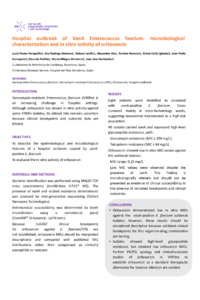
Vancomycin-resistant Enterococcus faecium (VREfm) is an increasing challenge in hospital settings. Although oritavancin has shown in vitro activity against some VREfm isolates, its clinical role remains uncertain because clinical breakpoints and outcome data are limited.
Objectives
To describe the epidemiological and microbiological features of a hospital outbreak caused by vanA-positive E. faecium.
To evaluate the in vitro activity of oritavancin.
Materials and methods
Bacterial identification was performed using MALDI-TOF mass spectrometry (bioMérieux VITEK® MS). The presence of vanA and related resistance determinants was assessed by next-generation sequencing (Oxford Nanopore Technologies).
Antimicrobial susceptibility was determined by broth microdilution using a commercial panel (ComASP® Oritavancin, Liofilchem).
Because EUCAST clinical breakpoints for oritavancin against E. faecium/VRE are not established, oritavancin MICs should be interpreted descriptively and compared with published MIC distributions rather than categorized as clinically susceptible or resistant.
Eight patients were identified as colonized with vanA-positive E. faecium. Cases clustered mainly in onco-hematology wards, suggesting nosocomial transmission in a high-risk population.
All isolates carried vanA and expressed high-level glycopeptide resistance, with:
- Vancomycin resistance (MIC ≥ 256 mg/L)
- Teicoplanin resistance (MIC ≥ 64 mg/L)
Oritavancin showed low in vitro MIC values against the outbreak isolates:
- MIC range: 0.25 mg/L
- Low MIC values were observed despite the presence of vanA. This finding is microbiologically relevant but should not be presented as evidence of clinical susceptibility in the absence of validated breakpoints and clinical outcomes.
Conclusions
Oritavancin demonstrated low in vitro MICs against the vanA-positive E. faecium outbreak isolates; however, these results should be considered descriptive because validated clinical breakpoints for this organism-drug combination are lacking.
Isolates showed high-level glycopeptide resistance, but retained low oritavancin MICs. Further PK/PD, synergy and clinical-outcome studies of oritavancin in VREfms to establish oritavancin as a standard therapeutic alternative for invasive infection are needed.
Keywords
VanA-positive Enterococcus faecium
Vancomycin-resistant Enterococcus (VRE)
Oritavancin
Hospital outbreak
Poster
Poster Oritavancin.pdf
Why are there virtually no antibiotics in clinical use based on bioactive compounds from plants?
In vitro activity of eravacycline against cefiderocol-resistant ESBL/NDM-producing Enterobacterales: a preliminary series