Event submissions
Published
This submission belongs to the session S2. Antimicrobials, Antimicrobial Resistance, and One Health of the event Antibiotics 2026—Advances in Antimicrobial Action and Resistance
Published date
06 May, 2026
Academic Editor
'%3e%3cpath%20d='M12.6657%2010.9104C12.4185%2010.325%2012.0599%209.79327%2011.6097%209.34482C11.1609%208.89508%2010.6293%208.5365%2010.0442%208.28888C10.0389%208.28626%2010.0337%208.28495%2010.0285%208.28233C10.8446%207.69279%2011.3752%206.73249%2011.3752%205.64904C11.3752%203.8542%209.92103%202.39999%208.1262%202.39999C6.33136%202.39999%204.87715%203.8542%204.87715%205.64904C4.87715%206.73249%205.40774%207.69279%206.22393%208.28364C6.21869%208.28626%206.21345%208.28757%206.20821%208.29019C5.62129%208.5378%205.09463%208.89284%204.64265%209.34613C4.1929%209.79493%203.83432%2010.3266%203.58671%2010.9117C3.34345%2011.4845%203.21226%2012.0987%203.20023%2012.7209C3.19988%2012.7349%203.20233%2012.7488%203.20744%2012.7619C3.21255%2012.7749%203.22022%2012.7867%203.22998%2012.7968C3.23975%2012.8068%203.25142%2012.8147%203.26431%2012.8202C3.2772%2012.8256%203.29105%2012.8284%203.30504%2012.8284H4.09109C4.14874%2012.8284%204.19459%2012.7825%204.1959%2012.7262C4.2221%2011.7148%204.62823%2010.7676%205.34617%2010.0497C6.08899%209.30683%207.0755%208.89808%208.1262%208.89808C9.17689%208.89808%2010.1634%209.30683%2010.9062%2010.0497C11.6242%2010.7676%2012.0303%2011.7148%2012.0565%2012.7262C12.0578%2012.7838%2012.1037%2012.8284%2012.1613%2012.8284H12.9474C12.9613%2012.8284%2012.9752%2012.8256%2012.9881%2012.8202C13.001%2012.8147%2013.0126%2012.8068%2013.0224%2012.7968C13.0322%2012.7867%2013.0398%2012.7749%2013.0449%2012.7619C13.0501%2012.7488%2013.0525%2012.7349%2013.0522%2012.7209C13.0391%2012.0947%2012.9094%2011.4855%2012.6657%2010.9104ZM8.1262%207.9024C7.52486%207.9024%206.9589%207.6679%206.53312%207.24211C6.10733%206.81633%205.87283%206.25037%205.87283%205.64904C5.87283%205.0477%206.10733%204.48174%206.53312%204.05596C6.9589%203.63018%207.52486%203.39567%208.1262%203.39567C8.72753%203.39567%209.29349%203.63018%209.71927%204.05596C10.1451%204.48174%2010.3796%205.0477%2010.3796%205.64904C10.3796%206.25037%2010.1451%206.81633%209.71927%207.24211C9.29349%207.6679%208.72753%207.9024%208.1262%207.9024Z'%20fill='%235D1EE1'/%3e%3c/g%3e%3c/svg%3e) Marc Maresca
Marc MarescaCitation
Lucía Pastor-Ronquillo, Ana Rodrigo-Moreno, Rebeca Lavilla, Alexandre Viu, Romina Romero, María Carla Iglesias, Juan Pablo Horcajada, Eduardo Padilla, María Milagro Montero, Juan José Hernández, In vitro activity of eravacycline against cefiderocol-resistant ESBL/NDM-producing Enterobacterales: a preliminary series, in Proceedings of Antibiotics 2026—Advances in Antimicrobial Action and Resistance, Barcelona, 11 May–14 May 2026, MDPI: Basel, Switzerland
Share
Email
Facebook
Twitter
LinkedIn
In vitro activity of eravacycline against cefiderocol-resistant ESBL/NDM-producing Enterobacterales: a preliminary series
'%3e%3cpath%20d='M12.6647%2010.9104C12.4176%2010.325%2012.0589%209.7933%2011.6088%209.34485C11.16%208.89511%2010.6283%208.53653%2010.0432%208.28891C10.038%208.28629%2010.0327%208.28498%2010.0275%208.28236C10.8437%207.69282%2011.3743%206.73252%2011.3743%205.64907C11.3743%203.85423%209.92005%202.40002%208.12522%202.40002C6.33038%202.40002%204.87618%203.85423%204.87618%205.64907C4.87618%206.73252%205.40677%207.69282%206.22296%208.28367C6.21772%208.28629%206.21248%208.2876%206.20724%208.29022C5.62031%208.53783%205.09365%208.89287%204.64167%209.34616C4.19192%209.79496%203.83334%2010.3266%203.58573%2010.9117C3.34247%2011.4846%203.21128%2012.0987%203.19925%2012.721C3.1989%2012.735%203.20135%2012.7489%203.20646%2012.7619C3.21157%2012.7749%203.21924%2012.7868%203.22901%2012.7968C3.23877%2012.8068%203.25045%2012.8148%203.26334%2012.8202C3.27623%2012.8256%203.29007%2012.8284%203.30406%2012.8284H4.09012C4.14776%2012.8284%204.19362%2012.7825%204.19493%2012.7262C4.22113%2011.7148%204.62726%2010.7676%205.34519%2010.0497C6.08802%209.30686%207.07452%208.89811%208.12522%208.89811C9.17592%208.89811%2010.1624%209.30686%2010.9052%2010.0497C11.6232%2010.7676%2012.0293%2011.7148%2012.0555%2012.7262C12.0568%2012.7839%2012.1027%2012.8284%2012.1603%2012.8284H12.9464C12.9604%2012.8284%2012.9742%2012.8256%2012.9871%2012.8202C13%2012.8148%2013.0117%2012.8068%2013.0214%2012.7968C13.0312%2012.7868%2013.0389%2012.7749%2013.044%2012.7619C13.0491%2012.7489%2013.0515%2012.735%2013.0512%2012.721C13.0381%2012.0947%2012.9084%2011.4856%2012.6647%2010.9104ZM8.12522%207.90243C7.52388%207.90243%206.95792%207.66793%206.53214%207.24215C6.10636%206.81636%205.87185%206.2504%205.87185%205.64907C5.87185%205.04773%206.10636%204.48177%206.53214%204.05599C6.95792%203.63021%207.52388%203.3957%208.12522%203.3957C8.72655%203.3957%209.29252%203.63021%209.7183%204.05599C10.1441%204.48177%2010.3786%205.04773%2010.3786%205.64907C10.3786%206.2504%2010.1441%206.81636%209.7183%207.24215C9.29252%207.66793%208.72655%207.90243%208.12522%207.90243Z'%20fill='%235D1EE1'/%3e%3c/g%3e%3c/svg%3e)
Lucía Pastor-Ronquillo 1
Ana Rodrigo-Moreno 1
Rebeca Lavilla 1
Alexandre Viu 1
Romina Romero 1
María Carla Iglesias 2
Juan Pablo Horcajada 2
Eduardo Padilla 1
María Milagro Montero 2
Juan José Hernández 1
1. Laboratori de Referència de Catalunya, Barcelona, Spain
2. Infectious Diseases Service, Hospital del Mar, Barcelona, Spain
Abstract
Introduction
Infections caused by carbapenemase-producing Enterobacterales, represent a major therapeutic challenge. Among them, NDM-type metallo-β-lactamases limit treatment options. Cefiderocol has emerged as one of the main therapeutic alternatives.
Eravacycline, a novel fluorocycline approved for complicated intra-abdominal infections, has demonstrated potent in vitro activity against carbapenemase-producing Enterobacterales, including KPC, NDM, and OXA-48 producing isolates. However, its clinical use should be interpreted in light of infection source, drug exposure, absence of a urinary indication, and the limited availability of outcome data in infections caused by cefiderocol-resistant NDM-producing organisms.
Objectives
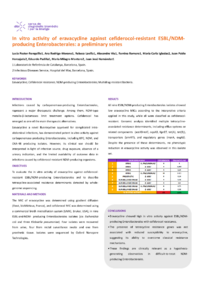
To evaluate the in vitro activity of eravacycline against cefiderocol-resistant ESBL/NDM-producing Enterobacterales and to describe tetracycline-associated resistance determinants detected by whole-genome sequencing.
Materials and methods
The MIC of eravacycline was determined using gradient diffusion (Etest, bioMérieux, France), and cefiderocol MIC was determined using a commercial broth microdilution system (UMIC, Bruker, USA), in nine ESBL- and NDM-producing Enterobacterales isolates (six Escherichia coli and three Klebsiella pneumoniae). Four isolates were recovered from urine, four from rectal surveillance swabs, and one from prosthetic tissue.Isolates were sequenced by Oxford Nanopore Technologies.
Results
All nine ESBL/NDM-producing Enterobacterales isolates showed low eravacycline MICs according to the interpretive criteria applied in this study, while all were classified as cefiderocol-resistant. Genomic analysis identified multiple tetracycline-associated resistance determinants, including efflux systems or related components (acrAB-tolC, oqxAB, KpnEF, tet(A), tet(B)), transporters (emrKY), and regulatory genes (marA, evgAS). Despite the presence of these determinants, no phenotypic reduction in eravacycline activity was observed in this isolate set.
Conclusions
Eravacycline showed high in vitro activity against ESBL/NDM -producing Enterobacterales with cefiderocol resistance. The presence of tetracycline resistance genes was not associated with reduced susceptibility to eravacyline, suggesting its ability to overcome classical resistance mechanisms. These findings are clinically relevant as a hypothesis-generating observation in difficult-to-treat NDM-producing Enterobacterales.
Keywords
Eravacycline
Cefiderocol resistance
NDM-producing Enterobacterales
Multidrug-resistant bacteria
Poster
Poster eravacycline.pdf
Hospital outbreak of VanA Enterococcus faecium: microbiological characterization and in vitro activity of oritavancin
Genomic co-occurrence of blaNDM-5 and yersiniabactin-associated loci in cefiderocol-resistant Enterobacterales