Event submissions
Published
This submission belongs to the session S3. Energy and Environment. Sustainable Transition of the event The 3rd International Online Conference on Energies
Published date
07 May, 2026
Academic Editor
'%3e%3cpath%20d='M12.6657%2010.9104C12.4185%2010.325%2012.0599%209.79327%2011.6097%209.34482C11.1609%208.89508%2010.6293%208.5365%2010.0442%208.28888C10.0389%208.28626%2010.0337%208.28495%2010.0285%208.28233C10.8446%207.69279%2011.3752%206.73249%2011.3752%205.64904C11.3752%203.8542%209.92103%202.39999%208.1262%202.39999C6.33136%202.39999%204.87715%203.8542%204.87715%205.64904C4.87715%206.73249%205.40774%207.69279%206.22393%208.28364C6.21869%208.28626%206.21345%208.28757%206.20821%208.29019C5.62129%208.5378%205.09463%208.89284%204.64265%209.34613C4.1929%209.79493%203.83432%2010.3266%203.58671%2010.9117C3.34345%2011.4845%203.21226%2012.0987%203.20023%2012.7209C3.19988%2012.7349%203.20233%2012.7488%203.20744%2012.7619C3.21255%2012.7749%203.22022%2012.7867%203.22998%2012.7968C3.23975%2012.8068%203.25142%2012.8147%203.26431%2012.8202C3.2772%2012.8256%203.29105%2012.8284%203.30504%2012.8284H4.09109C4.14874%2012.8284%204.19459%2012.7825%204.1959%2012.7262C4.2221%2011.7148%204.62823%2010.7676%205.34617%2010.0497C6.08899%209.30683%207.0755%208.89808%208.1262%208.89808C9.17689%208.89808%2010.1634%209.30683%2010.9062%2010.0497C11.6242%2010.7676%2012.0303%2011.7148%2012.0565%2012.7262C12.0578%2012.7838%2012.1037%2012.8284%2012.1613%2012.8284H12.9474C12.9613%2012.8284%2012.9752%2012.8256%2012.9881%2012.8202C13.001%2012.8147%2013.0126%2012.8068%2013.0224%2012.7968C13.0322%2012.7867%2013.0398%2012.7749%2013.0449%2012.7619C13.0501%2012.7488%2013.0525%2012.7349%2013.0522%2012.7209C13.0391%2012.0947%2012.9094%2011.4855%2012.6657%2010.9104ZM8.1262%207.9024C7.52486%207.9024%206.9589%207.6679%206.53312%207.24211C6.10733%206.81633%205.87283%206.25037%205.87283%205.64904C5.87283%205.0477%206.10733%204.48174%206.53312%204.05596C6.9589%203.63018%207.52486%203.39567%208.1262%203.39567C8.72753%203.39567%209.29349%203.63018%209.71927%204.05596C10.1451%204.48174%2010.3796%205.0477%2010.3796%205.64904C10.3796%206.25037%2010.1451%206.81633%209.71927%207.24211C9.29349%207.6679%208.72753%207.9024%208.1262%207.9024Z'%20fill='%235D1EE1'/%3e%3c/g%3e%3c/svg%3e) Jose Ramon Fernandez
Jose Ramon FernandezCitation
Ioannis Logothetis, Kleareti Tourpali, Dimitris Melas, Dimitrios-Sotirios Kourkoumpas, Adamantios Mitsotakis, Panagiotis Grammelis, The CMIP6 Efficiency of Capturing Wind Energy Potential Over the Southeastern Mediterranean and Future Projections According to SSP2-4.5 and SSP5-8.5, in Proceedings of The 3rd International Online Conference on Energies, 12 May–15 May 2026, MDPI: Basel, Switzerland
Share
Email
Facebook
Twitter
LinkedIn
The CMIP6 Efficiency of Capturing Wind Energy Potential Over the Southeastern Mediterranean and Future Projections According to SSP2-4.5 and SSP5-8.5

Ioannis Logothetis 1,2
'%3e%3cpath%20d='M12.6647%2010.9104C12.4176%2010.325%2012.0589%209.7933%2011.6088%209.34485C11.16%208.89511%2010.6283%208.53653%2010.0432%208.28891C10.038%208.28629%2010.0327%208.28498%2010.0275%208.28236C10.8437%207.69282%2011.3743%206.73252%2011.3743%205.64907C11.3743%203.85423%209.92005%202.40002%208.12522%202.40002C6.33038%202.40002%204.87618%203.85423%204.87618%205.64907C4.87618%206.73252%205.40677%207.69282%206.22296%208.28367C6.21772%208.28629%206.21248%208.2876%206.20724%208.29022C5.62031%208.53783%205.09365%208.89287%204.64167%209.34616C4.19192%209.79496%203.83334%2010.3266%203.58573%2010.9117C3.34247%2011.4846%203.21128%2012.0987%203.19925%2012.721C3.1989%2012.735%203.20135%2012.7489%203.20646%2012.7619C3.21157%2012.7749%203.21924%2012.7868%203.22901%2012.7968C3.23877%2012.8068%203.25045%2012.8148%203.26334%2012.8202C3.27623%2012.8256%203.29007%2012.8284%203.30406%2012.8284H4.09012C4.14776%2012.8284%204.19362%2012.7825%204.19493%2012.7262C4.22113%2011.7148%204.62726%2010.7676%205.34519%2010.0497C6.08802%209.30686%207.07452%208.89811%208.12522%208.89811C9.17592%208.89811%2010.1624%209.30686%2010.9052%2010.0497C11.6232%2010.7676%2012.0293%2011.7148%2012.0555%2012.7262C12.0568%2012.7839%2012.1027%2012.8284%2012.1603%2012.8284H12.9464C12.9604%2012.8284%2012.9742%2012.8256%2012.9871%2012.8202C13%2012.8148%2013.0117%2012.8068%2013.0214%2012.7968C13.0312%2012.7868%2013.0389%2012.7749%2013.044%2012.7619C13.0491%2012.7489%2013.0515%2012.735%2013.0512%2012.721C13.0381%2012.0947%2012.9084%2011.4856%2012.6647%2010.9104ZM8.12522%207.90243C7.52388%207.90243%206.95792%207.66793%206.53214%207.24215C6.10636%206.81636%205.87185%206.2504%205.87185%205.64907C5.87185%205.04773%206.10636%204.48177%206.53214%204.05599C6.95792%203.63021%207.52388%203.3957%208.12522%203.3957C8.72655%203.3957%209.29252%203.63021%209.7183%204.05599C10.1441%204.48177%2010.3786%205.04773%2010.3786%205.64907C10.3786%206.2504%2010.1441%206.81636%209.7183%207.24215C9.29252%207.66793%208.72655%207.90243%208.12522%207.90243Z'%20fill='%235D1EE1'/%3e%3c/g%3e%3c/svg%3e)
Kleareti Tourpali 2

Dimitris Melas 2
Dimitrios-Sotirios Kourkoumpas 1
Adamantios Mitsotakis 1

Panagiotis Grammelis 1
1. Centre for Research and Technology Hellas, Chemical Process and Energy Resources Institute, Thermi, GR 57001 Thessaloniki, Greece
2. Laboratory of Atmospheric Physics, Department of Physics, Faculty of Sciences, Aristotle University of Thessaloniki, GR 54124 Thessaloniki, Greece
Abstract
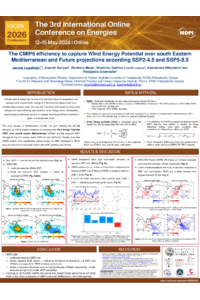
Renewables are crucial for climate and socioeconomic sustainability, reducing the environmental footprint of fossil fuels, and supporting the green transition. Wind energy is one of the most competitive renewable energy sources, playing a pivotal role in achieving the United Nations Sustainable Development Goals (SDGs; namely, SDG 7 and 13—Affordable and Clean Energy and Climate Action). Moreover, the potential of Aeolian energy is acknowledged as a key factor in enhancing energy security, fostering socioeconomic resilience, and contributing to climate change mitigation. This work investigates the mean efficiency of the Coupled Model Intercomparison Project Phase 6th (CMIP6) models (ΜΜ) in capturing and reproducing distributional and temporal wind energy potential (WEP) features over a geographical window that covers the climatically vulnerable region of the central Eastern Mediterranean (cEMed). Outputs from eighteen (18) CMIP6 model simulations are utilized to compute the CMIP6 MM WEP, which is subsequently evaluated against the fifth-generation global climate reanalysis dataset from ECMWF (ERA5 reanalysis). In addition, WEP projections under two Shared Socioeconomic Pathways (namely, moderate, SSP2-4.5, and extreme, SSP5-8.5, scenarios) are studied, focusing on the changes between the last period of the 21st century and a basis period that covers the historical period from 1970 to 2000. Results show that CMIP6 MM demonstrates low performance (in terms of Kling–Gupta efficiency index; KGE ~ -0.22) in capturing and reproducing the WEP features over cEMed. Both SSP scenarios show WEP increasing over the central, and slightly decreasing over the south, area of the southeastern Mediterranean, respectively. CMIP6 show high multi-model variability in model simulations WEP outputs over cEMed area. Considering the model simulations that show better performance in reproducing WEP over cEMed (four out of eighteen model simulations; KGE>0.35), a reduction in WEP over the southeastern Mediterranean is shown. However, due to high multi-model variability and uncertainty in the WEP results, further investigation combining different datasets is needed.
Keywords
SDGs
CMIP6
ERA5 reanalysis
Mediterranean
climate change
energy sustainability
wind energy
Aeolian potential
SSPs
Poster
Wind_Energy_Potential_CMIP6_Projections_POSTER.pdf
Theoretical Design and Efficiency Analysis of a Small-Scale Hydropower Turbine: Insights for Sustainable Energy Applications
An Energy Management Optimization Method for Arctic Space Environment Monitoring Buoys Based on Deep Reinforcement Learning