Event submissions
Published
This submission belongs to the session S3. Energy and Environment. Sustainable Transition of the event The 3rd International Online Conference on Energies
Published date
07 May, 2026
Academic Editor
'%3e%3cpath%20d='M12.6657%2010.9104C12.4185%2010.325%2012.0599%209.79327%2011.6097%209.34482C11.1609%208.89508%2010.6293%208.5365%2010.0442%208.28888C10.0389%208.28626%2010.0337%208.28495%2010.0285%208.28233C10.8446%207.69279%2011.3752%206.73249%2011.3752%205.64904C11.3752%203.8542%209.92103%202.39999%208.1262%202.39999C6.33136%202.39999%204.87715%203.8542%204.87715%205.64904C4.87715%206.73249%205.40774%207.69279%206.22393%208.28364C6.21869%208.28626%206.21345%208.28757%206.20821%208.29019C5.62129%208.5378%205.09463%208.89284%204.64265%209.34613C4.1929%209.79493%203.83432%2010.3266%203.58671%2010.9117C3.34345%2011.4845%203.21226%2012.0987%203.20023%2012.7209C3.19988%2012.7349%203.20233%2012.7488%203.20744%2012.7619C3.21255%2012.7749%203.22022%2012.7867%203.22998%2012.7968C3.23975%2012.8068%203.25142%2012.8147%203.26431%2012.8202C3.2772%2012.8256%203.29105%2012.8284%203.30504%2012.8284H4.09109C4.14874%2012.8284%204.19459%2012.7825%204.1959%2012.7262C4.2221%2011.7148%204.62823%2010.7676%205.34617%2010.0497C6.08899%209.30683%207.0755%208.89808%208.1262%208.89808C9.17689%208.89808%2010.1634%209.30683%2010.9062%2010.0497C11.6242%2010.7676%2012.0303%2011.7148%2012.0565%2012.7262C12.0578%2012.7838%2012.1037%2012.8284%2012.1613%2012.8284H12.9474C12.9613%2012.8284%2012.9752%2012.8256%2012.9881%2012.8202C13.001%2012.8147%2013.0126%2012.8068%2013.0224%2012.7968C13.0322%2012.7867%2013.0398%2012.7749%2013.0449%2012.7619C13.0501%2012.7488%2013.0525%2012.7349%2013.0522%2012.7209C13.0391%2012.0947%2012.9094%2011.4855%2012.6657%2010.9104ZM8.1262%207.9024C7.52486%207.9024%206.9589%207.6679%206.53312%207.24211C6.10733%206.81633%205.87283%206.25037%205.87283%205.64904C5.87283%205.0477%206.10733%204.48174%206.53312%204.05596C6.9589%203.63018%207.52486%203.39567%208.1262%203.39567C8.72753%203.39567%209.29349%203.63018%209.71927%204.05596C10.1451%204.48174%2010.3796%205.0477%2010.3796%205.64904C10.3796%206.25037%2010.1451%206.81633%209.71927%207.24211C9.29349%207.6679%208.72753%207.9024%208.1262%207.9024Z'%20fill='%235D1EE1'/%3e%3c/g%3e%3c/svg%3e) Jose Ramon Fernandez
Jose Ramon FernandezCitation
Khuloud Ali, Ghayth Tintawi, AI-Driven Multi-City Optimization of Glazing and Shading Systems for Building Energy Use and Operational Carbon Reduction Across Global Climate Zones, in Proceedings of The 3rd International Online Conference on Energies, 12 May–15 May 2026, MDPI: Basel, Switzerland
Share
Email
Facebook
Twitter
LinkedIn
AI-Driven Multi-City Optimization of Glazing and Shading Systems for Building Energy Use and Operational Carbon Reduction Across Global Climate Zones

Khuloud Ali 1

Ghayth Tintawi 1
1. Research and Development Division, IMAGINE Studios, Rio de Janeiro, RJ 22780-084, Brazil
Abstract
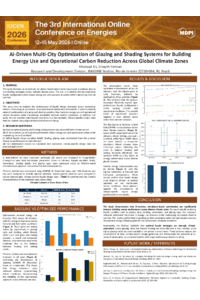
Buildings account for a substantial share of global energy consumption and operational carbon emissions, and a significantly high value of this impact is formed long before mechanical systems are specified. The building envelope, particularly glazing and shading design, controls how solar radiation and heat exchange, along with daylight, are managed across different climates. Despite this, façade optimization research has largely been conducted within isolated climatic contexts, producing results that are difficult to transfer beyond their original location. This fragmentation leaves designers without robust and comparative guidance for climate-responsive façade decisions.
Rather than focusing on a single city or environmental condition, this study aimed to develop and evaluate an AI-driven, multi-city optimization methodology for glazing and shading systems capable of operating across diverse global climate zones.
A standardized prototype-based simulation methodology was adopted to ensure consistency across all analyses. The building model was developed in DesignBuilder, with EnergyPlus performing the underlying energy calculations. The prototype was tested in representative cities corresponding to major Köppen climate classifications, including hot–arid, hot–humid, Mediterranean, temperate, and cold climates. An AI-driven optimization workflow was then used to change the ratios of glazing to walls, the fixed external shading configurations, and the building's orientation. Performance was assessed using annual energy use intensity, heating and cooling demand, and operational carbon emissions, enabling direct comparison of façade strategies under contrasting climatic conditions.
The analysis showed that façade performance varied significantly across different climatic conditions. AI-optimized solutions consistently outperformed baseline configurations and achieved measurable reductions in energy use and associated operational carbon emissions. Climates that were mostly cool were the most sensitive to shading depth and glazing proportion. Climates that were mixed or mostly warm had more complex interactions between solar gains and thermal losses. No single glazing or shading configuration emerged as optimal across all climates, highlighting the limitations of uniform façade design practices.
In conclusion, these findings support a shift away from standardized façade solutions toward façade possibilities that respond directly to the climate in which they are built. This is achieved by framing façade design as an adaptive problem rather than a fixed solution; this study contributes a transferable, AI-assisted methodology suitable for early stage decisions. The approach provides a scalable foundation for future research on more complex building typologies and advanced façade systems. It also provides climate-responsive pathways toward operational carbon reduction.
Keywords
Façade Optimization
Artificial Intelligence
Building Energy Performance
Operational Carbon Emissions
Global Climate Zones
Poster
Conference 2026 Ali,Tintawi v.02.pdf
Photovoltaic Power Prediction Using a Hybrid Method Combining FFT and ANN
Transforming Energy Sector: A Policy-Oriented Approach to Carbon Neutrality through Green Innovation and Carbon Pricing