Event submissions
Published
This submission belongs to the session S3. Energy and Environment. Sustainable Transition of the event The 3rd International Online Conference on Energies
Published date
07 May, 2026
Academic Editor
'%3e%3cpath%20d='M12.6657%2010.9104C12.4185%2010.325%2012.0599%209.79327%2011.6097%209.34482C11.1609%208.89508%2010.6293%208.5365%2010.0442%208.28888C10.0389%208.28626%2010.0337%208.28495%2010.0285%208.28233C10.8446%207.69279%2011.3752%206.73249%2011.3752%205.64904C11.3752%203.8542%209.92103%202.39999%208.1262%202.39999C6.33136%202.39999%204.87715%203.8542%204.87715%205.64904C4.87715%206.73249%205.40774%207.69279%206.22393%208.28364C6.21869%208.28626%206.21345%208.28757%206.20821%208.29019C5.62129%208.5378%205.09463%208.89284%204.64265%209.34613C4.1929%209.79493%203.83432%2010.3266%203.58671%2010.9117C3.34345%2011.4845%203.21226%2012.0987%203.20023%2012.7209C3.19988%2012.7349%203.20233%2012.7488%203.20744%2012.7619C3.21255%2012.7749%203.22022%2012.7867%203.22998%2012.7968C3.23975%2012.8068%203.25142%2012.8147%203.26431%2012.8202C3.2772%2012.8256%203.29105%2012.8284%203.30504%2012.8284H4.09109C4.14874%2012.8284%204.19459%2012.7825%204.1959%2012.7262C4.2221%2011.7148%204.62823%2010.7676%205.34617%2010.0497C6.08899%209.30683%207.0755%208.89808%208.1262%208.89808C9.17689%208.89808%2010.1634%209.30683%2010.9062%2010.0497C11.6242%2010.7676%2012.0303%2011.7148%2012.0565%2012.7262C12.0578%2012.7838%2012.1037%2012.8284%2012.1613%2012.8284H12.9474C12.9613%2012.8284%2012.9752%2012.8256%2012.9881%2012.8202C13.001%2012.8147%2013.0126%2012.8068%2013.0224%2012.7968C13.0322%2012.7867%2013.0398%2012.7749%2013.0449%2012.7619C13.0501%2012.7488%2013.0525%2012.7349%2013.0522%2012.7209C13.0391%2012.0947%2012.9094%2011.4855%2012.6657%2010.9104ZM8.1262%207.9024C7.52486%207.9024%206.9589%207.6679%206.53312%207.24211C6.10733%206.81633%205.87283%206.25037%205.87283%205.64904C5.87283%205.0477%206.10733%204.48174%206.53312%204.05596C6.9589%203.63018%207.52486%203.39567%208.1262%203.39567C8.72753%203.39567%209.29349%203.63018%209.71927%204.05596C10.1451%204.48174%2010.3796%205.0477%2010.3796%205.64904C10.3796%206.25037%2010.1451%206.81633%209.71927%207.24211C9.29349%207.6679%208.72753%207.9024%208.1262%207.9024Z'%20fill='%235D1EE1'/%3e%3c/g%3e%3c/svg%3e) Jose Ramon Fernandez
Jose Ramon FernandezCitation
Fernando Aricapa, Jorge L Gallego, Alejandro Silva-Cortés, Claudia Díaz-Mendoza, Jorgelina Pasqualino, Solar Energy Assessment in Rural Areas of the Colombian Caribbean Using Sunshine-Based Empirical Models for Water Treatment Applications, in Proceedings of The 3rd International Online Conference on Energies, 12 May–15 May 2026, MDPI: Basel, Switzerland
Share
Email
Facebook
Twitter
LinkedIn
Solar Energy Assessment in Rural Areas of the Colombian Caribbean Using Sunshine-Based Empirical Models for Water Treatment Applications
'%3e%3cpath%20d='M12.6647%2010.9104C12.4176%2010.325%2012.0589%209.7933%2011.6088%209.34485C11.16%208.89511%2010.6283%208.53653%2010.0432%208.28891C10.038%208.28629%2010.0327%208.28498%2010.0275%208.28236C10.8437%207.69282%2011.3743%206.73252%2011.3743%205.64907C11.3743%203.85423%209.92005%202.40002%208.12522%202.40002C6.33038%202.40002%204.87618%203.85423%204.87618%205.64907C4.87618%206.73252%205.40677%207.69282%206.22296%208.28367C6.21772%208.28629%206.21248%208.2876%206.20724%208.29022C5.62031%208.53783%205.09365%208.89287%204.64167%209.34616C4.19192%209.79496%203.83334%2010.3266%203.58573%2010.9117C3.34247%2011.4846%203.21128%2012.0987%203.19925%2012.721C3.1989%2012.735%203.20135%2012.7489%203.20646%2012.7619C3.21157%2012.7749%203.21924%2012.7868%203.22901%2012.7968C3.23877%2012.8068%203.25045%2012.8148%203.26334%2012.8202C3.27623%2012.8256%203.29007%2012.8284%203.30406%2012.8284H4.09012C4.14776%2012.8284%204.19362%2012.7825%204.19493%2012.7262C4.22113%2011.7148%204.62726%2010.7676%205.34519%2010.0497C6.08802%209.30686%207.07452%208.89811%208.12522%208.89811C9.17592%208.89811%2010.1624%209.30686%2010.9052%2010.0497C11.6232%2010.7676%2012.0293%2011.7148%2012.0555%2012.7262C12.0568%2012.7839%2012.1027%2012.8284%2012.1603%2012.8284H12.9464C12.9604%2012.8284%2012.9742%2012.8256%2012.9871%2012.8202C13%2012.8148%2013.0117%2012.8068%2013.0214%2012.7968C13.0312%2012.7868%2013.0389%2012.7749%2013.044%2012.7619C13.0491%2012.7489%2013.0515%2012.735%2013.0512%2012.721C13.0381%2012.0947%2012.9084%2011.4856%2012.6647%2010.9104ZM8.12522%207.90243C7.52388%207.90243%206.95792%207.66793%206.53214%207.24215C6.10636%206.81636%205.87185%206.2504%205.87185%205.64907C5.87185%205.04773%206.10636%204.48177%206.53214%204.05599C6.95792%203.63021%207.52388%203.3957%208.12522%203.3957C8.72655%203.3957%209.29252%203.63021%209.7183%204.05599C10.1441%204.48177%2010.3786%205.04773%2010.3786%205.64907C10.3786%206.2504%2010.1441%206.81636%209.7183%207.24215C9.29252%207.66793%208.72655%207.90243%208.12522%207.90243Z'%20fill='%235D1EE1'/%3e%3c/g%3e%3c/svg%3e)
Fernando Aricapa 1,2

Jorge L Gallego 3
Alejandro Silva-Cortés 4
Claudia Díaz-Mendoza 1

Jorgelina Pasqualino 1
1. GISAH Research Group, Environmental Engineering Program, Universidad Tecnológica de Bolívar Campus Tecnológico km 1 vía Turbaco Cartagena, Cartagena de Indias, Colombia
2. GIA Research Group, Department of Engineering, Fundación Universitaria Tecnológico Comfenalco, Cartagena de Indias 130015, Colombia
3. Biodiversity, Biotechnology and Bioengineering Research Group GRINBIO, Department of Engineering, University of Medellin, 050026, Medellín, Colombia.
4. Department of Management Sciences, Instituto Tecnológico Metropolitano, 050013 Medellín, Colombia
Abstract
Introduction
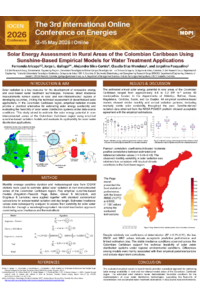
Access to reliable drinking water remains limited in many rural and non-interconnected areas of lower-income countries, where conventional water treatment infrastructure is absent or insufficient. In these contexts, solar water disinfection has been recognized as a low-cost and decentralized alternative that relies on the availability of adequate solar irradiance. However, the assessment of solar energy potential is frequently constrained by the lack of ground-based radiometric measurements, particularly in rural regions. Empirical models for solar radiation estimation provide a practical solution under such data-scarce conditions. The Colombian Caribbean region presents favorable climatic characteristics for solar applications, yet comprehensive evaluations of solar energy availability in its rural zones remain limited. This study estimates the solar energy potential in rural and non-interconnected areas of the Colombian Caribbean region using sunshine-based empirical models and evaluates its suitability for solar water disinfection applications.
Methods
Global solar radiation was estimated using five empirical models based on sunshine duration: Angstrom–Prescott, Glover and McCulloch, Dogniaux and Lemoine, Page, and Bahel. Monthly average meteorological data were obtained from the nearest available stations operated by the Institute of Hydrology, Meteorology and Environmental Studies of Colombia, IDEAM, due to the absence of local measurements in several evaluated areas. The analysis focused on rural zones across 92 municipalities located in the departments of Atlántico, Bolívar, Cesar, Magdalena, Córdoba, Sucre, and La Guajira. Estimated irradiance values were evaluated on monthly and annual bases and compared with satellite-derived solar radiation data obtained from the Prediction Of Worldwide Energy Resources (POWER) platform. Model performance was assessed using statistical indicators including Mean Bias Error, Mean Absolute Error, Root Mean Square Error, coefficient of determination, and Pearson correlation coefficient. Spatial distribution maps of annual average solar radiation were generated for each empirical model to evaluate regional consistency.
Results
The estimated annual solar energy potential in rural areas of the Colombian Caribbean region ranged between approximately 4.8 and 6.2 kW m⁻². All evaluated models exhibited consistent seasonal behavior with moderate monthly variability, reflecting the relatively stable solar resource characteristic of low-latitude regions. The coefficient of determination values were approximately 0.22 across models, indicating limited temporal variability, while additional statistical indicators showed no significant systematic bias and satisfactory predictive performance. Root Mean Square Error values remained within acceptable ranges, and Pearson correlation coefficients indicated moderate positive linear relationships between estimated and satellite-derived irradiance values. Among the evaluated formulations, the Page model presented the lowest error metrics, although all models showed comparable performance. Spatial analysis revealed a relatively homogeneous distribution of solar radiation across the evaluated rural zones, with minor geographic variations associated with location and sunshine duration inputs.
Conclusions
The results indicate that rural and non-interconnected areas of the Colombian Caribbean region exhibit solar energy availability compatible with the operational requirements reported for solar water disinfection systems. Sunshine-based empirical models provide a practical and reliable approach for assessing solar radiation in data-limited regions, supporting preliminary feasibility analyses for decentralized solar water treatment technologies. The integration of empirical estimations with satellite-derived reference data enhances confidence in regional-scale assessments and offers a transferable framework for evaluating solar-based solutions in rural environments lacking direct radiometric measurements.
Keywords
Drinking water
Non-interconnected regions
solar irradiance
Solar resource assessment
Sunshine duration models
sustainable communities.
Poster
165147.pdf
Experimental Validation of Steam-Enhanced Calcium Looping for CO₂ Capture
Practical Implications of Tessellated Geometric Façades for Optimal Daylighting Performance