Event submissions
Published
This submission belongs to the session S1. Energy Sources (Fossil & Renewable) of the event The 3rd International Online Conference on Energies
Published date
07 May, 2026
Academic Editor
'%3e%3cpath%20d='M12.6657%2010.9104C12.4185%2010.325%2012.0599%209.79327%2011.6097%209.34482C11.1609%208.89508%2010.6293%208.5365%2010.0442%208.28888C10.0389%208.28626%2010.0337%208.28495%2010.0285%208.28233C10.8446%207.69279%2011.3752%206.73249%2011.3752%205.64904C11.3752%203.8542%209.92103%202.39999%208.1262%202.39999C6.33136%202.39999%204.87715%203.8542%204.87715%205.64904C4.87715%206.73249%205.40774%207.69279%206.22393%208.28364C6.21869%208.28626%206.21345%208.28757%206.20821%208.29019C5.62129%208.5378%205.09463%208.89284%204.64265%209.34613C4.1929%209.79493%203.83432%2010.3266%203.58671%2010.9117C3.34345%2011.4845%203.21226%2012.0987%203.20023%2012.7209C3.19988%2012.7349%203.20233%2012.7488%203.20744%2012.7619C3.21255%2012.7749%203.22022%2012.7867%203.22998%2012.7968C3.23975%2012.8068%203.25142%2012.8147%203.26431%2012.8202C3.2772%2012.8256%203.29105%2012.8284%203.30504%2012.8284H4.09109C4.14874%2012.8284%204.19459%2012.7825%204.1959%2012.7262C4.2221%2011.7148%204.62823%2010.7676%205.34617%2010.0497C6.08899%209.30683%207.0755%208.89808%208.1262%208.89808C9.17689%208.89808%2010.1634%209.30683%2010.9062%2010.0497C11.6242%2010.7676%2012.0303%2011.7148%2012.0565%2012.7262C12.0578%2012.7838%2012.1037%2012.8284%2012.1613%2012.8284H12.9474C12.9613%2012.8284%2012.9752%2012.8256%2012.9881%2012.8202C13.001%2012.8147%2013.0126%2012.8068%2013.0224%2012.7968C13.0322%2012.7867%2013.0398%2012.7749%2013.0449%2012.7619C13.0501%2012.7488%2013.0525%2012.7349%2013.0522%2012.7209C13.0391%2012.0947%2012.9094%2011.4855%2012.6657%2010.9104ZM8.1262%207.9024C7.52486%207.9024%206.9589%207.6679%206.53312%207.24211C6.10733%206.81633%205.87283%206.25037%205.87283%205.64904C5.87283%205.0477%206.10733%204.48174%206.53312%204.05596C6.9589%203.63018%207.52486%203.39567%208.1262%203.39567C8.72753%203.39567%209.29349%203.63018%209.71927%204.05596C10.1451%204.48174%2010.3796%205.0477%2010.3796%205.64904C10.3796%206.25037%2010.1451%206.81633%209.71927%207.24211C9.29349%207.6679%208.72753%207.9024%208.1262%207.9024Z'%20fill='%235D1EE1'/%3e%3c/g%3e%3c/svg%3e) Adrian Ilinca
Adrian IlincaCitation
Bekzod Eshkulov, Process Integration Strategies for High-Purity CO2 Recovery from Acid Gas Mixtures in Gas Chemical Complexes, in Proceedings of The 3rd International Online Conference on Energies, 12 May–15 May 2026, MDPI: Basel, Switzerland
Share
Email
Facebook
Twitter
LinkedIn
Process Integration Strategies for High-Purity CO2 Recovery from Acid Gas Mixtures in Gas Chemical Complexes

Bekzod Eshkulov 1
1. Transport and Civil Engineering Faculty, Karshi State Technical University, Karshi city, 180119, Uzbekistan
Abstract
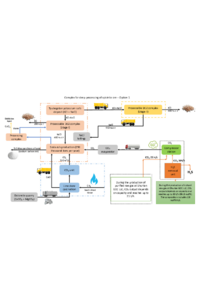
CO2-rich streams generated by acid gas removal units in gas chemical complexes are usually treated as waste, despite their potential value as a technical product. However, conventional separation techniques are frequently only intended for gas purification, which leads to high energy consumption and poor CO2 recovery purity. This study investigates process integration strategies to convert traditional acid gas treatment units into carbon capture systems that generate value in order to recover high-purity CO2 from acid gas mixtures originating from natural gas processing. With a focus on reducing regeneration energy and increasing overall system efficiency, the suggested framework assesses the integration of absorption-based CO2 separation with downstream conditioning, regeneration, and recycling stages. The analysis highlights the role of hybrid chemical loops in improving CO2 selectivity while concurrently lowering solvent degradation, corrosion risks, and utility demand. It takes into account both traditional solvent-based systems and alkaline-assisted capture routes. The relationship between separation units and current plant utilities such as steam, electricity, and waste heat streams is given particular consideration because these factors are crucial in determining overall energy performance. To find critical integration points where heat recovery, material recycling, and process coupling can greatly increase separation efficiency and energy, and mass balance evaluations are used. Reusing low-grade heat from upstream units, optimising solvent regeneration, and carefully conditioning captured CO2 to satisfy purity standards for technical and industrial applications are some of these integration opportunities. The findings show that, in comparison to traditional stand-alone configurations, integrated separation schemes can achieve high CO2 purity appropriate for downstream use while lowering the specific energy consumption of acid gas treatment. Overall, the results show that upgrading current gas purification infrastructure into integrated carbon capture and utilisation platforms is feasible through process-level optimisation. By facilitating circular carbon approaches within gas chemical complexes and promoting more efficient use of fossil-based energy resources, such strategies aid in the shift towards more sustainable and energy-efficient industrial systems.
Keywords
Energy Efficiency
CO2 Capture
Acid Gas Separation
Process Integration
Carbon Utilization.
Poster
СОДА.pdf
Policy Signals and Transition Outcomes: Examining the Influence of Energy Policy on Fossil Fuel Production in Australia
Recent Developments in the Utilization of Glass Waste for Green Concrete: Toward Sustainable and Energy-Efficient Construction