Event submissions
Published
This submission belongs to the session S3. Energy and Environment. Sustainable Transition of the event The 3rd International Online Conference on Energies
Published date
07 May, 2026
Academic Editor
'%3e%3cpath%20d='M12.6657%2010.9104C12.4185%2010.325%2012.0599%209.79327%2011.6097%209.34482C11.1609%208.89508%2010.6293%208.5365%2010.0442%208.28888C10.0389%208.28626%2010.0337%208.28495%2010.0285%208.28233C10.8446%207.69279%2011.3752%206.73249%2011.3752%205.64904C11.3752%203.8542%209.92103%202.39999%208.1262%202.39999C6.33136%202.39999%204.87715%203.8542%204.87715%205.64904C4.87715%206.73249%205.40774%207.69279%206.22393%208.28364C6.21869%208.28626%206.21345%208.28757%206.20821%208.29019C5.62129%208.5378%205.09463%208.89284%204.64265%209.34613C4.1929%209.79493%203.83432%2010.3266%203.58671%2010.9117C3.34345%2011.4845%203.21226%2012.0987%203.20023%2012.7209C3.19988%2012.7349%203.20233%2012.7488%203.20744%2012.7619C3.21255%2012.7749%203.22022%2012.7867%203.22998%2012.7968C3.23975%2012.8068%203.25142%2012.8147%203.26431%2012.8202C3.2772%2012.8256%203.29105%2012.8284%203.30504%2012.8284H4.09109C4.14874%2012.8284%204.19459%2012.7825%204.1959%2012.7262C4.2221%2011.7148%204.62823%2010.7676%205.34617%2010.0497C6.08899%209.30683%207.0755%208.89808%208.1262%208.89808C9.17689%208.89808%2010.1634%209.30683%2010.9062%2010.0497C11.6242%2010.7676%2012.0303%2011.7148%2012.0565%2012.7262C12.0578%2012.7838%2012.1037%2012.8284%2012.1613%2012.8284H12.9474C12.9613%2012.8284%2012.9752%2012.8256%2012.9881%2012.8202C13.001%2012.8147%2013.0126%2012.8068%2013.0224%2012.7968C13.0322%2012.7867%2013.0398%2012.7749%2013.0449%2012.7619C13.0501%2012.7488%2013.0525%2012.7349%2013.0522%2012.7209C13.0391%2012.0947%2012.9094%2011.4855%2012.6657%2010.9104ZM8.1262%207.9024C7.52486%207.9024%206.9589%207.6679%206.53312%207.24211C6.10733%206.81633%205.87283%206.25037%205.87283%205.64904C5.87283%205.0477%206.10733%204.48174%206.53312%204.05596C6.9589%203.63018%207.52486%203.39567%208.1262%203.39567C8.72753%203.39567%209.29349%203.63018%209.71927%204.05596C10.1451%204.48174%2010.3796%205.0477%2010.3796%205.64904C10.3796%206.25037%2010.1451%206.81633%209.71927%207.24211C9.29349%207.6679%208.72753%207.9024%208.1262%207.9024Z'%20fill='%235D1EE1'/%3e%3c/g%3e%3c/svg%3e) Jose Ramon Fernandez
Jose Ramon FernandezCitation
Arly Arienda Morico, Jeffrey Lavarias, Antonio Barroga, Process Stability and Biomethane Production in Food Waste Anaerobic Digestion with Functional Compost-Based Additives, in Proceedings of The 3rd International Online Conference on Energies, 12 May–15 May 2026, MDPI: Basel, Switzerland
Share
Email
Facebook
Twitter
LinkedIn
Process Stability and Biomethane Production in Food Waste Anaerobic Digestion with Functional Compost-Based Additives

Arly Arienda Morico 1

Jeffrey Lavarias 1
'%3e%3cpath%20d='M12.6647%2010.9104C12.4176%2010.325%2012.0589%209.7933%2011.6088%209.34485C11.16%208.89511%2010.6283%208.53653%2010.0432%208.28891C10.038%208.28629%2010.0327%208.28498%2010.0275%208.28236C10.8437%207.69282%2011.3743%206.73252%2011.3743%205.64907C11.3743%203.85423%209.92005%202.40002%208.12522%202.40002C6.33038%202.40002%204.87618%203.85423%204.87618%205.64907C4.87618%206.73252%205.40677%207.69282%206.22296%208.28367C6.21772%208.28629%206.21248%208.2876%206.20724%208.29022C5.62031%208.53783%205.09365%208.89287%204.64167%209.34616C4.19192%209.79496%203.83334%2010.3266%203.58573%2010.9117C3.34247%2011.4846%203.21128%2012.0987%203.19925%2012.721C3.1989%2012.735%203.20135%2012.7489%203.20646%2012.7619C3.21157%2012.7749%203.21924%2012.7868%203.22901%2012.7968C3.23877%2012.8068%203.25045%2012.8148%203.26334%2012.8202C3.27623%2012.8256%203.29007%2012.8284%203.30406%2012.8284H4.09012C4.14776%2012.8284%204.19362%2012.7825%204.19493%2012.7262C4.22113%2011.7148%204.62726%2010.7676%205.34519%2010.0497C6.08802%209.30686%207.07452%208.89811%208.12522%208.89811C9.17592%208.89811%2010.1624%209.30686%2010.9052%2010.0497C11.6232%2010.7676%2012.0293%2011.7148%2012.0555%2012.7262C12.0568%2012.7839%2012.1027%2012.8284%2012.1603%2012.8284H12.9464C12.9604%2012.8284%2012.9742%2012.8256%2012.9871%2012.8202C13%2012.8148%2013.0117%2012.8068%2013.0214%2012.7968C13.0312%2012.7868%2013.0389%2012.7749%2013.044%2012.7619C13.0491%2012.7489%2013.0515%2012.735%2013.0512%2012.721C13.0381%2012.0947%2012.9084%2011.4856%2012.6647%2010.9104ZM8.12522%207.90243C7.52388%207.90243%206.95792%207.66793%206.53214%207.24215C6.10636%206.81636%205.87185%206.2504%205.87185%205.64907C5.87185%205.04773%206.10636%204.48177%206.53214%204.05599C6.95792%203.63021%207.52388%203.3957%208.12522%203.3957C8.72655%203.3957%209.29252%203.63021%209.7183%204.05599C10.1441%204.48177%2010.3786%205.04773%2010.3786%205.64907C10.3786%206.2504%2010.1441%206.81636%209.7183%207.24215C9.29252%207.66793%208.72655%207.90243%208.12522%207.90243Z'%20fill='%235D1EE1'/%3e%3c/g%3e%3c/svg%3e)
Antonio Barroga 2
1. Department of Agricultural and Biosystems Engineering, College of Engineering, Central Luzon State University, Science City of Muñoz 3120, Nueva Ecija, Philippines
2. Department of Animal Science, College of Agriculture, Central Luzon State University, Science City of Muñoz 3120, Nueva Ecija, Philippines
Abstract
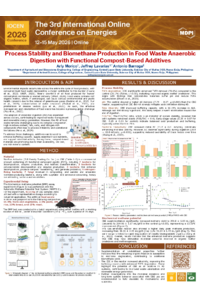
Anaerobic digestion (AD) is a widely implemented biotechnological process for treating organic wastes, such as food waste, providing the dual advantages of renewable energy production and nutrient recovery. Nonetheless, the heterogeneous composition of food wastes—characterized by high moisture content, lipids, salts, and nitrogenous compounds—often results in process instability and suboptimal biomethane yields. The use of multifunctional additives offers a promising avenue to enhance buffering capacity, microbial activity, and overall system stability. This investigation examined the effects of a compost-based additive (CBA) containing 25 functional compound agents (FCAs), including bacteria and fungi involved in organic matter decomposition, enzymatic activity, nitrogen fixation, methane production, and sulfate and ammonia reduction, on the AD of food waste. Batch AD experiments were performed under mesophilic conditions (37 ± 1°C) over a 20-day digestion period. The influence of CBA supplementation on biomethane production and key stability parameters, including pH, alkalinity, total volatile fatty acids (TVFAs), FOS/TAC ratio, and electrical conductivity (EC), was systematically evaluated. Results showed that CBA supplementation significantly improved process stability by increasing alkalinity and overall buffering capacity, which facilitated more effective TVFA degradation. The CBA-amended reactor achieved a TVFA degradation efficiency of 78.55%, nearly double that of the control (36.10%) (p < 0.01). Although pH is directly influenced by TVFA concentration, no statistically significant differences in pH were observed between treatments (p > 0.05), indicating that the enhanced alkalinity effectively maintained stable conditions. Furthermore, the EC in the CBA-treated reactor decreased by 19.7% relative to its initial value, while the FOS/TAC ratio declined to 0.10 by the end of the digestion period, indicating enhanced metabolic balance and a markedly reduced risk of acidification. These stability enhancements translated into improved performance, with the CBA-treated reactor attaining a maximum cumulative biomethane yield of 291.80 ± 6.09 mL g⁻¹ VS, representing a 10.51% increase over food waste digestion without additives. In conclusion, this study demonstrates that CBA can enhance process stability and biomethane production from food waste, highlighting its potential to support sustainable, low-carbon energy generation through the AD process.
Keywords
food waste
anaerobic digestion
biomethane
compost-based additives
process stability
waste-to-energy
low-carbon technologies
Poster
Arly Morico-Process Stability and Biomethane Production in Food Waste Anaerobic Digestion with Functional Compost-Based Additives .pdf
Unveiling the Role of Donor–Acceptor Attachment Sites in Molecular Design for High-Performance Organic Solar Cells: A Theoretical Study
Hybrid Neuro-Fuzzy Controllers for Robust Maximum Power Point Tracking under Variable Environmental Conditions