Event submissions
Published
This submission belongs to the session S1. Energy Sources (Fossil & Renewable) of the event The 3rd International Online Conference on Energies
Published date
07 May, 2026
Academic Editor
'%3e%3cpath%20d='M12.6657%2010.9104C12.4185%2010.325%2012.0599%209.79327%2011.6097%209.34482C11.1609%208.89508%2010.6293%208.5365%2010.0442%208.28888C10.0389%208.28626%2010.0337%208.28495%2010.0285%208.28233C10.8446%207.69279%2011.3752%206.73249%2011.3752%205.64904C11.3752%203.8542%209.92103%202.39999%208.1262%202.39999C6.33136%202.39999%204.87715%203.8542%204.87715%205.64904C4.87715%206.73249%205.40774%207.69279%206.22393%208.28364C6.21869%208.28626%206.21345%208.28757%206.20821%208.29019C5.62129%208.5378%205.09463%208.89284%204.64265%209.34613C4.1929%209.79493%203.83432%2010.3266%203.58671%2010.9117C3.34345%2011.4845%203.21226%2012.0987%203.20023%2012.7209C3.19988%2012.7349%203.20233%2012.7488%203.20744%2012.7619C3.21255%2012.7749%203.22022%2012.7867%203.22998%2012.7968C3.23975%2012.8068%203.25142%2012.8147%203.26431%2012.8202C3.2772%2012.8256%203.29105%2012.8284%203.30504%2012.8284H4.09109C4.14874%2012.8284%204.19459%2012.7825%204.1959%2012.7262C4.2221%2011.7148%204.62823%2010.7676%205.34617%2010.0497C6.08899%209.30683%207.0755%208.89808%208.1262%208.89808C9.17689%208.89808%2010.1634%209.30683%2010.9062%2010.0497C11.6242%2010.7676%2012.0303%2011.7148%2012.0565%2012.7262C12.0578%2012.7838%2012.1037%2012.8284%2012.1613%2012.8284H12.9474C12.9613%2012.8284%2012.9752%2012.8256%2012.9881%2012.8202C13.001%2012.8147%2013.0126%2012.8068%2013.0224%2012.7968C13.0322%2012.7867%2013.0398%2012.7749%2013.0449%2012.7619C13.0501%2012.7488%2013.0525%2012.7349%2013.0522%2012.7209C13.0391%2012.0947%2012.9094%2011.4855%2012.6657%2010.9104ZM8.1262%207.9024C7.52486%207.9024%206.9589%207.6679%206.53312%207.24211C6.10733%206.81633%205.87283%206.25037%205.87283%205.64904C5.87283%205.0477%206.10733%204.48174%206.53312%204.05596C6.9589%203.63018%207.52486%203.39567%208.1262%203.39567C8.72753%203.39567%209.29349%203.63018%209.71927%204.05596C10.1451%204.48174%2010.3796%205.0477%2010.3796%205.64904C10.3796%206.25037%2010.1451%206.81633%209.71927%207.24211C9.29349%207.6679%208.72753%207.9024%208.1262%207.9024Z'%20fill='%235D1EE1'/%3e%3c/g%3e%3c/svg%3e) Giovanni Esposito
Giovanni EspositoCitation
CASIMIRO AGOSTINHO, Fabio Meneghetti Ugulino de Araujo de Araujo, Hybrid Neuro-Fuzzy Controllers for Robust Maximum Power Point Tracking under Variable Environmental Conditions, in Proceedings of The 3rd International Online Conference on Energies, 12 May–15 May 2026, MDPI: Basel, Switzerland
Share
Email
Facebook
Twitter
LinkedIn
Hybrid Neuro-Fuzzy Controllers for Robust Maximum Power Point Tracking under Variable Environmental Conditions
'%3e%3cpath%20d='M12.6647%2010.9104C12.4176%2010.325%2012.0589%209.7933%2011.6088%209.34485C11.16%208.89511%2010.6283%208.53653%2010.0432%208.28891C10.038%208.28629%2010.0327%208.28498%2010.0275%208.28236C10.8437%207.69282%2011.3743%206.73252%2011.3743%205.64907C11.3743%203.85423%209.92005%202.40002%208.12522%202.40002C6.33038%202.40002%204.87618%203.85423%204.87618%205.64907C4.87618%206.73252%205.40677%207.69282%206.22296%208.28367C6.21772%208.28629%206.21248%208.2876%206.20724%208.29022C5.62031%208.53783%205.09365%208.89287%204.64167%209.34616C4.19192%209.79496%203.83334%2010.3266%203.58573%2010.9117C3.34247%2011.4846%203.21128%2012.0987%203.19925%2012.721C3.1989%2012.735%203.20135%2012.7489%203.20646%2012.7619C3.21157%2012.7749%203.21924%2012.7868%203.22901%2012.7968C3.23877%2012.8068%203.25045%2012.8148%203.26334%2012.8202C3.27623%2012.8256%203.29007%2012.8284%203.30406%2012.8284H4.09012C4.14776%2012.8284%204.19362%2012.7825%204.19493%2012.7262C4.22113%2011.7148%204.62726%2010.7676%205.34519%2010.0497C6.08802%209.30686%207.07452%208.89811%208.12522%208.89811C9.17592%208.89811%2010.1624%209.30686%2010.9052%2010.0497C11.6232%2010.7676%2012.0293%2011.7148%2012.0555%2012.7262C12.0568%2012.7839%2012.1027%2012.8284%2012.1603%2012.8284H12.9464C12.9604%2012.8284%2012.9742%2012.8256%2012.9871%2012.8202C13%2012.8148%2013.0117%2012.8068%2013.0214%2012.7968C13.0312%2012.7868%2013.0389%2012.7749%2013.044%2012.7619C13.0491%2012.7489%2013.0515%2012.735%2013.0512%2012.721C13.0381%2012.0947%2012.9084%2011.4856%2012.6647%2010.9104ZM8.12522%207.90243C7.52388%207.90243%206.95792%207.66793%206.53214%207.24215C6.10636%206.81636%205.87185%206.2504%205.87185%205.64907C5.87185%205.04773%206.10636%204.48177%206.53214%204.05599C6.95792%203.63021%207.52388%203.3957%208.12522%203.3957C8.72655%203.3957%209.29252%203.63021%209.7183%204.05599C10.1441%204.48177%2010.3786%205.04773%2010.3786%205.64907C10.3786%206.2504%2010.1441%206.81636%209.7183%207.24215C9.29252%207.66793%208.72655%207.90243%208.12522%207.90243Z'%20fill='%235D1EE1'/%3e%3c/g%3e%3c/svg%3e)
CASIMIRO AGOSTINHO 1
Fabio Meneghetti Ugulino de Araujo de Araujo 1
1. Department of Control and Automation, Federal University of Rio Grande do Norte (UFRN), Natal, 59078-970, Brazil
Abstract
I. Introduction
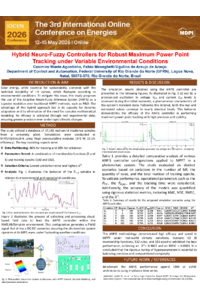
Global energy security positions solar energy as a strategic alternative, although the efficiency of photovoltaic systems is constrained by the non-linear nature of I-V curves under environmental variations. MPPT techniques are essential for optimizing this operation. However, conventional methods, such as P&O, fail under transient regimes. This work proposes the ANFIS model as a robust solution, integrating Artificial Neural Networks and Fuzzy Logic to provide dynamic adaptation without the need for complex mathematical modeling.
II. Methodology
An experimental database of 17,193 real-world irradiance samples, collected from a university plant, was utilized. The system was sized using Yingli polycrystalline modules (245 W, 15.1% efficiency) and simulated within the MATLAB/Simulink environment. The model was trained with 80% of the data and validated with the remaining 20%, exploring four scenarios that varied the number of membership functions (5 and 8) and training epochs (100 and 150). The ideal configuration was defined by the lowest prediction error and the highest coefficient of determination (?2).
III. Results
Simulations confirmed the high tracking capability of the ANFIS controller. It was observed that increasing the training to 150 epochs significantly optimized the stability of the estimated power. Despite initial oscillations typical of the transient regime, the voltage (???) and current (???) curves converged rapidly. Scenario B_2 (8 functions, 150 epochs) exhibited superior performance, achieving an ?2 of 0.91 and the lowest Mean Squared Error (MSE) of 0.6895.
IV. Conclusions
The ANFIS model proved highly effective in extracting the maximum power point under real-world disturbances. The integration of climatic and electrical variables resulted in rapid responses and low oscillation around the MPP, validating the technique as a robust tool for the optimization of photovoltaic systems.
Keywords
ANFIS
Energy tracking
Fuzzy control
MPPT
Solar power.
Poster
Hybrid Neuro-fuzzy_poster.pdf
Process Stability and Biomethane Production in Food Waste Anaerobic Digestion with Functional Compost-Based Additives
Biodiesel Production from Waste Cooking Oil Catalysed by a Calcium Oxide Heterogeneous Catalyst: Kinetics, Simulation, and Life Cycle Assessment