Event submissions
Published
This submission belongs to the session S3. Energy and Environment. Sustainable Transition of the event The 3rd International Online Conference on Energies
Published date
07 May, 2026
Academic Editor
'%3e%3cpath%20d='M12.6657%2010.9104C12.4185%2010.325%2012.0599%209.79327%2011.6097%209.34482C11.1609%208.89508%2010.6293%208.5365%2010.0442%208.28888C10.0389%208.28626%2010.0337%208.28495%2010.0285%208.28233C10.8446%207.69279%2011.3752%206.73249%2011.3752%205.64904C11.3752%203.8542%209.92103%202.39999%208.1262%202.39999C6.33136%202.39999%204.87715%203.8542%204.87715%205.64904C4.87715%206.73249%205.40774%207.69279%206.22393%208.28364C6.21869%208.28626%206.21345%208.28757%206.20821%208.29019C5.62129%208.5378%205.09463%208.89284%204.64265%209.34613C4.1929%209.79493%203.83432%2010.3266%203.58671%2010.9117C3.34345%2011.4845%203.21226%2012.0987%203.20023%2012.7209C3.19988%2012.7349%203.20233%2012.7488%203.20744%2012.7619C3.21255%2012.7749%203.22022%2012.7867%203.22998%2012.7968C3.23975%2012.8068%203.25142%2012.8147%203.26431%2012.8202C3.2772%2012.8256%203.29105%2012.8284%203.30504%2012.8284H4.09109C4.14874%2012.8284%204.19459%2012.7825%204.1959%2012.7262C4.2221%2011.7148%204.62823%2010.7676%205.34617%2010.0497C6.08899%209.30683%207.0755%208.89808%208.1262%208.89808C9.17689%208.89808%2010.1634%209.30683%2010.9062%2010.0497C11.6242%2010.7676%2012.0303%2011.7148%2012.0565%2012.7262C12.0578%2012.7838%2012.1037%2012.8284%2012.1613%2012.8284H12.9474C12.9613%2012.8284%2012.9752%2012.8256%2012.9881%2012.8202C13.001%2012.8147%2013.0126%2012.8068%2013.0224%2012.7968C13.0322%2012.7867%2013.0398%2012.7749%2013.0449%2012.7619C13.0501%2012.7488%2013.0525%2012.7349%2013.0522%2012.7209C13.0391%2012.0947%2012.9094%2011.4855%2012.6657%2010.9104ZM8.1262%207.9024C7.52486%207.9024%206.9589%207.6679%206.53312%207.24211C6.10733%206.81633%205.87283%206.25037%205.87283%205.64904C5.87283%205.0477%206.10733%204.48174%206.53312%204.05596C6.9589%203.63018%207.52486%203.39567%208.1262%203.39567C8.72753%203.39567%209.29349%203.63018%209.71927%204.05596C10.1451%204.48174%2010.3796%205.0477%2010.3796%205.64904C10.3796%206.25037%2010.1451%206.81633%209.71927%207.24211C9.29349%207.6679%208.72753%207.9024%208.1262%207.9024Z'%20fill='%235D1EE1'/%3e%3c/g%3e%3c/svg%3e) Jose Ramon Fernandez
Jose Ramon FernandezCitation
Victor José Olivero, Carlos Arturo Robles, Mario José Callejas, John Alexander Taborda, Laura Alejandra Chia Pinto, An IoT-Enhanced Life Cycle Assessment Framework for Continuous Environmental Impact Monitoring in Solar Energy Systems, in Proceedings of The 3rd International Online Conference on Energies, 12 May–15 May 2026, MDPI: Basel, Switzerland
Share
Email
Facebook
Twitter
LinkedIn
An IoT-Enhanced Life Cycle Assessment Framework for Continuous Environmental Impact Monitoring in Solar Energy Systems
'%3e%3cpath%20d='M12.6647%2010.9104C12.4176%2010.325%2012.0589%209.7933%2011.6088%209.34485C11.16%208.89511%2010.6283%208.53653%2010.0432%208.28891C10.038%208.28629%2010.0327%208.28498%2010.0275%208.28236C10.8437%207.69282%2011.3743%206.73252%2011.3743%205.64907C11.3743%203.85423%209.92005%202.40002%208.12522%202.40002C6.33038%202.40002%204.87618%203.85423%204.87618%205.64907C4.87618%206.73252%205.40677%207.69282%206.22296%208.28367C6.21772%208.28629%206.21248%208.2876%206.20724%208.29022C5.62031%208.53783%205.09365%208.89287%204.64167%209.34616C4.19192%209.79496%203.83334%2010.3266%203.58573%2010.9117C3.34247%2011.4846%203.21128%2012.0987%203.19925%2012.721C3.1989%2012.735%203.20135%2012.7489%203.20646%2012.7619C3.21157%2012.7749%203.21924%2012.7868%203.22901%2012.7968C3.23877%2012.8068%203.25045%2012.8148%203.26334%2012.8202C3.27623%2012.8256%203.29007%2012.8284%203.30406%2012.8284H4.09012C4.14776%2012.8284%204.19362%2012.7825%204.19493%2012.7262C4.22113%2011.7148%204.62726%2010.7676%205.34519%2010.0497C6.08802%209.30686%207.07452%208.89811%208.12522%208.89811C9.17592%208.89811%2010.1624%209.30686%2010.9052%2010.0497C11.6232%2010.7676%2012.0293%2011.7148%2012.0555%2012.7262C12.0568%2012.7839%2012.1027%2012.8284%2012.1603%2012.8284H12.9464C12.9604%2012.8284%2012.9742%2012.8256%2012.9871%2012.8202C13%2012.8148%2013.0117%2012.8068%2013.0214%2012.7968C13.0312%2012.7868%2013.0389%2012.7749%2013.044%2012.7619C13.0491%2012.7489%2013.0515%2012.735%2013.0512%2012.721C13.0381%2012.0947%2012.9084%2011.4856%2012.6647%2010.9104ZM8.12522%207.90243C7.52388%207.90243%206.95792%207.66793%206.53214%207.24215C6.10636%206.81636%205.87185%206.2504%205.87185%205.64907C5.87185%205.04773%206.10636%204.48177%206.53214%204.05599C6.95792%203.63021%207.52388%203.3957%208.12522%203.3957C8.72655%203.3957%209.29252%203.63021%209.7183%204.05599C10.1441%204.48177%2010.3786%205.04773%2010.3786%205.64907C10.3786%206.2504%2010.1441%206.81636%209.7183%207.24215C9.29252%207.66793%208.72655%207.90243%208.12522%207.90243Z'%20fill='%235D1EE1'/%3e%3c/g%3e%3c/svg%3e)
Victor José Olivero 1
Carlos Arturo Robles 1
Mario José Callejas 1
John Alexander Taborda 1
Laura Alejandra Chia Pinto 2
1. Facultad de Ingeniería, Universidad del Magdalena, Calle 29H3 No 22 - 01, 470004, Santa Marta D.T.C.H., Colombia
2. Vicepresidencia Técnica, Agencia Nacional de Hidrocarburos (ANH), Avenida Calle 26 N° 59 - 65 Piso 2, Bogotá, Colombia
Abstract
The rapid expansion of solar energy systems is a cornerstone of the global energy transition; however, their environmental assessment still relies predominantly on static Life Cycle Assessment (LCA) approaches based on aggregated, time-invariant datasets, which limit the ability to capture operational variability, context-specific dynamics, and data quality challenges—particularly in emerging economies where public institutions, private developers, and local communities interact. To address these limitations, this study proposes an Internet of Things (IoT)-enhanced dynamic Life Cycle Assessment (dLCA) framework aimed at enabling continuous environmental impact monitoring of solar energy systems in support of a sustainable and just energy transition. The proposed approach integrates real-time data streams from IoT devices into a dLCA methodological structure, allowing life cycle inventory parameters to be updated dynamically throughout key project phases. The framework is implemented through an edge/cloud IoT architecture, in which edge devices capture and pre-process environmental and operational data, while cloud-based services aggregate, harmonize, and feed these data into the dLCA workflow. Particular emphasis is placed on data provenance, temporal consistency, interoperability, and transparent documentation of assumptions. The framework has been operationalized within a functional digital platform developed under the IMPACT Energy.CO project and applied to a Latin American—specifically Colombian—solar energy case study characterized by regulatory oversight, public-sector involvement, and community engagement. The results demonstrate that integrating IoT-enabled data collection with dLCA significantly enhances the capacity to track environmental performance over time and across system boundaries, improving traceability, data quality control, and transparency in environmental assessments. Although the results are qualitative and functional rather than quantitative, they show how the proposed framework overcomes key limitations of conventional static LCA, particularly regarding temporal resolution and stakeholder trust. Overall, this work advances LCA practice from retrospective analysis toward dynamic, platform-based environmental monitoring, providing a transferable methodological foundation for evidence-based decision-making in solar energy projects and establishing the basis for future quantitative assessments and full-scale journal publication on the transition from static to dynamic LCA. This research was funded by the Agencia Nacional de Hidrocarburos, through its Vicepresidencia Técnica, under Contract No. 515 of 2025 executed with the Universidad del Magdalena.
Keywords
Life Cycle Assessment (LCA)
Dynamic LCA
Internet of Things (IoT)
Solar Energy Systems
Environmental Impact Monitoring
Data Traceability
Edge–Cloud Architectures
Sustainable Energy Transition
Digital Platforms for Sustainability
Poster
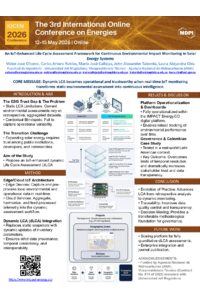
Poster_IOCEN_2026_IoT_dLCA_v2.pdf
A Blockchain-Supported LCA Framework to Strengthen Environmental and Social Governance in Renewable Energy Projects
Study of emissions formation in a spark‑ignition engine fuelled with natural‑gas–hydrogen blends