Event submissions
Published
This submission belongs to the session S3. Energy and Environment. Sustainable Transition of the event The 3rd International Online Conference on Energies
Published date
07 May, 2026
Academic Editor
'%3e%3cpath%20d='M12.6657%2010.9104C12.4185%2010.325%2012.0599%209.79327%2011.6097%209.34482C11.1609%208.89508%2010.6293%208.5365%2010.0442%208.28888C10.0389%208.28626%2010.0337%208.28495%2010.0285%208.28233C10.8446%207.69279%2011.3752%206.73249%2011.3752%205.64904C11.3752%203.8542%209.92103%202.39999%208.1262%202.39999C6.33136%202.39999%204.87715%203.8542%204.87715%205.64904C4.87715%206.73249%205.40774%207.69279%206.22393%208.28364C6.21869%208.28626%206.21345%208.28757%206.20821%208.29019C5.62129%208.5378%205.09463%208.89284%204.64265%209.34613C4.1929%209.79493%203.83432%2010.3266%203.58671%2010.9117C3.34345%2011.4845%203.21226%2012.0987%203.20023%2012.7209C3.19988%2012.7349%203.20233%2012.7488%203.20744%2012.7619C3.21255%2012.7749%203.22022%2012.7867%203.22998%2012.7968C3.23975%2012.8068%203.25142%2012.8147%203.26431%2012.8202C3.2772%2012.8256%203.29105%2012.8284%203.30504%2012.8284H4.09109C4.14874%2012.8284%204.19459%2012.7825%204.1959%2012.7262C4.2221%2011.7148%204.62823%2010.7676%205.34617%2010.0497C6.08899%209.30683%207.0755%208.89808%208.1262%208.89808C9.17689%208.89808%2010.1634%209.30683%2010.9062%2010.0497C11.6242%2010.7676%2012.0303%2011.7148%2012.0565%2012.7262C12.0578%2012.7838%2012.1037%2012.8284%2012.1613%2012.8284H12.9474C12.9613%2012.8284%2012.9752%2012.8256%2012.9881%2012.8202C13.001%2012.8147%2013.0126%2012.8068%2013.0224%2012.7968C13.0322%2012.7867%2013.0398%2012.7749%2013.0449%2012.7619C13.0501%2012.7488%2013.0525%2012.7349%2013.0522%2012.7209C13.0391%2012.0947%2012.9094%2011.4855%2012.6657%2010.9104ZM8.1262%207.9024C7.52486%207.9024%206.9589%207.6679%206.53312%207.24211C6.10733%206.81633%205.87283%206.25037%205.87283%205.64904C5.87283%205.0477%206.10733%204.48174%206.53312%204.05596C6.9589%203.63018%207.52486%203.39567%208.1262%203.39567C8.72753%203.39567%209.29349%203.63018%209.71927%204.05596C10.1451%204.48174%2010.3796%205.0477%2010.3796%205.64904C10.3796%206.25037%2010.1451%206.81633%209.71927%207.24211C9.29349%207.6679%208.72753%207.9024%208.1262%207.9024Z'%20fill='%235D1EE1'/%3e%3c/g%3e%3c/svg%3e) Jose Ramon Fernandez
Jose Ramon FernandezCitation
Juan Carlos Carmona Pulido, Irene Peñas Fuertes, Jesús Serrano-Jiménez, Julia Isidro Elvira, Jesús Rodríguez Ruiz, Exploring platinum recycling methods towards sustainable and more cost-effective PEM technologies., in Proceedings of The 3rd International Online Conference on Energies, 12 May–15 May 2026, MDPI: Basel, Switzerland
Share
Email
Facebook
Twitter
LinkedIn
Exploring platinum recycling methods towards sustainable and more cost-effective PEM technologies.
'%3e%3cpath%20d='M12.6647%2010.9104C12.4176%2010.325%2012.0589%209.7933%2011.6088%209.34485C11.16%208.89511%2010.6283%208.53653%2010.0432%208.28891C10.038%208.28629%2010.0327%208.28498%2010.0275%208.28236C10.8437%207.69282%2011.3743%206.73252%2011.3743%205.64907C11.3743%203.85423%209.92005%202.40002%208.12522%202.40002C6.33038%202.40002%204.87618%203.85423%204.87618%205.64907C4.87618%206.73252%205.40677%207.69282%206.22296%208.28367C6.21772%208.28629%206.21248%208.2876%206.20724%208.29022C5.62031%208.53783%205.09365%208.89287%204.64167%209.34616C4.19192%209.79496%203.83334%2010.3266%203.58573%2010.9117C3.34247%2011.4846%203.21128%2012.0987%203.19925%2012.721C3.1989%2012.735%203.20135%2012.7489%203.20646%2012.7619C3.21157%2012.7749%203.21924%2012.7868%203.22901%2012.7968C3.23877%2012.8068%203.25045%2012.8148%203.26334%2012.8202C3.27623%2012.8256%203.29007%2012.8284%203.30406%2012.8284H4.09012C4.14776%2012.8284%204.19362%2012.7825%204.19493%2012.7262C4.22113%2011.7148%204.62726%2010.7676%205.34519%2010.0497C6.08802%209.30686%207.07452%208.89811%208.12522%208.89811C9.17592%208.89811%2010.1624%209.30686%2010.9052%2010.0497C11.6232%2010.7676%2012.0293%2011.7148%2012.0555%2012.7262C12.0568%2012.7839%2012.1027%2012.8284%2012.1603%2012.8284H12.9464C12.9604%2012.8284%2012.9742%2012.8256%2012.9871%2012.8202C13%2012.8148%2013.0117%2012.8068%2013.0214%2012.7968C13.0312%2012.7868%2013.0389%2012.7749%2013.044%2012.7619C13.0491%2012.7489%2013.0515%2012.735%2013.0512%2012.721C13.0381%2012.0947%2012.9084%2011.4856%2012.6647%2010.9104ZM8.12522%207.90243C7.52388%207.90243%206.95792%207.66793%206.53214%207.24215C6.10636%206.81636%205.87185%206.2504%205.87185%205.64907C5.87185%205.04773%206.10636%204.48177%206.53214%204.05599C6.95792%203.63021%207.52388%203.3957%208.12522%203.3957C8.72655%203.3957%209.29252%203.63021%209.7183%204.05599C10.1441%204.48177%2010.3786%205.04773%2010.3786%205.64907C10.3786%206.2504%2010.1441%206.81636%209.7183%207.24215C9.29252%207.66793%208.72655%207.90243%208.12522%207.90243Z'%20fill='%235D1EE1'/%3e%3c/g%3e%3c/svg%3e)
Juan Carlos Carmona Pulido 1
Irene Peñas Fuertes 1
Jesús Serrano-Jiménez 1
Julia Isidro Elvira 1
Jesús Rodríguez Ruiz 1
1. Scientific Development Unit, National Hydrogen Center, Prolongación Fernando el Santo S/N, Puertollano, Ciudad Real, 13500, Spain
Abstract
The large-scale deployment of green hydrogen technologies based on proton exchange membrane (PEM) electrolyzers and fuel cells is widely recognized as a key pillar for global decarbonization strategies. However, analyses conducted by organizations such as the International Renewable Energy Agency (IRENA) and the United States Department of Energy (DOE) consistently highlight that the economic viability and scalability of these technologies remain strongly constrained by their reliance on platinum group metals (PGMs) [1]. In particular, platinum loadings must be significantly reduced in both PEM electrolyzers and fuel cells to meet future cost targets. This challenge has stimulated growing interest in strategies that simultaneously minimize catalyst usage and enable the efficient recovery and recycling of critical raw materials from end-of-life components.
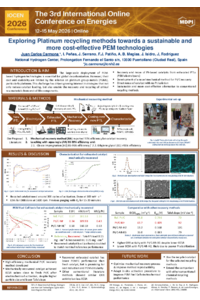
In this context, the present study addresses the recovery and reuse of platinum-based catalysts from exhausted PEM system components, with a specific focus on titanium porous transport layers (PTLs). We report the development of a novel, predominantly mechanical recovery procedure for Pt/C catalysts that enables the reuse of the entire catalytic ink, rather than isolated platinum. By avoiding chemically intensive processing steps and the use of expensive reagents, this approach offers a potentially more cost-effective and environmentally favorable alternative to conventional recycling pathways reported in the literature. The proposed method is systematically compared with established recovery techniques, including electrochemical dissolution of Pt from used electrodes and its subsequent catalyst synthesis, which typically involve higher process complexity and material costs [2].
Methods
Recovered Pt/C catalysts were reformulated into inks and redeposited onto several substrates via spray coating (airbrush Vega V2000). The electrochemical performance of the recycled catalysts was evaluated through a combination of several tests. The characterization included cyclic voltammetry to determine key parameters such as the specific electrochemical surface area (SECSA), providing insight into catalyst accessibility and utilization after recovery. Polarization curves and electrochemical impedance spectroscopy were used in PEM fuel cells to assess overall cell performance, kinetic behavior, and transport losses. In addition, scanning electron microscopy coupled with energy-dispersive X-ray spectroscopy (SEM-EDS) was employed to analyze catalyst morphology, dispersion, and elemental composition following recovery and redeposition.
Results and Conclusions
This study presents a novel approach for the recovery of Pt/C catalysts supported on titanium porous transport layers (PTLs), demonstrating its applicability in PEM fuel cell systems and enabling a direct comparison with established recovery protocols reported in the literature. The recovered catalytic ink, obtained directly from PEM electrolysis PTLs with recovery efficiencies of up to 95%, was successfully reused in PEM fuel cells. Although functional operation was achieved, the electrochemical performance did not fully meet initial expectations when compared with catalysts recovered using alternative methods, indicating that additional optimization of the recovery and reformulation processes is required. Furthermore, challenges were identified in the quantitative determination of the specific electrochemical surface area (SECSA) for catalyst layers deposited on carbon paper containing Pt/C and Nafion, highlighting limitations associated with substrate effects and measurement methodologies. Despite these challenges, the results confirm the technical feasibility of reusing mechanically recovered Pt/C catalysts and underscore the potential of simplified, cost-effective recycling routes as viable alternatives to more complex and resource-intensive recovery strategies.
References
[1] U.S. Department of Energy. Hydrogen and Fuel Cell Technologies Office Multi‑Year Program Plan (MYPP) 2024; Hydrogen and Fuel Cell Technologies Office, Office of Energy Efficiency & Renewable Energy: Washington, D.C. (2024).
[2] Montiel, M.A.; Granados-Fernández, R.; Díaz-Abad, S.; Sáez, C.; Fernández-Marchante, C.M.; Rodrigo, M.A. and Lobato, J. Towards a circular economy for Pt catalysts. Case study: Pt recovery from electrodes for hydrogen production. Applied Catalysis B: Environmental, Vol. 327, 122414, (2023).
Keywords
PEM fuel cell
PEM electrolysis
recycling
platinum
PTL
cyclic voltammetry
SECSA.
Poster
Poster IOCEN Ver Final.pdf
Symmetric SOECs based on PrBaMn2O5+δ electrodes for co-electrolysis processes
CO2 valorization in portable pilot plants for e-fuel production