Event submissions
Published
This submission belongs to the session S8. AI Applications to Energy Conversion Systems of the event The 3rd International Online Conference on Energies
Published date
07 May, 2026
Academic Editor
'%3e%3cpath%20d='M12.6657%2010.9104C12.4185%2010.325%2012.0599%209.79327%2011.6097%209.34482C11.1609%208.89508%2010.6293%208.5365%2010.0442%208.28888C10.0389%208.28626%2010.0337%208.28495%2010.0285%208.28233C10.8446%207.69279%2011.3752%206.73249%2011.3752%205.64904C11.3752%203.8542%209.92103%202.39999%208.1262%202.39999C6.33136%202.39999%204.87715%203.8542%204.87715%205.64904C4.87715%206.73249%205.40774%207.69279%206.22393%208.28364C6.21869%208.28626%206.21345%208.28757%206.20821%208.29019C5.62129%208.5378%205.09463%208.89284%204.64265%209.34613C4.1929%209.79493%203.83432%2010.3266%203.58671%2010.9117C3.34345%2011.4845%203.21226%2012.0987%203.20023%2012.7209C3.19988%2012.7349%203.20233%2012.7488%203.20744%2012.7619C3.21255%2012.7749%203.22022%2012.7867%203.22998%2012.7968C3.23975%2012.8068%203.25142%2012.8147%203.26431%2012.8202C3.2772%2012.8256%203.29105%2012.8284%203.30504%2012.8284H4.09109C4.14874%2012.8284%204.19459%2012.7825%204.1959%2012.7262C4.2221%2011.7148%204.62823%2010.7676%205.34617%2010.0497C6.08899%209.30683%207.0755%208.89808%208.1262%208.89808C9.17689%208.89808%2010.1634%209.30683%2010.9062%2010.0497C11.6242%2010.7676%2012.0303%2011.7148%2012.0565%2012.7262C12.0578%2012.7838%2012.1037%2012.8284%2012.1613%2012.8284H12.9474C12.9613%2012.8284%2012.9752%2012.8256%2012.9881%2012.8202C13.001%2012.8147%2013.0126%2012.8068%2013.0224%2012.7968C13.0322%2012.7867%2013.0398%2012.7749%2013.0449%2012.7619C13.0501%2012.7488%2013.0525%2012.7349%2013.0522%2012.7209C13.0391%2012.0947%2012.9094%2011.4855%2012.6657%2010.9104ZM8.1262%207.9024C7.52486%207.9024%206.9589%207.6679%206.53312%207.24211C6.10733%206.81633%205.87283%206.25037%205.87283%205.64904C5.87283%205.0477%206.10733%204.48174%206.53312%204.05596C6.9589%203.63018%207.52486%203.39567%208.1262%203.39567C8.72753%203.39567%209.29349%203.63018%209.71927%204.05596C10.1451%204.48174%2010.3796%205.0477%2010.3796%205.64904C10.3796%206.25037%2010.1451%206.81633%209.71927%207.24211C9.29349%207.6679%208.72753%207.9024%208.1262%207.9024Z'%20fill='%235D1EE1'/%3e%3c/g%3e%3c/svg%3e) Ramiro Barbosa
Ramiro BarbosaCitation
Kelvin Godwin Anaman, Sanjith Balamurali, AI-Optimized Pyrolysis: A Machine Learning Framework for Predictive Waste-to-Energy Conversion, in Proceedings of The 3rd International Online Conference on Energies, 12 May–15 May 2026, MDPI: Basel, Switzerland
Share
Email
Facebook
Twitter
LinkedIn
AI-Optimized Pyrolysis: A Machine Learning Framework for Predictive Waste-to-Energy Conversion
'%3e%3cpath%20d='M12.6647%2010.9104C12.4176%2010.325%2012.0589%209.7933%2011.6088%209.34485C11.16%208.89511%2010.6283%208.53653%2010.0432%208.28891C10.038%208.28629%2010.0327%208.28498%2010.0275%208.28236C10.8437%207.69282%2011.3743%206.73252%2011.3743%205.64907C11.3743%203.85423%209.92005%202.40002%208.12522%202.40002C6.33038%202.40002%204.87618%203.85423%204.87618%205.64907C4.87618%206.73252%205.40677%207.69282%206.22296%208.28367C6.21772%208.28629%206.21248%208.2876%206.20724%208.29022C5.62031%208.53783%205.09365%208.89287%204.64167%209.34616C4.19192%209.79496%203.83334%2010.3266%203.58573%2010.9117C3.34247%2011.4846%203.21128%2012.0987%203.19925%2012.721C3.1989%2012.735%203.20135%2012.7489%203.20646%2012.7619C3.21157%2012.7749%203.21924%2012.7868%203.22901%2012.7968C3.23877%2012.8068%203.25045%2012.8148%203.26334%2012.8202C3.27623%2012.8256%203.29007%2012.8284%203.30406%2012.8284H4.09012C4.14776%2012.8284%204.19362%2012.7825%204.19493%2012.7262C4.22113%2011.7148%204.62726%2010.7676%205.34519%2010.0497C6.08802%209.30686%207.07452%208.89811%208.12522%208.89811C9.17592%208.89811%2010.1624%209.30686%2010.9052%2010.0497C11.6232%2010.7676%2012.0293%2011.7148%2012.0555%2012.7262C12.0568%2012.7839%2012.1027%2012.8284%2012.1603%2012.8284H12.9464C12.9604%2012.8284%2012.9742%2012.8256%2012.9871%2012.8202C13%2012.8148%2013.0117%2012.8068%2013.0214%2012.7968C13.0312%2012.7868%2013.0389%2012.7749%2013.044%2012.7619C13.0491%2012.7489%2013.0515%2012.735%2013.0512%2012.721C13.0381%2012.0947%2012.9084%2011.4856%2012.6647%2010.9104ZM8.12522%207.90243C7.52388%207.90243%206.95792%207.66793%206.53214%207.24215C6.10636%206.81636%205.87185%206.2504%205.87185%205.64907C5.87185%205.04773%206.10636%204.48177%206.53214%204.05599C6.95792%203.63021%207.52388%203.3957%208.12522%203.3957C8.72655%203.3957%209.29252%203.63021%209.7183%204.05599C10.1441%204.48177%2010.3786%205.04773%2010.3786%205.64907C10.3786%206.2504%2010.1441%206.81636%209.7183%207.24215C9.29252%207.66793%208.72655%207.90243%208.12522%207.90243Z'%20fill='%235D1EE1'/%3e%3c/g%3e%3c/svg%3e)
Kelvin Godwin Anaman 1
Sanjith Balamurali 2
1. Presbyterian Boys Secondary School, Pulse Organization, Accra, 00233, Ghana
2. Metea Valley High School, Pulse Organization, Aurora, Illinois, 60502, United States
Abstract
Introduction:
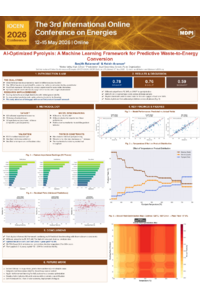
Global municipal solid waste (MSW) generation is projected to reach 3.4 billion tons annually by 2050. While pyrolysis offers a sustainable waste-to-energy alternative to landfilling, its industrial application is hindered by the complexity of heterogeneous feedstocks and the limited availability of reliable predictive optimization tools. This research addresses these challenges by developing a scalable, data-driven framework that integrates artificial intelligence with thermochemical principles.
Methods:
Using a dataset of 619 experimentally validated scenarios across 75 feedstock types, we benchmarked XGBoost against Random Forest (RF), Support Vector Regression (SVR), and Multi-Layer Perceptron (MLP) models. Model selection was based on predictive accuracy (R²), robustness across diverse feedstocks, and stability under cross-validation. XGBoost was chosen due to its superior performance in capturing non-linear relationships in high-dimensional chemical data. The dataset was split using an 80/20 train–test scheme, ensuring representative coverage of different feedstock categories in both sets, and model reliability was further assessed using stratified 5-fold cross-validation. Physics-informed constraints were applied post-training to enforce mass balance (total yield ≈ 100%) and thermochemical consistency, ensuring adherence to fundamental physical laws.
Results:
The framework achieved strong predictive performance, with R² values of 0.78 for syngas, 0.76 for bio-oil, and 0.59 for biochar. Reactor type emerged as a significant predictor: fluidized-bed reactors showed higher bio-oil yields due to enhanced heat and mass transfer compared to fixed-bed systems, while auger reactors favored biochar formation under lower heating rates. Temperature remained the dominant operational variable, with an optimal bio-oil production region identified near 526 °C and a heating rate of approximately 100 °C/min.
Conclusions:
This study introduces a novel, physics-informed machine-learning framework that combines algorithm benchmarking, feedstock-diverse validation, and thermodynamic constraints for pyrolysis modeling, addressing key limitations in existing AI-based pyrolysis research. Rather than providing fixed emission reduction values, the model offers a pathway toward improved process efficiency and informed operational optimization. By enabling data-driven reactor and condition selection, this work supports the development of smarter and more sustainable waste-to-energy systems within a circular economy framework.
Keywords
Pyrolysis
Predictive Model
Biomass
Poster
Pyrolysis Poster.pdf
An Optimized Hybrid Artificial Intelligence-based Control Strategy for Standalone Photovoltaic Systems under Complex Partial Shading Conditions
Benchmarking Deep Learning Techniques for Photovoltaic Output Prediction: A Case Study of PV Systems in China