Event submissions
Published
This submission belongs to the session S8. AI Applications to Energy Conversion Systems of the event The 3rd International Online Conference on Energies
Published date
07 May, 2026
Academic Editor
'%3e%3cpath%20d='M12.6657%2010.9104C12.4185%2010.325%2012.0599%209.79327%2011.6097%209.34482C11.1609%208.89508%2010.6293%208.5365%2010.0442%208.28888C10.0389%208.28626%2010.0337%208.28495%2010.0285%208.28233C10.8446%207.69279%2011.3752%206.73249%2011.3752%205.64904C11.3752%203.8542%209.92103%202.39999%208.1262%202.39999C6.33136%202.39999%204.87715%203.8542%204.87715%205.64904C4.87715%206.73249%205.40774%207.69279%206.22393%208.28364C6.21869%208.28626%206.21345%208.28757%206.20821%208.29019C5.62129%208.5378%205.09463%208.89284%204.64265%209.34613C4.1929%209.79493%203.83432%2010.3266%203.58671%2010.9117C3.34345%2011.4845%203.21226%2012.0987%203.20023%2012.7209C3.19988%2012.7349%203.20233%2012.7488%203.20744%2012.7619C3.21255%2012.7749%203.22022%2012.7867%203.22998%2012.7968C3.23975%2012.8068%203.25142%2012.8147%203.26431%2012.8202C3.2772%2012.8256%203.29105%2012.8284%203.30504%2012.8284H4.09109C4.14874%2012.8284%204.19459%2012.7825%204.1959%2012.7262C4.2221%2011.7148%204.62823%2010.7676%205.34617%2010.0497C6.08899%209.30683%207.0755%208.89808%208.1262%208.89808C9.17689%208.89808%2010.1634%209.30683%2010.9062%2010.0497C11.6242%2010.7676%2012.0303%2011.7148%2012.0565%2012.7262C12.0578%2012.7838%2012.1037%2012.8284%2012.1613%2012.8284H12.9474C12.9613%2012.8284%2012.9752%2012.8256%2012.9881%2012.8202C13.001%2012.8147%2013.0126%2012.8068%2013.0224%2012.7968C13.0322%2012.7867%2013.0398%2012.7749%2013.0449%2012.7619C13.0501%2012.7488%2013.0525%2012.7349%2013.0522%2012.7209C13.0391%2012.0947%2012.9094%2011.4855%2012.6657%2010.9104ZM8.1262%207.9024C7.52486%207.9024%206.9589%207.6679%206.53312%207.24211C6.10733%206.81633%205.87283%206.25037%205.87283%205.64904C5.87283%205.0477%206.10733%204.48174%206.53312%204.05596C6.9589%203.63018%207.52486%203.39567%208.1262%203.39567C8.72753%203.39567%209.29349%203.63018%209.71927%204.05596C10.1451%204.48174%2010.3796%205.0477%2010.3796%205.64904C10.3796%206.25037%2010.1451%206.81633%209.71927%207.24211C9.29349%207.6679%208.72753%207.9024%208.1262%207.9024Z'%20fill='%235D1EE1'/%3e%3c/g%3e%3c/svg%3e) Enrico Sciubba
Enrico SciubbaCitation
Veena Madavanathara Narayanan, Chris Ogwumike, Maria Jenisha Packiaraj, Michael Short, Energy-Aware Machine Learning Framework for Multi-Class Weather Classification in Edge-Enabled Renewable Energy Systems, in Proceedings of The 3rd International Online Conference on Energies, 12 May–15 May 2026, MDPI: Basel, Switzerland
Share
Email
Facebook
Twitter
LinkedIn
Energy-Aware Machine Learning Framework for Multi-Class Weather Classification in Edge-Enabled Renewable Energy Systems

Veena Madavanathara Narayanan 1

Chris Ogwumike 2
'%3e%3cpath%20d='M12.6647%2010.9104C12.4176%2010.325%2012.0589%209.7933%2011.6088%209.34485C11.16%208.89511%2010.6283%208.53653%2010.0432%208.28891C10.038%208.28629%2010.0327%208.28498%2010.0275%208.28236C10.8437%207.69282%2011.3743%206.73252%2011.3743%205.64907C11.3743%203.85423%209.92005%202.40002%208.12522%202.40002C6.33038%202.40002%204.87618%203.85423%204.87618%205.64907C4.87618%206.73252%205.40677%207.69282%206.22296%208.28367C6.21772%208.28629%206.21248%208.2876%206.20724%208.29022C5.62031%208.53783%205.09365%208.89287%204.64167%209.34616C4.19192%209.79496%203.83334%2010.3266%203.58573%2010.9117C3.34247%2011.4846%203.21128%2012.0987%203.19925%2012.721C3.1989%2012.735%203.20135%2012.7489%203.20646%2012.7619C3.21157%2012.7749%203.21924%2012.7868%203.22901%2012.7968C3.23877%2012.8068%203.25045%2012.8148%203.26334%2012.8202C3.27623%2012.8256%203.29007%2012.8284%203.30406%2012.8284H4.09012C4.14776%2012.8284%204.19362%2012.7825%204.19493%2012.7262C4.22113%2011.7148%204.62726%2010.7676%205.34519%2010.0497C6.08802%209.30686%207.07452%208.89811%208.12522%208.89811C9.17592%208.89811%2010.1624%209.30686%2010.9052%2010.0497C11.6232%2010.7676%2012.0293%2011.7148%2012.0555%2012.7262C12.0568%2012.7839%2012.1027%2012.8284%2012.1603%2012.8284H12.9464C12.9604%2012.8284%2012.9742%2012.8256%2012.9871%2012.8202C13%2012.8148%2013.0117%2012.8068%2013.0214%2012.7968C13.0312%2012.7868%2013.0389%2012.7749%2013.044%2012.7619C13.0491%2012.7489%2013.0515%2012.735%2013.0512%2012.721C13.0381%2012.0947%2012.9084%2011.4856%2012.6647%2010.9104ZM8.12522%207.90243C7.52388%207.90243%206.95792%207.66793%206.53214%207.24215C6.10636%206.81636%205.87185%206.2504%205.87185%205.64907C5.87185%205.04773%206.10636%204.48177%206.53214%204.05599C6.95792%203.63021%207.52388%203.3957%208.12522%203.3957C8.72655%203.3957%209.29252%203.63021%209.7183%204.05599C10.1441%204.48177%2010.3786%205.04773%2010.3786%205.64907C10.3786%206.2504%2010.1441%206.81636%209.7183%207.24215C9.29252%207.66793%208.72655%207.90243%208.12522%207.90243Z'%20fill='%235D1EE1'/%3e%3c/g%3e%3c/svg%3e)
Maria Jenisha Packiaraj 3

Michael Short 4
1. School of Computing, Engineering & Digital Technologies, Teesside University, Middlesbrough, UK
2. Electrical & Electronic Engineering, SCEDT Engineering, Centre for Sustainable Engineering, Teesside University, Middlesbrough, UK
3. Engineering (Electrical/Mechanical), SCEDT Engineering, Teesside University, Middlesbrough, UK
4. SCEDT Engineering, Teesside University, Middlesbrough, UK
Abstract
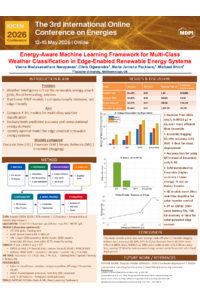
Accurate, low-latency weather intelligence plays a critical role in renewable energy integration, smart grid stability, and climate-resilient infrastructure planning. Conventional numerical weather prediction approaches, while physically robust, are computationally intensive and often unsuitable for localized and real-time decision-making in distributed energy environments. This work proposes an energy-aware machine learning framework for multi-class weather classification designed to support edge-enabled renewable energy systems and data-driven urban energy management. A decade-long historical meteorological dataset (2014–2023) containing hourly weather observations is utilized to train and evaluate multiple supervised learning models under a unified experimental protocol.
Four widely adopted classifiers—Decision Trees, Gaussian kernel Support Vector Machines, Feedforward Neural Networks, and Ensemble (Bagging) methods—are systematically compared using consistent preprocessing, temporal feature extraction, five-fold cross-validation, and Bayesian hyperparameter optimization. Model performance is assessed using both predictive and computational metrics, including classification accuracy, macro-averaged F1-score, ROC-AUC, training time, and inference throughput. This dual-metric evaluation enables explicit quantification of the trade-off between predictive quality and computational energy demand, which is a critical factor in edge and embedded deployment scenarios.
Experimental results indicate that Ensemble (Bagging) achieves the highest predictive performance with an accuracy of 85.44% and ROC-AUC of 0.91, demonstrating strong generalization across diverse weather categories. Gaussian SVM provides near-comparable accuracy with reduced training overhead, offering a balanced compromise between precision and computational burden. Decision Trees exhibit exceptional inference speed exceeding 590,000 observations per second, highlighting their suitability for real-time and low-power edge applications despite comparatively lower accuracy. Neural Networks deliver moderate but stable performance across all metrics, emphasizing the influence of architecture depth and optimization strategies on tabular meteorological data.
The findings reveal a clear accuracy–efficiency frontier that supports application-specific model selection for renewable energy forecasting, solar and wind resource assessment, smart city weather sensing, and distributed energy management systems. Conceptual edge-AI deployment analysis further suggests that lightweight classifiers can significantly reduce computational energy consumption while maintaining acceptable predictive reliability. This research contributes an energy-conscious, scalable machine learning approach that bridges artificial intelligence and sustainable energy infrastructures, enabling more resilient, adaptive, and environmentally responsible smart energy ecosystems.
Keywords
Weather Classification
Machine Learning
Renewable Energy
Edge AI
Smart Grids
Energy Efficiency
Sustainability
Predictive Analytics
Poster
VeenaMNarayanan_IOCEN_Poster.pdf
Optimizing Remaining Useful Life Prediction in Photovoltaic Systems Using AI-Enhanced LSTM Models
Deep Learning-Driven Real-Time Optimization for Improved Exergy Efficiency in Hybrid Renewable Energy Conversion Systems