Event submissions
Published
This submission belongs to the session S8. AI Applications to Energy Conversion Systems of the event The 3rd International Online Conference on Energies
Published date
07 May, 2026
Academic Editor
'%3e%3cpath%20d='M12.6657%2010.9104C12.4185%2010.325%2012.0599%209.79327%2011.6097%209.34482C11.1609%208.89508%2010.6293%208.5365%2010.0442%208.28888C10.0389%208.28626%2010.0337%208.28495%2010.0285%208.28233C10.8446%207.69279%2011.3752%206.73249%2011.3752%205.64904C11.3752%203.8542%209.92103%202.39999%208.1262%202.39999C6.33136%202.39999%204.87715%203.8542%204.87715%205.64904C4.87715%206.73249%205.40774%207.69279%206.22393%208.28364C6.21869%208.28626%206.21345%208.28757%206.20821%208.29019C5.62129%208.5378%205.09463%208.89284%204.64265%209.34613C4.1929%209.79493%203.83432%2010.3266%203.58671%2010.9117C3.34345%2011.4845%203.21226%2012.0987%203.20023%2012.7209C3.19988%2012.7349%203.20233%2012.7488%203.20744%2012.7619C3.21255%2012.7749%203.22022%2012.7867%203.22998%2012.7968C3.23975%2012.8068%203.25142%2012.8147%203.26431%2012.8202C3.2772%2012.8256%203.29105%2012.8284%203.30504%2012.8284H4.09109C4.14874%2012.8284%204.19459%2012.7825%204.1959%2012.7262C4.2221%2011.7148%204.62823%2010.7676%205.34617%2010.0497C6.08899%209.30683%207.0755%208.89808%208.1262%208.89808C9.17689%208.89808%2010.1634%209.30683%2010.9062%2010.0497C11.6242%2010.7676%2012.0303%2011.7148%2012.0565%2012.7262C12.0578%2012.7838%2012.1037%2012.8284%2012.1613%2012.8284H12.9474C12.9613%2012.8284%2012.9752%2012.8256%2012.9881%2012.8202C13.001%2012.8147%2013.0126%2012.8068%2013.0224%2012.7968C13.0322%2012.7867%2013.0398%2012.7749%2013.0449%2012.7619C13.0501%2012.7488%2013.0525%2012.7349%2013.0522%2012.7209C13.0391%2012.0947%2012.9094%2011.4855%2012.6657%2010.9104ZM8.1262%207.9024C7.52486%207.9024%206.9589%207.6679%206.53312%207.24211C6.10733%206.81633%205.87283%206.25037%205.87283%205.64904C5.87283%205.0477%206.10733%204.48174%206.53312%204.05596C6.9589%203.63018%207.52486%203.39567%208.1262%203.39567C8.72753%203.39567%209.29349%203.63018%209.71927%204.05596C10.1451%204.48174%2010.3796%205.0477%2010.3796%205.64904C10.3796%206.25037%2010.1451%206.81633%209.71927%207.24211C9.29349%207.6679%208.72753%207.9024%208.1262%207.9024Z'%20fill='%235D1EE1'/%3e%3c/g%3e%3c/svg%3e) Enrico Sciubba
Enrico SciubbaCitation
Desmond Chinecherem Nwana, Deep Learning-Driven Real-Time Optimization for Improved Exergy Efficiency in Hybrid Renewable Energy Conversion Systems, in Proceedings of The 3rd International Online Conference on Energies, 12 May–15 May 2026, MDPI: Basel, Switzerland
Share
Email
Facebook
Twitter
LinkedIn
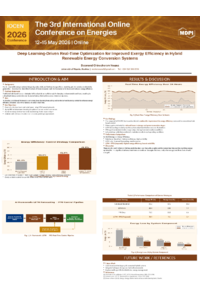
Deep Learning-Driven Real-Time Optimization for Improved Exergy Efficiency in Hybrid Renewable Energy Conversion Systems

Desmond Chinecherem Nwana 1
1. Department of Accountancy, Faculty of Management Sciences, University of Nigeria, Nsukka, 410001, Nigeria
Abstract
Hybrid renewable energy systems that integrate solar, wind, and energy storage provide a promising solution for sustainable electricity generation. However, the intermittent nature of these resources often leads to inefficient energy conversion and increased thermodynamic losses, reducing exergy efficiency. Traditional rule-based control strategies struggle to adapt to rapidly changing environmental conditions. This study proposes an artificial intelligence–based framework that combines deep learning forecasting with reinforcement learning control to enhance system performance.
The proposed approach utilizes a Long Short-Term Memory (LSTM) neural network to predict short-term solar irradiance and wind speed using meteorological data from NASA POWER and historical records. These forecasts are integrated into a reinforcement learning agent based on the Proximal Policy Optimization (PPO) algorithm, which dynamically adjusts system parameters such as inverter operation, battery scheduling, and wind turbine pitch angle. The objective is to minimize exergy destruction while maintaining stable energy output.
The framework was evaluated using a simulation model of a hybrid solar–wind–battery system developed with Python-based tools, including TensorFlow. Exergy analysis was applied to quantify losses across system components. Validation was further conducted using a small-scale laboratory prototype comprising photovoltaic panels, a micro wind turbine, battery storage, and programmable converters.
Results indicate that the proposed approach achieves a noticeable improvement in exergy efficiency compared to conventional control strategies, primarily due to reduced losses in storage and conversion stages. These findings highlight the potential of AI-driven optimization for improving the efficiency and reliability of hybrid renewable energy systems.
Keywords
Artificial Intelligence
Deep Learning
Exergy Analysis
Hybrid Renewable Energy Systems
Energy Optimization
Poster
ffff
Energy-Aware Machine Learning Framework for Multi-Class Weather Classification in Edge-Enabled Renewable Energy Systems
Securing Critical Energy Infrastructure: Cyber Risks, Challenges, and Defense Strategies in the Digital Era