Event submissions
Published
This submission belongs to the session S8. AI Applications to Energy Conversion Systems of the event The 3rd International Online Conference on Energies
Published date
07 May, 2026
Academic Editor
'%3e%3cpath%20d='M12.6657%2010.9104C12.4185%2010.325%2012.0599%209.79327%2011.6097%209.34482C11.1609%208.89508%2010.6293%208.5365%2010.0442%208.28888C10.0389%208.28626%2010.0337%208.28495%2010.0285%208.28233C10.8446%207.69279%2011.3752%206.73249%2011.3752%205.64904C11.3752%203.8542%209.92103%202.39999%208.1262%202.39999C6.33136%202.39999%204.87715%203.8542%204.87715%205.64904C4.87715%206.73249%205.40774%207.69279%206.22393%208.28364C6.21869%208.28626%206.21345%208.28757%206.20821%208.29019C5.62129%208.5378%205.09463%208.89284%204.64265%209.34613C4.1929%209.79493%203.83432%2010.3266%203.58671%2010.9117C3.34345%2011.4845%203.21226%2012.0987%203.20023%2012.7209C3.19988%2012.7349%203.20233%2012.7488%203.20744%2012.7619C3.21255%2012.7749%203.22022%2012.7867%203.22998%2012.7968C3.23975%2012.8068%203.25142%2012.8147%203.26431%2012.8202C3.2772%2012.8256%203.29105%2012.8284%203.30504%2012.8284H4.09109C4.14874%2012.8284%204.19459%2012.7825%204.1959%2012.7262C4.2221%2011.7148%204.62823%2010.7676%205.34617%2010.0497C6.08899%209.30683%207.0755%208.89808%208.1262%208.89808C9.17689%208.89808%2010.1634%209.30683%2010.9062%2010.0497C11.6242%2010.7676%2012.0303%2011.7148%2012.0565%2012.7262C12.0578%2012.7838%2012.1037%2012.8284%2012.1613%2012.8284H12.9474C12.9613%2012.8284%2012.9752%2012.8256%2012.9881%2012.8202C13.001%2012.8147%2013.0126%2012.8068%2013.0224%2012.7968C13.0322%2012.7867%2013.0398%2012.7749%2013.0449%2012.7619C13.0501%2012.7488%2013.0525%2012.7349%2013.0522%2012.7209C13.0391%2012.0947%2012.9094%2011.4855%2012.6657%2010.9104ZM8.1262%207.9024C7.52486%207.9024%206.9589%207.6679%206.53312%207.24211C6.10733%206.81633%205.87283%206.25037%205.87283%205.64904C5.87283%205.0477%206.10733%204.48174%206.53312%204.05596C6.9589%203.63018%207.52486%203.39567%208.1262%203.39567C8.72753%203.39567%209.29349%203.63018%209.71927%204.05596C10.1451%204.48174%2010.3796%205.0477%2010.3796%205.64904C10.3796%206.25037%2010.1451%206.81633%209.71927%207.24211C9.29349%207.6679%208.72753%207.9024%208.1262%207.9024Z'%20fill='%235D1EE1'/%3e%3c/g%3e%3c/svg%3e) Ramiro Barbosa
Ramiro BarbosaCitation
Prince Alex Ogbodum, Physics-Informed Neural Network Hysteresis Compensation for Precision Piezoelectric Energy Conversion Systems, in Proceedings of The 3rd International Online Conference on Energies, 12 May–15 May 2026, MDPI: Basel, Switzerland
Share
Email
Facebook
Twitter
LinkedIn
Physics-Informed Neural Network Hysteresis Compensation for Precision Piezoelectric Energy Conversion Systems

Prince Alex Ogbodum 1
1. Department of Robotics and AI, Faculty of Control systems and robotics, National Research University ITMO, 197101, Kronverkskiy Prospekt, 49, St Petersburg, Russia
Abstract
Introduction
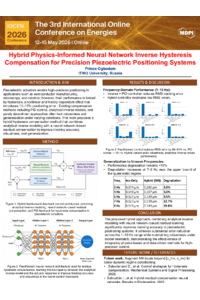
Piezoelectric actuators are critical components in precision energy systems, enabling applications ranging from renewable energy inspection robotics to vibration energy harvesting. However, inherent hysteresis nonlinearity degrades positioning accuracy by 10–15% of the full stroke, limiting energy conversion efficiency and operational precision. Standard proportional-integral-derivative (PID) control fails to adequately compensate for this history-dependent behavior. This work presents a hybrid physics-informed neural network (PINN) control strategy that combines analytical inverse hysteresis modeling with data-driven residual learning to achieve superior accuracy and robustness compared to purely analytical or data-driven approaches.
Methods
The system models a PI P-088.741 piezoelectric stack integrated into a flexure-guided stage, characterized by a second-order transfer function (natural frequency 3.45 kHz) and Bouc–Wen hysteresis. The control architecture comprises three cascaded components: (1) an analytical Bouc–Wen inverse model computing the baseline voltage; (2) a physics-informed residual neural network (RRN) predicting a voltage correction term; and (3) a PID feedback controller with anti-windup. The RRN implementation utilizes a compact feedforward architecture (two hidden layers, 64 neurons each, ReLU activation) trained to minimize mean-squared error on the residual voltage. Crucially, the network is physics-informed through its input features, which include reference displacement, tracking error, and physics-derived inverse voltage terms, ensuring the network learns context-aware corrections grounded in physical system states rather than black-box mapping.
Results
Validation was conducted via high-fidelity simulation under both nominal and parameter mismatch conditions. Performance metrics included RMS tracking error, transient response specifications, and frequency robustness. Against a baseline PID controller, the hybrid (inverse and PID) configuration achieved an 88–91% reduction in RMS tracking error across 1–10 Hz sinusoidal tests. The hybrid PINN variant maintained robustness under parameter mismatch, with performance degradation remaining below 10% for unseen frequencies (2–6 Hz), though slight degradation occurred at higher unseen frequencies (7–9 Hz). Transient validation using a 10 µm step command demonstrated settling times of approximately 6 ms (well within the 0.5 s specification) and negligible overshoot (<0.02%). The results confirm that the residual learning approach effectively compensates for model uncertainties without sacrificing stability.
Conclusions
This research demonstrates the feasibility of hybrid physics-informed residual learning for precision piezoelectric positioning in energy systems. By leveraging an analytical physics-based inverse as the primary compensator and a neural network for residual correction, the proposed method balances interpretability with adaptive accuracy. The validated controller enables high-precision operation under hysteresis-limited conditions, suitable for smart energy inspection and harvesting applications. Future work will focus on hardware implementation and expanding robustness validation to broader frequency ranges and amplitude variations.
Keywords
piezoelectric actuators
hysteresis compensation
physics-informed neural networks
energy conversion
precision positioning
hybrid control
inverse modeling
Poster
IOCEN_Poster_Ogbodum.pdf
IuditAR: A Pilot Study on Overcoming Indonesia’s Household Energy Waste via AI-driven Game-As-Reality (GAR) Audits
AI-Driven Multi-Modal Integration for Structural Health Monitoring of Photovoltaic Systems: A Nigerian Context