Event submissions
Published
This submission belongs to the session S5. Advanced Energy Materials of the event The 3rd International Online Conference on Energies
Published date
07 May, 2026
Academic Editor
'%3e%3cpath%20d='M12.6657%2010.9104C12.4185%2010.325%2012.0599%209.79327%2011.6097%209.34482C11.1609%208.89508%2010.6293%208.5365%2010.0442%208.28888C10.0389%208.28626%2010.0337%208.28495%2010.0285%208.28233C10.8446%207.69279%2011.3752%206.73249%2011.3752%205.64904C11.3752%203.8542%209.92103%202.39999%208.1262%202.39999C6.33136%202.39999%204.87715%203.8542%204.87715%205.64904C4.87715%206.73249%205.40774%207.69279%206.22393%208.28364C6.21869%208.28626%206.21345%208.28757%206.20821%208.29019C5.62129%208.5378%205.09463%208.89284%204.64265%209.34613C4.1929%209.79493%203.83432%2010.3266%203.58671%2010.9117C3.34345%2011.4845%203.21226%2012.0987%203.20023%2012.7209C3.19988%2012.7349%203.20233%2012.7488%203.20744%2012.7619C3.21255%2012.7749%203.22022%2012.7867%203.22998%2012.7968C3.23975%2012.8068%203.25142%2012.8147%203.26431%2012.8202C3.2772%2012.8256%203.29105%2012.8284%203.30504%2012.8284H4.09109C4.14874%2012.8284%204.19459%2012.7825%204.1959%2012.7262C4.2221%2011.7148%204.62823%2010.7676%205.34617%2010.0497C6.08899%209.30683%207.0755%208.89808%208.1262%208.89808C9.17689%208.89808%2010.1634%209.30683%2010.9062%2010.0497C11.6242%2010.7676%2012.0303%2011.7148%2012.0565%2012.7262C12.0578%2012.7838%2012.1037%2012.8284%2012.1613%2012.8284H12.9474C12.9613%2012.8284%2012.9752%2012.8256%2012.9881%2012.8202C13.001%2012.8147%2013.0126%2012.8068%2013.0224%2012.7968C13.0322%2012.7867%2013.0398%2012.7749%2013.0449%2012.7619C13.0501%2012.7488%2013.0525%2012.7349%2013.0522%2012.7209C13.0391%2012.0947%2012.9094%2011.4855%2012.6657%2010.9104ZM8.1262%207.9024C7.52486%207.9024%206.9589%207.6679%206.53312%207.24211C6.10733%206.81633%205.87283%206.25037%205.87283%205.64904C5.87283%205.0477%206.10733%204.48174%206.53312%204.05596C6.9589%203.63018%207.52486%203.39567%208.1262%203.39567C8.72753%203.39567%209.29349%203.63018%209.71927%204.05596C10.1451%204.48174%2010.3796%205.0477%2010.3796%205.64904C10.3796%206.25037%2010.1451%206.81633%209.71927%207.24211C9.29349%207.6679%208.72753%207.9024%208.1262%207.9024Z'%20fill='%235D1EE1'/%3e%3c/g%3e%3c/svg%3e) Elisa Sani
Elisa SaniCitation
Karen Ailed Neri-Espinoza, José Alberto Andraca-Adame, Diana Palma-Ramírez, Francisco Gutiérrez-Galicia, Acela López-Benítez, Ramón Peña-Sierra, Memcapacitive Devices Based on ZnO and Mg Thin Films: Toward Adaptive Energy Interfaces, in Proceedings of The 3rd International Online Conference on Energies, 12 May–15 May 2026, MDPI: Basel, Switzerland
Share
Email
Facebook
Twitter
LinkedIn
Memcapacitive Devices Based on ZnO and Mg Thin Films: Toward Adaptive Energy Interfaces
'%3e%3cpath%20d='M12.6647%2010.9104C12.4176%2010.325%2012.0589%209.7933%2011.6088%209.34485C11.16%208.89511%2010.6283%208.53653%2010.0432%208.28891C10.038%208.28629%2010.0327%208.28498%2010.0275%208.28236C10.8437%207.69282%2011.3743%206.73252%2011.3743%205.64907C11.3743%203.85423%209.92005%202.40002%208.12522%202.40002C6.33038%202.40002%204.87618%203.85423%204.87618%205.64907C4.87618%206.73252%205.40677%207.69282%206.22296%208.28367C6.21772%208.28629%206.21248%208.2876%206.20724%208.29022C5.62031%208.53783%205.09365%208.89287%204.64167%209.34616C4.19192%209.79496%203.83334%2010.3266%203.58573%2010.9117C3.34247%2011.4846%203.21128%2012.0987%203.19925%2012.721C3.1989%2012.735%203.20135%2012.7489%203.20646%2012.7619C3.21157%2012.7749%203.21924%2012.7868%203.22901%2012.7968C3.23877%2012.8068%203.25045%2012.8148%203.26334%2012.8202C3.27623%2012.8256%203.29007%2012.8284%203.30406%2012.8284H4.09012C4.14776%2012.8284%204.19362%2012.7825%204.19493%2012.7262C4.22113%2011.7148%204.62726%2010.7676%205.34519%2010.0497C6.08802%209.30686%207.07452%208.89811%208.12522%208.89811C9.17592%208.89811%2010.1624%209.30686%2010.9052%2010.0497C11.6232%2010.7676%2012.0293%2011.7148%2012.0555%2012.7262C12.0568%2012.7839%2012.1027%2012.8284%2012.1603%2012.8284H12.9464C12.9604%2012.8284%2012.9742%2012.8256%2012.9871%2012.8202C13%2012.8148%2013.0117%2012.8068%2013.0214%2012.7968C13.0312%2012.7868%2013.0389%2012.7749%2013.044%2012.7619C13.0491%2012.7489%2013.0515%2012.735%2013.0512%2012.721C13.0381%2012.0947%2012.9084%2011.4856%2012.6647%2010.9104ZM8.12522%207.90243C7.52388%207.90243%206.95792%207.66793%206.53214%207.24215C6.10636%206.81636%205.87185%206.2504%205.87185%205.64907C5.87185%205.04773%206.10636%204.48177%206.53214%204.05599C6.95792%203.63021%207.52388%203.3957%208.12522%203.3957C8.72655%203.3957%209.29252%203.63021%209.7183%204.05599C10.1441%204.48177%2010.3786%205.04773%2010.3786%205.64907C10.3786%206.2504%2010.1441%206.81636%209.7183%207.24215C9.29252%207.66793%208.72655%207.90243%208.12522%207.90243Z'%20fill='%235D1EE1'/%3e%3c/g%3e%3c/svg%3e)
Karen Ailed Neri-Espinoza 1
José Alberto Andraca-Adame 1
Diana Palma-Ramírez 2
Francisco Gutiérrez-Galicia 3
Acela López-Benítez 2
Ramón Peña-Sierra 4
1. Department of Nanomaterials, Unidad Profesional Interdisciplinaria de Ingeniería Campus Hidalgo (UPIIH), Instituto Politécnico Nacional (IPN), Hidalgo 42162, Mexico
2. Department of Polymers and Nanomaterials, Unidad Profesional Interdisciplinaria de Ingeniería Campus Hidalgo (UPIIH), Instituto Politécnico Nacional (IPN), Hidalgo 42162, Mexico
3. Escuela Superior de Ingeniería y Arquitectura (ESIA), Instituto Politécnico Nacional (IPN), CDMX 07320, Mexico
4. Department of Electrical Engineering, Sección de Electrónica de Estado Sólido (SEES), Center for Research and Advanced Studies of the National Polytechnic Institute (CINVESTAV-IPN), Mexico City 07360, Mexico
Abstract
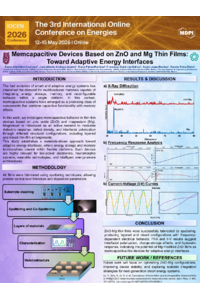
The fast evolution of smart and adaptive energy systems has intensified the demand for multifunctional materials capable of integrating energy storage, memory, and reconfigurable behavior within a single platform. Conventional capacitive devices, while effective for energy storage, lack the ability to retain information about their previous electrical states. In this context, memcapacitive systems have emerged as a promising class of components that combine capacitive functionality with memory effects, enabling adaptive and history-dependent responses.
In this work, we investigate memcapacitive behavior in thin-film devices based on zinc oxide (ZnO) and magnesium (Mg) [1] deposited on flexible polymer substrates. The use of polymeric substrates enables mechanical flexibility and lightweight architectures, while ZnO offers a wide bandgap, high dielectric stability, and defect-mediated charge transport properties. Magnesium is introduced as an active material to modulate dielectric response, defect density, and interfacial polarization through different structural configurations, including layered and mixed thin-film arrangements. All films were fabricated using sputtering techniques, allowing precise control over thickness and deposition parameters.
Electrical characterization was performed using current–voltage (I–V) measurements and frequency response analysis (FRA) over a broad frequency range. The devices exhibited nonlinear charge–voltage relationships, frequency-dependent capacitance, and hysteresis loops that cannot be described by conventional linear capacitors. These features are consistent with memcapacitive behavior, where the instantaneous capacitance depends on the history of the applied electrical stimulus. The incorporation of Mg was found to significantly influence the electrical response, suggesting tunability of memory retention and switching characteristics through material design.
Complementary structural and morphological analyses, including techniques such as X-ray diffraction (XRD), are employed to correlate electrical behavior with crystalline structure, film uniformity, and defect-related mechanisms. The observed memcapacitive effects are attributed to interfacial charge trapping, defect migration, and polarization processes within the ZnO–Mg thin-film system.
This study establishes a material-driven approach toward adaptive energy interfaces, where energy storage and memory functionalities coexist within flexible platforms. Such devices are highly relevant for low-power electronics, neuromorphic systems, wearable technologies, and intelligent energy-aware architectures. Future work will focus on optimizing ZnO–Mg configurations, improving device stability, and exploring scalable integration strategies for next-generation smart energy systems.
[1] Lv, Y., Guo, X., Li, X. et al. Coexistence of memristive and memcapacitive characteristics in Pt/MgO/ZnO metal-insulator-semiconductor heterostructure device. Appl. Phys. A 131, 251 (2025). https://doi.org/10.1007/s00339-025-08368-3
Keywords
Memcapacitor
Adaptive
ZnO
Mg
Poster
Poster.pdf
TiSiO4 as a Catalytic Dopant for Lowering the Decomposition Temperature and Improve Kinetics of AlH3 for Solid-State Hydrogen Storage
Enhanced Energy-Relevant and Multifunctional Properties of β-SiC/Polypropylene Nanocomposites for Advanced Energy Materials