Event submissions
Published
This submission belongs to the session S5. Advanced Energy Materials of the event The 3rd International Online Conference on Energies
Published date
07 May, 2026
Academic Editor
'%3e%3cpath%20d='M12.6657%2010.9104C12.4185%2010.325%2012.0599%209.79327%2011.6097%209.34482C11.1609%208.89508%2010.6293%208.5365%2010.0442%208.28888C10.0389%208.28626%2010.0337%208.28495%2010.0285%208.28233C10.8446%207.69279%2011.3752%206.73249%2011.3752%205.64904C11.3752%203.8542%209.92103%202.39999%208.1262%202.39999C6.33136%202.39999%204.87715%203.8542%204.87715%205.64904C4.87715%206.73249%205.40774%207.69279%206.22393%208.28364C6.21869%208.28626%206.21345%208.28757%206.20821%208.29019C5.62129%208.5378%205.09463%208.89284%204.64265%209.34613C4.1929%209.79493%203.83432%2010.3266%203.58671%2010.9117C3.34345%2011.4845%203.21226%2012.0987%203.20023%2012.7209C3.19988%2012.7349%203.20233%2012.7488%203.20744%2012.7619C3.21255%2012.7749%203.22022%2012.7867%203.22998%2012.7968C3.23975%2012.8068%203.25142%2012.8147%203.26431%2012.8202C3.2772%2012.8256%203.29105%2012.8284%203.30504%2012.8284H4.09109C4.14874%2012.8284%204.19459%2012.7825%204.1959%2012.7262C4.2221%2011.7148%204.62823%2010.7676%205.34617%2010.0497C6.08899%209.30683%207.0755%208.89808%208.1262%208.89808C9.17689%208.89808%2010.1634%209.30683%2010.9062%2010.0497C11.6242%2010.7676%2012.0303%2011.7148%2012.0565%2012.7262C12.0578%2012.7838%2012.1037%2012.8284%2012.1613%2012.8284H12.9474C12.9613%2012.8284%2012.9752%2012.8256%2012.9881%2012.8202C13.001%2012.8147%2013.0126%2012.8068%2013.0224%2012.7968C13.0322%2012.7867%2013.0398%2012.7749%2013.0449%2012.7619C13.0501%2012.7488%2013.0525%2012.7349%2013.0522%2012.7209C13.0391%2012.0947%2012.9094%2011.4855%2012.6657%2010.9104ZM8.1262%207.9024C7.52486%207.9024%206.9589%207.6679%206.53312%207.24211C6.10733%206.81633%205.87283%206.25037%205.87283%205.64904C5.87283%205.0477%206.10733%204.48174%206.53312%204.05596C6.9589%203.63018%207.52486%203.39567%208.1262%203.39567C8.72753%203.39567%209.29349%203.63018%209.71927%204.05596C10.1451%204.48174%2010.3796%205.0477%2010.3796%205.64904C10.3796%206.25037%2010.1451%206.81633%209.71927%207.24211C9.29349%207.6679%208.72753%207.9024%208.1262%207.9024Z'%20fill='%235D1EE1'/%3e%3c/g%3e%3c/svg%3e) Elisa Sani
Elisa SaniCitation
Priyam Srivastava, Rani Rohini, Beate Krause, High-Performance Thermoelectric MXene/SWCNT Composites, in Proceedings of The 3rd International Online Conference on Energies, 12 May–15 May 2026, MDPI: Basel, Switzerland
Share
Email
Facebook
Twitter
LinkedIn
High-Performance Thermoelectric MXene/SWCNT Composites
'%3e%3cpath%20d='M12.6647%2010.9104C12.4176%2010.325%2012.0589%209.7933%2011.6088%209.34485C11.16%208.89511%2010.6283%208.53653%2010.0432%208.28891C10.038%208.28629%2010.0327%208.28498%2010.0275%208.28236C10.8437%207.69282%2011.3743%206.73252%2011.3743%205.64907C11.3743%203.85423%209.92005%202.40002%208.12522%202.40002C6.33038%202.40002%204.87618%203.85423%204.87618%205.64907C4.87618%206.73252%205.40677%207.69282%206.22296%208.28367C6.21772%208.28629%206.21248%208.2876%206.20724%208.29022C5.62031%208.53783%205.09365%208.89287%204.64167%209.34616C4.19192%209.79496%203.83334%2010.3266%203.58573%2010.9117C3.34247%2011.4846%203.21128%2012.0987%203.19925%2012.721C3.1989%2012.735%203.20135%2012.7489%203.20646%2012.7619C3.21157%2012.7749%203.21924%2012.7868%203.22901%2012.7968C3.23877%2012.8068%203.25045%2012.8148%203.26334%2012.8202C3.27623%2012.8256%203.29007%2012.8284%203.30406%2012.8284H4.09012C4.14776%2012.8284%204.19362%2012.7825%204.19493%2012.7262C4.22113%2011.7148%204.62726%2010.7676%205.34519%2010.0497C6.08802%209.30686%207.07452%208.89811%208.12522%208.89811C9.17592%208.89811%2010.1624%209.30686%2010.9052%2010.0497C11.6232%2010.7676%2012.0293%2011.7148%2012.0555%2012.7262C12.0568%2012.7839%2012.1027%2012.8284%2012.1603%2012.8284H12.9464C12.9604%2012.8284%2012.9742%2012.8256%2012.9871%2012.8202C13%2012.8148%2013.0117%2012.8068%2013.0214%2012.7968C13.0312%2012.7868%2013.0389%2012.7749%2013.044%2012.7619C13.0491%2012.7489%2013.0515%2012.735%2013.0512%2012.721C13.0381%2012.0947%2012.9084%2011.4856%2012.6647%2010.9104ZM8.12522%207.90243C7.52388%207.90243%206.95792%207.66793%206.53214%207.24215C6.10636%206.81636%205.87185%206.2504%205.87185%205.64907C5.87185%205.04773%206.10636%204.48177%206.53214%204.05599C6.95792%203.63021%207.52388%203.3957%208.12522%203.3957C8.72655%203.3957%209.29252%203.63021%209.7183%204.05599C10.1441%204.48177%2010.3786%205.04773%2010.3786%205.64907C10.3786%206.2504%2010.1441%206.81636%209.7183%207.24215C9.29252%207.66793%208.72655%207.90243%208.12522%207.90243Z'%20fill='%235D1EE1'/%3e%3c/g%3e%3c/svg%3e)
Priyam Srivastava 1
Rani Rohini 1

Beate Krause 2
1. Department of Materials Engineering, Indian Institute of Technology, Jammu, India
2. Dept. Sustainable Polymer Structures, Leibniz-Institut für Polymerforschung Dresden e. V. | Leibniz Institute of Polymer Research Dresden, Germany
Abstract
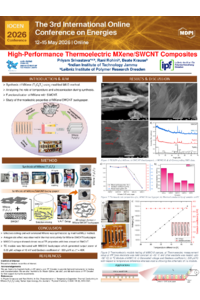
Polymer-based thermoelectric materials offer several advantages compared to conventional metal oxides (like bismuth telluride (Bi₂Te₃), lead telluride (PbTe), silicon germanium (SiGe), and bismuth antimony telluride (BiSbTe) alloys), including enhanced availability, cost efficiency, ease of processing, mechanical flexibility, low density, and reduced thermal conductivity. The incorporation of these materials into flexible and wearable electronics is a straightforward process that gives rise to the possibility of energy harvesting from body heat or other low-grade heat sources. If SWCNTs are combined with other materials, interfaces can scatter phonons and reduce heat conductivity, which would be better for thermoelectric applications. The integration of SWCNT and MXene can provide more phonon scattering, which causes reduced thermal conductivity; however, it also depends on the thickness of the material. Additionally, the various surface termination groups provide more options for modifying MXene, leading to combinations that possess the necessary capabilities. The inherent two-dimensional layered structure makes it possible to regulate properties practically and to assemble several layers. Due to these qualities, there are exciting prospects to adjust the electrical and thermal properties of MXene, which has promise in the field of thermoelectrics.
Herein, a thermoelectric device was fabricated using the bucky paper by combining single-walled carbon nanotubes (SWCNTs) and 2D MXene (Ti3C2Tx) sheets. This combination of materials helped to achieve a significantly lower heat conductivity by introducing phonon scattering into the system while simultaneously improving electrical conductivity. We accomplished this by creating a hollow three-dimensional structure that serves as a thermal insulator and by using energy filtering at the MXene/SWCNT interfaces to increase the Seebeck coefficient. The M90C10 bucky paper, composed of 90 wt.% MXene and 10 wt.% SWCNT, achieved a Seebeck coefficient of 50.45 μV/K and a power factor of 3.82 μW/(m⋅K2). A prototype thermoelectric device was fabricated with the same composition, having a Seebeck coefficient of 320.77 μV/K and a maximum output power of 0.053 μW to confirm its promise for high-performance and scalable thermoelectric applications.
Keywords
Thermoelectric device
SWCNT
MXene (Ti3C2Tx)
thermoelectric applications.
Poster
MDPI conference poster.pdf
Space-Charge Effects in Lithium Garnet Solid Electrolytes: A Continuum Modeling Study Using the Poisson–Nernst–Planck Framework
Additive Manufacturing Of Energy Materials With Composite Structure