Event submissions
Published
This submission belongs to the session S5. Advanced Energy Materials of the event The 3rd International Online Conference on Energies
Published date
07 May, 2026
Academic Editor
'%3e%3cpath%20d='M12.6657%2010.9104C12.4185%2010.325%2012.0599%209.79327%2011.6097%209.34482C11.1609%208.89508%2010.6293%208.5365%2010.0442%208.28888C10.0389%208.28626%2010.0337%208.28495%2010.0285%208.28233C10.8446%207.69279%2011.3752%206.73249%2011.3752%205.64904C11.3752%203.8542%209.92103%202.39999%208.1262%202.39999C6.33136%202.39999%204.87715%203.8542%204.87715%205.64904C4.87715%206.73249%205.40774%207.69279%206.22393%208.28364C6.21869%208.28626%206.21345%208.28757%206.20821%208.29019C5.62129%208.5378%205.09463%208.89284%204.64265%209.34613C4.1929%209.79493%203.83432%2010.3266%203.58671%2010.9117C3.34345%2011.4845%203.21226%2012.0987%203.20023%2012.7209C3.19988%2012.7349%203.20233%2012.7488%203.20744%2012.7619C3.21255%2012.7749%203.22022%2012.7867%203.22998%2012.7968C3.23975%2012.8068%203.25142%2012.8147%203.26431%2012.8202C3.2772%2012.8256%203.29105%2012.8284%203.30504%2012.8284H4.09109C4.14874%2012.8284%204.19459%2012.7825%204.1959%2012.7262C4.2221%2011.7148%204.62823%2010.7676%205.34617%2010.0497C6.08899%209.30683%207.0755%208.89808%208.1262%208.89808C9.17689%208.89808%2010.1634%209.30683%2010.9062%2010.0497C11.6242%2010.7676%2012.0303%2011.7148%2012.0565%2012.7262C12.0578%2012.7838%2012.1037%2012.8284%2012.1613%2012.8284H12.9474C12.9613%2012.8284%2012.9752%2012.8256%2012.9881%2012.8202C13.001%2012.8147%2013.0126%2012.8068%2013.0224%2012.7968C13.0322%2012.7867%2013.0398%2012.7749%2013.0449%2012.7619C13.0501%2012.7488%2013.0525%2012.7349%2013.0522%2012.7209C13.0391%2012.0947%2012.9094%2011.4855%2012.6657%2010.9104ZM8.1262%207.9024C7.52486%207.9024%206.9589%207.6679%206.53312%207.24211C6.10733%206.81633%205.87283%206.25037%205.87283%205.64904C5.87283%205.0477%206.10733%204.48174%206.53312%204.05596C6.9589%203.63018%207.52486%203.39567%208.1262%203.39567C8.72753%203.39567%209.29349%203.63018%209.71927%204.05596C10.1451%204.48174%2010.3796%205.0477%2010.3796%205.64904C10.3796%206.25037%2010.1451%206.81633%209.71927%207.24211C9.29349%207.6679%208.72753%207.9024%208.1262%207.9024Z'%20fill='%235D1EE1'/%3e%3c/g%3e%3c/svg%3e) Elisa Sani
Elisa SaniCitation
Huma Amber, Karina Vjūnova, Dijana Šimkūnaitė, Zenius Mockus, Aleksandrs Volperts, Ance Plavniece, Galina Dobele, Aivars Zhurinsh, Loreta Tamasauskaite-Tamasiunaite, Eugenijus Norkus, Bimetallic Transition Metal-Supported Biomass-Derived Carbon Catalyst for Efficient Hydrazine Oxidation, in Proceedings of The 3rd International Online Conference on Energies, 12 May–15 May 2026, MDPI: Basel, Switzerland
Share
Email
Facebook
Twitter
LinkedIn
Bimetallic Transition Metal-Supported Biomass-Derived Carbon Catalyst for Efficient Hydrazine Oxidation
'%3e%3cpath%20d='M12.6647%2010.9104C12.4176%2010.325%2012.0589%209.7933%2011.6088%209.34485C11.16%208.89511%2010.6283%208.53653%2010.0432%208.28891C10.038%208.28629%2010.0327%208.28498%2010.0275%208.28236C10.8437%207.69282%2011.3743%206.73252%2011.3743%205.64907C11.3743%203.85423%209.92005%202.40002%208.12522%202.40002C6.33038%202.40002%204.87618%203.85423%204.87618%205.64907C4.87618%206.73252%205.40677%207.69282%206.22296%208.28367C6.21772%208.28629%206.21248%208.2876%206.20724%208.29022C5.62031%208.53783%205.09365%208.89287%204.64167%209.34616C4.19192%209.79496%203.83334%2010.3266%203.58573%2010.9117C3.34247%2011.4846%203.21128%2012.0987%203.19925%2012.721C3.1989%2012.735%203.20135%2012.7489%203.20646%2012.7619C3.21157%2012.7749%203.21924%2012.7868%203.22901%2012.7968C3.23877%2012.8068%203.25045%2012.8148%203.26334%2012.8202C3.27623%2012.8256%203.29007%2012.8284%203.30406%2012.8284H4.09012C4.14776%2012.8284%204.19362%2012.7825%204.19493%2012.7262C4.22113%2011.7148%204.62726%2010.7676%205.34519%2010.0497C6.08802%209.30686%207.07452%208.89811%208.12522%208.89811C9.17592%208.89811%2010.1624%209.30686%2010.9052%2010.0497C11.6232%2010.7676%2012.0293%2011.7148%2012.0555%2012.7262C12.0568%2012.7839%2012.1027%2012.8284%2012.1603%2012.8284H12.9464C12.9604%2012.8284%2012.9742%2012.8256%2012.9871%2012.8202C13%2012.8148%2013.0117%2012.8068%2013.0214%2012.7968C13.0312%2012.7868%2013.0389%2012.7749%2013.044%2012.7619C13.0491%2012.7489%2013.0515%2012.735%2013.0512%2012.721C13.0381%2012.0947%2012.9084%2011.4856%2012.6647%2010.9104ZM8.12522%207.90243C7.52388%207.90243%206.95792%207.66793%206.53214%207.24215C6.10636%206.81636%205.87185%206.2504%205.87185%205.64907C5.87185%205.04773%206.10636%204.48177%206.53214%204.05599C6.95792%203.63021%207.52388%203.3957%208.12522%203.3957C8.72655%203.3957%209.29252%203.63021%209.7183%204.05599C10.1441%204.48177%2010.3786%205.04773%2010.3786%205.64907C10.3786%206.2504%2010.1441%206.81636%209.7183%207.24215C9.29252%207.66793%208.72655%207.90243%208.12522%207.90243Z'%20fill='%235D1EE1'/%3e%3c/g%3e%3c/svg%3e)
Huma Amber 1
Karina Vjūnova 1
Dijana Šimkūnaitė 1
Zenius Mockus 2
Aleksandrs Volperts 3
Ance Plavniece 3
Galina Dobele 3
Aivars Zhurinsh 3

Loreta Tamasauskaite-Tamasiunaite 1
Eugenijus Norkus 1
1. Department of Catalysis, Center for Physical Sciences and Technology (FTMC), Vilnius 10257, Lithuania
2. Department of Chemical Engineering and Technology, Center for Physical Sciences and Technology (FTMC), Vilnius 10257, Lithuania
3. Latvian State Institute of Wood Chemistry, Dzerbenes Str. 27, LV-1006 Riga, Latvia
Abstract
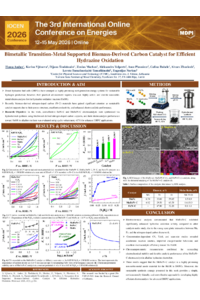
Direct hydrazine fuel cells (DHFCs) have attracted significant interest as a promising method for sustainable hydrogen production, as they can overcome the slow oxygen evolution rate that limits conventional water splitting. The practical deployment of DHFCs is strongly dependent on the availability of cost-effective and efficient anode electrocatalysts for the hydrazine oxidation reaction (HzOR). The current study proposes a straightforward, scalable, and ecologically sustainable approach to the synthesis of non-noble metal electrocatalysts derived from sustainable biomass resources. The synthesis of nitrogen-doped carbon (N–C) was achieved through a hydrothermal carbonisation (HTC) process, utilising birchwood chips. This was followed by activation and nitrogen incorporation, yielding a porous, conductive carbon framework. Subsequently, iron (Fe) and manganese–iron (MnFe) were introduced as active components. The morphology, structure, and elemental composition of the MnFe, MnFe/N–C, and Fe/N–C catalysts were characterised by scanning electron microscopy (SEM), X-ray diffraction (XRD), and energy-dispersive X-ray spectroscopy (EDS). The catalytic activity of the catalysts for HzOR was evaluated in an alkaline medium by performing cyclic voltammetry (CV).
Electrochemical investigations have demonstrated that the MnFe/N–C catalyst demonstrates a significantly enhanced HzOR activity, exhibiting a lower onset potential and a substantially higher current density in comparison with both Fe/N–C and MnFe counterparts. The enhanced electrocatalytic performance of MnFe/N–C is attributable to a combination of factors, including the presence of numerous exposed active sites, the optimised mass transport within the porous nitrogen-doped carbon matrix, and the robust synergistic interactions between Mn, Fe, and N–C. The results of this study identify MnFe/N–C as a highly promising anode material for DHFCs. This work offers a viable, cost-effective, and sustainable approach to the design of efficient electrocatalysts that do not utilise noble metals. It provides significant insights into the development of next-generation hydrazine-based energy conversion and hydrogen production technologies.
Acknowledgment
This research was funded by a grant (No. P-ST-23-310) from the Research Council of Lithuania.
Keywords
manganese
iron
nitrogen-doped carbon
hydrothermal carbonization
hydrothermal synthesis
hydrazine oxidation
Poster
Poster.pdf
Numerical Evaluation of Monolithic Aerogel as a Transparent Insulation Layer for Building-Integrated Natural Convection Solar Air Collectors
Interfacial Engineering and Upscaling Strategy for Aluminum Foil Substrates Flexible Perovskite Solar Cells