Event submissions
Published
This submission belongs to the session S2. Condition Monitoring and Fault Diagnosis of the event The 3rd International Electronic Conference on Machines and Applications
Published date
07 May, 2026
Academic Editor
'%3e%3cpath%20d='M12.6657%2010.9104C12.4185%2010.325%2012.0599%209.79327%2011.6097%209.34482C11.1609%208.89508%2010.6293%208.5365%2010.0442%208.28888C10.0389%208.28626%2010.0337%208.28495%2010.0285%208.28233C10.8446%207.69279%2011.3752%206.73249%2011.3752%205.64904C11.3752%203.8542%209.92103%202.39999%208.1262%202.39999C6.33136%202.39999%204.87715%203.8542%204.87715%205.64904C4.87715%206.73249%205.40774%207.69279%206.22393%208.28364C6.21869%208.28626%206.21345%208.28757%206.20821%208.29019C5.62129%208.5378%205.09463%208.89284%204.64265%209.34613C4.1929%209.79493%203.83432%2010.3266%203.58671%2010.9117C3.34345%2011.4845%203.21226%2012.0987%203.20023%2012.7209C3.19988%2012.7349%203.20233%2012.7488%203.20744%2012.7619C3.21255%2012.7749%203.22022%2012.7867%203.22998%2012.7968C3.23975%2012.8068%203.25142%2012.8147%203.26431%2012.8202C3.2772%2012.8256%203.29105%2012.8284%203.30504%2012.8284H4.09109C4.14874%2012.8284%204.19459%2012.7825%204.1959%2012.7262C4.2221%2011.7148%204.62823%2010.7676%205.34617%2010.0497C6.08899%209.30683%207.0755%208.89808%208.1262%208.89808C9.17689%208.89808%2010.1634%209.30683%2010.9062%2010.0497C11.6242%2010.7676%2012.0303%2011.7148%2012.0565%2012.7262C12.0578%2012.7838%2012.1037%2012.8284%2012.1613%2012.8284H12.9474C12.9613%2012.8284%2012.9752%2012.8256%2012.9881%2012.8202C13.001%2012.8147%2013.0126%2012.8068%2013.0224%2012.7968C13.0322%2012.7867%2013.0398%2012.7749%2013.0449%2012.7619C13.0501%2012.7488%2013.0525%2012.7349%2013.0522%2012.7209C13.0391%2012.0947%2012.9094%2011.4855%2012.6657%2010.9104ZM8.1262%207.9024C7.52486%207.9024%206.9589%207.6679%206.53312%207.24211C6.10733%206.81633%205.87283%206.25037%205.87283%205.64904C5.87283%205.0477%206.10733%204.48174%206.53312%204.05596C6.9589%203.63018%207.52486%203.39567%208.1262%203.39567C8.72753%203.39567%209.29349%203.63018%209.71927%204.05596C10.1451%204.48174%2010.3796%205.0477%2010.3796%205.64904C10.3796%206.25037%2010.1451%206.81633%209.71927%207.24211C9.29349%207.6679%208.72753%207.9024%208.1262%207.9024Z'%20fill='%235D1EE1'/%3e%3c/g%3e%3c/svg%3e) Stefano Mariani
Stefano MarianiCitation
Mohamed Mazloum Salem, Neuro-Adaptive Machines: An Edge-Intelligent Framework for Real-Time Condition Monitoring and Self-Optimizing Control, in Proceedings of The 3rd International Electronic Conference on Machines and Applications, 12 May–14 May 2026, MDPI: Basel, Switzerland
Share
Email
Facebook
Twitter
LinkedIn
Neuro-Adaptive Machines: An Edge-Intelligent Framework for Real-Time Condition Monitoring and Self-Optimizing Control

Mohamed Mazloum Salem 1
1. Department of Computer Science, Faculty of Computers and Information, Mansoura University, Mansoura 35516, Egypt
Abstract
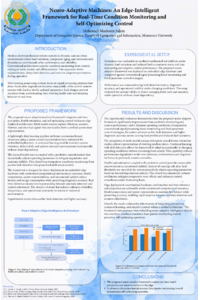
Modern electromechanical systems increasingly operate in dynamic, uncertain environments where conventional control and monitoring pipelines are insufficient for ensuring reliability, efficiency, and autonomy. Most existing approaches treat condition monitoring and control as isolated processes and rely heavily on static models and offline analysis. This paper introduces a unified neuro-adaptive machine framework designed to endow machines with real-time perception, health awareness, and self-optimizing control capabilities directly at the edge.
The proposed architecture integrates multi-modal sensor fusion (vibration, acoustic, thermal, and electrical signals) with a lightweight deep learning pipeline deployed on embedded hardware. A sparse neural representation layer performs continuous feature extraction, while a continual learning module tracks machine state evolution and detects emerging fault patterns. These learned health states are coupled with a predictive control module that dynamically adjusts operating parameters to mitigate degradation. Drift-aware training and incremental updating enable the system to adapt autonomously to changing operating conditions without cloud dependency.
Experimental evaluation on an electromechanical test platform demonstrates that the framework achieves earlier fault detection, higher diagnostic accuracy, and faster adaptation to unseen anomalies compared to traditional signal-processing-based monitoring and fixed-parameter control strategies. The system also exhibits improved operational stability and measurable gains in energy efficiency through health-aware control adjustments.
The results validate the feasibility of embedding neuro-adaptive intelligence directly into machines to move from passive monitoring toward proactive, self-optimizing operation. The proposed framework offers a scalable pathway toward cognitive electromechanical systems, contributing to advances in automation, condition monitoring, and intelligent machine design.
Keywords
Condition monitoring
fault diagnosis
edge intelligence
neuro-adaptive systems
electromechanical systems
sensor fusion
predictive maintenance
intelligent control
embedded machine learning
automation
Poster
Neuro-Adaptive-post.pdf
Design of a robotic hand gripper for pick-and-place operations
The Role of Society in Waste Supply Chain Simulation