Event submissions
Published
This submission belongs to the session S2. Condition Monitoring and Fault Diagnosis of the event The 3rd International Electronic Conference on Machines and Applications
Published date
07 May, 2026
Academic Editor
'%3e%3cpath%20d='M12.6657%2010.9104C12.4185%2010.325%2012.0599%209.79327%2011.6097%209.34482C11.1609%208.89508%2010.6293%208.5365%2010.0442%208.28888C10.0389%208.28626%2010.0337%208.28495%2010.0285%208.28233C10.8446%207.69279%2011.3752%206.73249%2011.3752%205.64904C11.3752%203.8542%209.92103%202.39999%208.1262%202.39999C6.33136%202.39999%204.87715%203.8542%204.87715%205.64904C4.87715%206.73249%205.40774%207.69279%206.22393%208.28364C6.21869%208.28626%206.21345%208.28757%206.20821%208.29019C5.62129%208.5378%205.09463%208.89284%204.64265%209.34613C4.1929%209.79493%203.83432%2010.3266%203.58671%2010.9117C3.34345%2011.4845%203.21226%2012.0987%203.20023%2012.7209C3.19988%2012.7349%203.20233%2012.7488%203.20744%2012.7619C3.21255%2012.7749%203.22022%2012.7867%203.22998%2012.7968C3.23975%2012.8068%203.25142%2012.8147%203.26431%2012.8202C3.2772%2012.8256%203.29105%2012.8284%203.30504%2012.8284H4.09109C4.14874%2012.8284%204.19459%2012.7825%204.1959%2012.7262C4.2221%2011.7148%204.62823%2010.7676%205.34617%2010.0497C6.08899%209.30683%207.0755%208.89808%208.1262%208.89808C9.17689%208.89808%2010.1634%209.30683%2010.9062%2010.0497C11.6242%2010.7676%2012.0303%2011.7148%2012.0565%2012.7262C12.0578%2012.7838%2012.1037%2012.8284%2012.1613%2012.8284H12.9474C12.9613%2012.8284%2012.9752%2012.8256%2012.9881%2012.8202C13.001%2012.8147%2013.0126%2012.8068%2013.0224%2012.7968C13.0322%2012.7867%2013.0398%2012.7749%2013.0449%2012.7619C13.0501%2012.7488%2013.0525%2012.7349%2013.0522%2012.7209C13.0391%2012.0947%2012.9094%2011.4855%2012.6657%2010.9104ZM8.1262%207.9024C7.52486%207.9024%206.9589%207.6679%206.53312%207.24211C6.10733%206.81633%205.87283%206.25037%205.87283%205.64904C5.87283%205.0477%206.10733%204.48174%206.53312%204.05596C6.9589%203.63018%207.52486%203.39567%208.1262%203.39567C8.72753%203.39567%209.29349%203.63018%209.71927%204.05596C10.1451%204.48174%2010.3796%205.0477%2010.3796%205.64904C10.3796%206.25037%2010.1451%206.81633%209.71927%207.24211C9.29349%207.6679%208.72753%207.9024%208.1262%207.9024Z'%20fill='%235D1EE1'/%3e%3c/g%3e%3c/svg%3e) Stefano Mariani
Stefano MarianiCitation
Oliwia Frankiewicz, The Influence of Operating Conditions and Measurement Duration on the Quality of Bearing Fault Information in Motor Fault Diagnostic Applications, in Proceedings of The 3rd International Electronic Conference on Machines and Applications, 12 May–14 May 2026, MDPI: Basel, Switzerland
Share
Email
Facebook
Twitter
LinkedIn
The Influence of Operating Conditions and Measurement Duration on the Quality of Bearing Fault Information in Motor Fault Diagnostic Applications

Oliwia Frankiewicz 1
1. Department of Electrical Machines, Drives, and Measurements, Faculty of Electrical Engineering, Wrocław University of Science and Technology, Wroclaw, 50-370, Poland
Abstract
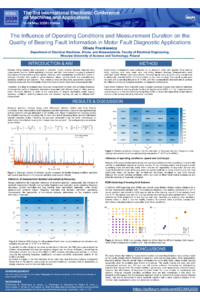
Electric motor diagnostic systems dedicated to rolling bearing fault detection impose specific signal processing requirements to ensure high effectiveness in technical condition assessment. In the case of mechanical faults, the most critical requirements include relatively long measurement durations, stable operating conditions, and high measurement accuracy. However, such conditions are difficult to achieve in real industrial drive systems, where transient states and variable operating conditions are common. Consequently, there is an increasing demand for fast and reliable fault detection methods based on the shortest possible data records.
This study investigates the influence of the data acquisition system and operating conditions on the quality of fault-related information in the rolling bearing diagnostics of induction motors. The primary objective is to determine the minimum measurement duration that enables reliable fault detection while preserving essential diagnostic features.
Experimental investigations were conducted for various types and severities of rolling bearing damage under both steady-state and transient operating conditions. To enable fully automated classification, a shallow neural network was employed. Specifically, a classifier based on Kohonen Self-Organizing Maps (SOMs) was used, with input features extracted from measurement signals using envelope spectrum analysis and selected statistical indicators.
The results demonstrate that the quality of fault-related information strongly depends on both the measurement duration and the operating conditions of the motor. Reducing the data vector length significantly degrades diagnostic performance, particularly under dynamic operating conditions. The obtained results highlight the importance of appropriate measurement duration selection in the design of fast and practically applicable diagnostic systems for induction motor bearing fault detection.
Keywords
induction motor
rolling bearing faults
fault diagnostics
self-organizing maps
Poster
IECMA Poster OF.pdf
Current-Based Induction Motor Eccentricity Classification with a Compact CNN Trained on Residual-Augmented Simulation Data
Multi-Objective Optimization of Methanol–Diesel RCCI Combustion for Sustainable Engine Performance