Event submissions
Published
This submission belongs to the session S1. Automation and Control Systems of the event The 3rd International Electronic Conference on Machines and Applications
Published date
07 May, 2026
Academic Editor
'%3e%3cpath%20d='M12.6657%2010.9104C12.4185%2010.325%2012.0599%209.79327%2011.6097%209.34482C11.1609%208.89508%2010.6293%208.5365%2010.0442%208.28888C10.0389%208.28626%2010.0337%208.28495%2010.0285%208.28233C10.8446%207.69279%2011.3752%206.73249%2011.3752%205.64904C11.3752%203.8542%209.92103%202.39999%208.1262%202.39999C6.33136%202.39999%204.87715%203.8542%204.87715%205.64904C4.87715%206.73249%205.40774%207.69279%206.22393%208.28364C6.21869%208.28626%206.21345%208.28757%206.20821%208.29019C5.62129%208.5378%205.09463%208.89284%204.64265%209.34613C4.1929%209.79493%203.83432%2010.3266%203.58671%2010.9117C3.34345%2011.4845%203.21226%2012.0987%203.20023%2012.7209C3.19988%2012.7349%203.20233%2012.7488%203.20744%2012.7619C3.21255%2012.7749%203.22022%2012.7867%203.22998%2012.7968C3.23975%2012.8068%203.25142%2012.8147%203.26431%2012.8202C3.2772%2012.8256%203.29105%2012.8284%203.30504%2012.8284H4.09109C4.14874%2012.8284%204.19459%2012.7825%204.1959%2012.7262C4.2221%2011.7148%204.62823%2010.7676%205.34617%2010.0497C6.08899%209.30683%207.0755%208.89808%208.1262%208.89808C9.17689%208.89808%2010.1634%209.30683%2010.9062%2010.0497C11.6242%2010.7676%2012.0303%2011.7148%2012.0565%2012.7262C12.0578%2012.7838%2012.1037%2012.8284%2012.1613%2012.8284H12.9474C12.9613%2012.8284%2012.9752%2012.8256%2012.9881%2012.8202C13.001%2012.8147%2013.0126%2012.8068%2013.0224%2012.7968C13.0322%2012.7867%2013.0398%2012.7749%2013.0449%2012.7619C13.0501%2012.7488%2013.0525%2012.7349%2013.0522%2012.7209C13.0391%2012.0947%2012.9094%2011.4855%2012.6657%2010.9104ZM8.1262%207.9024C7.52486%207.9024%206.9589%207.6679%206.53312%207.24211C6.10733%206.81633%205.87283%206.25037%205.87283%205.64904C5.87283%205.0477%206.10733%204.48174%206.53312%204.05596C6.9589%203.63018%207.52486%203.39567%208.1262%203.39567C8.72753%203.39567%209.29349%203.63018%209.71927%204.05596C10.1451%204.48174%2010.3796%205.0477%2010.3796%205.64904C10.3796%206.25037%2010.1451%206.81633%209.71927%207.24211C9.29349%207.6679%208.72753%207.9024%208.1262%207.9024Z'%20fill='%235D1EE1'/%3e%3c/g%3e%3c/svg%3e) James Lam
James LamCitation
Ana R. C. R. Vieira, César M. A. Vasques, Adélio M. S. Cavadas, Automated Dimensional and Geometric Inspection of Metal Plates Using a Collaborative SCARA Robot: A Preliminary Proof-of-Concept Study, in Proceedings of The 3rd International Electronic Conference on Machines and Applications, 12 May–14 May 2026, MDPI: Basel, Switzerland
Share
Email
Facebook
Twitter
LinkedIn
Automated Dimensional and Geometric Inspection of Metal Plates Using a Collaborative SCARA Robot: A Preliminary Proof-of-Concept Study
'%3e%3cpath%20d='M12.6647%2010.9104C12.4176%2010.325%2012.0589%209.7933%2011.6088%209.34485C11.16%208.89511%2010.6283%208.53653%2010.0432%208.28891C10.038%208.28629%2010.0327%208.28498%2010.0275%208.28236C10.8437%207.69282%2011.3743%206.73252%2011.3743%205.64907C11.3743%203.85423%209.92005%202.40002%208.12522%202.40002C6.33038%202.40002%204.87618%203.85423%204.87618%205.64907C4.87618%206.73252%205.40677%207.69282%206.22296%208.28367C6.21772%208.28629%206.21248%208.2876%206.20724%208.29022C5.62031%208.53783%205.09365%208.89287%204.64167%209.34616C4.19192%209.79496%203.83334%2010.3266%203.58573%2010.9117C3.34247%2011.4846%203.21128%2012.0987%203.19925%2012.721C3.1989%2012.735%203.20135%2012.7489%203.20646%2012.7619C3.21157%2012.7749%203.21924%2012.7868%203.22901%2012.7968C3.23877%2012.8068%203.25045%2012.8148%203.26334%2012.8202C3.27623%2012.8256%203.29007%2012.8284%203.30406%2012.8284H4.09012C4.14776%2012.8284%204.19362%2012.7825%204.19493%2012.7262C4.22113%2011.7148%204.62726%2010.7676%205.34519%2010.0497C6.08802%209.30686%207.07452%208.89811%208.12522%208.89811C9.17592%208.89811%2010.1624%209.30686%2010.9052%2010.0497C11.6232%2010.7676%2012.0293%2011.7148%2012.0555%2012.7262C12.0568%2012.7839%2012.1027%2012.8284%2012.1603%2012.8284H12.9464C12.9604%2012.8284%2012.9742%2012.8256%2012.9871%2012.8202C13%2012.8148%2013.0117%2012.8068%2013.0214%2012.7968C13.0312%2012.7868%2013.0389%2012.7749%2013.044%2012.7619C13.0491%2012.7489%2013.0515%2012.735%2013.0512%2012.721C13.0381%2012.0947%2012.9084%2011.4856%2012.6647%2010.9104ZM8.12522%207.90243C7.52388%207.90243%206.95792%207.66793%206.53214%207.24215C6.10636%206.81636%205.87185%206.2504%205.87185%205.64907C5.87185%205.04773%206.10636%204.48177%206.53214%204.05599C6.95792%203.63021%207.52388%203.3957%208.12522%203.3957C8.72655%203.3957%209.29252%203.63021%209.7183%204.05599C10.1441%204.48177%2010.3786%205.04773%2010.3786%205.64907C10.3786%206.2504%2010.1441%206.81636%209.7183%207.24215C9.29252%207.66793%208.72655%207.90243%208.12522%207.90243Z'%20fill='%235D1EE1'/%3e%3c/g%3e%3c/svg%3e)
Ana R. C. R. Vieira 1,2

César M. A. Vasques 1,2
Adélio M. S. Cavadas 1
1. proMetheus, Higher School of Technology and Management, Polytechnic Institute of Viana do Castelo (IPVC), Rua Escola Industrial e Comercial de Nun’Álvares, 4900-347, Viana do Castelo, Portugal.
2. Centre for Mechanical Technology and Automation (TEMA), Department of Mechanical Engineering, University of Aveiro, Campus Universitário de Santiago, 3810-193, Aveiro, Portugal.
Abstract
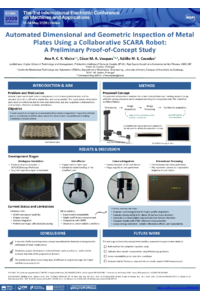
Industrial manufacturing increasingly requires reliable and repeatable dimensional and geometric inspection of small metal components, while minimizing inspection time, operational cost, and operator dependency. Conventional manual inspection based on mechanical fixtures remains widely used but is limited by operator variability, reduced flexibility, and poor scalability in high-mix production environments. This work presents a preliminary proof-of-concept for an automated dimensional and geometric inspection system based on a collaborative SCARA robot, whose primary role is to ensure repeatable positioning, handling, and automation of the inspection process. At this stage, the industrial problem is intentionally simplified to a representative squared tubular metal plate, preserving key length and width requirements while postponing full three-dimensional profile verification to later development phases. This incremental strategy reduces technical risk while enabling early validation of referencing, repeatability, and automated cycle execution. Rather than committing to a single measurement technology, the proposed system architecture remains measurement-agnostic, allowing the integration of different inspection approaches, such as vision-based methods, dedicated mechanical gauges, contact or non-contact sensors, and instrumented fixtures. In this context, the robot enables the automated manipulation and placement of parts into predefined inspection setups, replacing manual handling while preserving measurement reliability. A structured analysis of functional and operational requirements is used to justify this flexible architecture and to highlight its potential economic and operational benefits. Virtual validation is carried out using MATLAB-based simulation tools, namely Simulink 3D Animation and Simscape Multibody, to assess system layout, robot motion, accessibility, and cycle execution prior to physical integration. The results demonstrate the feasibility of the proposed concept and support a phased roadmap towards more advanced geometric inspection capabilities in subsequent development stages.
Keywords
automated metrology
dimensional and geometric inspection
collaborative robotics
SCARA robot
industrial verification systems
MATLAB-based simulation.
Poster
poster_sciforum_166118.pdf
A Decision Framework to Select Robotics Simulators for Automation and Control Tasks: Criteria and Validation
Experimental and Analytical Investigation of Infill Pattern and Build Orientation Effects on the Flexural Strength of FFF-Printed PLA Components