Event submissions
Published
This submission belongs to the session S3. Machines Design and Additive Manufacturing of the event The 3rd International Electronic Conference on Machines and Applications
Published date
07 May, 2026
Academic Editor
'%3e%3cpath%20d='M12.6657%2010.9104C12.4185%2010.325%2012.0599%209.79327%2011.6097%209.34482C11.1609%208.89508%2010.6293%208.5365%2010.0442%208.28888C10.0389%208.28626%2010.0337%208.28495%2010.0285%208.28233C10.8446%207.69279%2011.3752%206.73249%2011.3752%205.64904C11.3752%203.8542%209.92103%202.39999%208.1262%202.39999C6.33136%202.39999%204.87715%203.8542%204.87715%205.64904C4.87715%206.73249%205.40774%207.69279%206.22393%208.28364C6.21869%208.28626%206.21345%208.28757%206.20821%208.29019C5.62129%208.5378%205.09463%208.89284%204.64265%209.34613C4.1929%209.79493%203.83432%2010.3266%203.58671%2010.9117C3.34345%2011.4845%203.21226%2012.0987%203.20023%2012.7209C3.19988%2012.7349%203.20233%2012.7488%203.20744%2012.7619C3.21255%2012.7749%203.22022%2012.7867%203.22998%2012.7968C3.23975%2012.8068%203.25142%2012.8147%203.26431%2012.8202C3.2772%2012.8256%203.29105%2012.8284%203.30504%2012.8284H4.09109C4.14874%2012.8284%204.19459%2012.7825%204.1959%2012.7262C4.2221%2011.7148%204.62823%2010.7676%205.34617%2010.0497C6.08899%209.30683%207.0755%208.89808%208.1262%208.89808C9.17689%208.89808%2010.1634%209.30683%2010.9062%2010.0497C11.6242%2010.7676%2012.0303%2011.7148%2012.0565%2012.7262C12.0578%2012.7838%2012.1037%2012.8284%2012.1613%2012.8284H12.9474C12.9613%2012.8284%2012.9752%2012.8256%2012.9881%2012.8202C13.001%2012.8147%2013.0126%2012.8068%2013.0224%2012.7968C13.0322%2012.7867%2013.0398%2012.7749%2013.0449%2012.7619C13.0501%2012.7488%2013.0525%2012.7349%2013.0522%2012.7209C13.0391%2012.0947%2012.9094%2011.4855%2012.6657%2010.9104ZM8.1262%207.9024C7.52486%207.9024%206.9589%207.6679%206.53312%207.24211C6.10733%206.81633%205.87283%206.25037%205.87283%205.64904C5.87283%205.0477%206.10733%204.48174%206.53312%204.05596C6.9589%203.63018%207.52486%203.39567%208.1262%203.39567C8.72753%203.39567%209.29349%203.63018%209.71927%204.05596C10.1451%204.48174%2010.3796%205.0477%2010.3796%205.64904C10.3796%206.25037%2010.1451%206.81633%209.71927%207.24211C9.29349%207.6679%208.72753%207.9024%208.1262%207.9024Z'%20fill='%235D1EE1'/%3e%3c/g%3e%3c/svg%3e) Kai Cheng
Kai ChengCitation
Helal Uddin, Md. Nur Alam Mondal, MECHANICAL CAD DESIGN FOR NEXT-GENERATION AEROSPACE STRUCTURAL SYSTEMS USING ADVANCED MATERIAL ADDITIVE MANUFACTURING TECHNOLOGY, in Proceedings of The 3rd International Electronic Conference on Machines and Applications, 12 May–14 May 2026, MDPI: Basel, Switzerland
Share
Email
Facebook
Twitter
LinkedIn
MECHANICAL CAD DESIGN FOR NEXT-GENERATION AEROSPACE STRUCTURAL SYSTEMS USING ADVANCED MATERIAL ADDITIVE MANUFACTURING TECHNOLOGY

Helal Uddin 1
'%3e%3cpath%20d='M12.6647%2010.9104C12.4176%2010.325%2012.0589%209.7933%2011.6088%209.34485C11.16%208.89511%2010.6283%208.53653%2010.0432%208.28891C10.038%208.28629%2010.0327%208.28498%2010.0275%208.28236C10.8437%207.69282%2011.3743%206.73252%2011.3743%205.64907C11.3743%203.85423%209.92005%202.40002%208.12522%202.40002C6.33038%202.40002%204.87618%203.85423%204.87618%205.64907C4.87618%206.73252%205.40677%207.69282%206.22296%208.28367C6.21772%208.28629%206.21248%208.2876%206.20724%208.29022C5.62031%208.53783%205.09365%208.89287%204.64167%209.34616C4.19192%209.79496%203.83334%2010.3266%203.58573%2010.9117C3.34247%2011.4846%203.21128%2012.0987%203.19925%2012.721C3.1989%2012.735%203.20135%2012.7489%203.20646%2012.7619C3.21157%2012.7749%203.21924%2012.7868%203.22901%2012.7968C3.23877%2012.8068%203.25045%2012.8148%203.26334%2012.8202C3.27623%2012.8256%203.29007%2012.8284%203.30406%2012.8284H4.09012C4.14776%2012.8284%204.19362%2012.7825%204.19493%2012.7262C4.22113%2011.7148%204.62726%2010.7676%205.34519%2010.0497C6.08802%209.30686%207.07452%208.89811%208.12522%208.89811C9.17592%208.89811%2010.1624%209.30686%2010.9052%2010.0497C11.6232%2010.7676%2012.0293%2011.7148%2012.0555%2012.7262C12.0568%2012.7839%2012.1027%2012.8284%2012.1603%2012.8284H12.9464C12.9604%2012.8284%2012.9742%2012.8256%2012.9871%2012.8202C13%2012.8148%2013.0117%2012.8068%2013.0214%2012.7968C13.0312%2012.7868%2013.0389%2012.7749%2013.044%2012.7619C13.0491%2012.7489%2013.0515%2012.735%2013.0512%2012.721C13.0381%2012.0947%2012.9084%2011.4856%2012.6647%2010.9104ZM8.12522%207.90243C7.52388%207.90243%206.95792%207.66793%206.53214%207.24215C6.10636%206.81636%205.87185%206.2504%205.87185%205.64907C5.87185%205.04773%206.10636%204.48177%206.53214%204.05599C6.95792%203.63021%207.52388%203.3957%208.12522%203.3957C8.72655%203.3957%209.29252%203.63021%209.7183%204.05599C10.1441%204.48177%2010.3786%205.04773%2010.3786%205.64907C10.3786%206.2504%2010.1441%206.81636%209.7183%207.24215C9.29252%207.66793%208.72655%207.90243%208.12522%207.90243Z'%20fill='%235D1EE1'/%3e%3c/g%3e%3c/svg%3e)
Md. Nur Alam Mondal 1
1. Department of Mechanical Engineering,
Hajee Mohammad Danesh Science and Technology University, Dinajpur-5200, Bangladesh.
Abstract
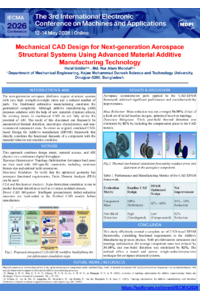
Next-generation aerospace platforms require structural systems with exceptional strength-to-weight ratios and reduced part counts. Unlike the capabilities of traditional subtractive techniques, AM provides us with the geometrical complexity and material structure that we require to achieve these objectives. Current mechanical CAD practices are ill-equipped to fully exploit AM's potential. The main drawbacks, including thermal distortion or anisotropic behavior, are not a concern when working with innovative new materials, like titanium alloys or high-performance materials. As a result, the components are ultimatelytoo expensive and do not meet the requirements. This research aims to create a new combined CAD-based Design for Additive Manufacturing (DFAM) that directly links a component's functional requirements with the material behavior and machine settings so that we can create advanced aerospace structural systems. Topology optimization, as an initial step in the workflow, takes aerospace load cases as input, and then we make AM constraints, such as minimum feature size and optimal build orientation. We then run FEA and thermal–mechanical AM analyses to optimize the geometry, reduce residual stresses, and conduct distortion forecasting prior to fabrication. Ultimately, when the DFAM framework is used, the average mass of our demo parts decrease by 34-38 percent compared to the initial designs. On top of this, we incorporated these do-it-right mitigation defect-reduction tricks directly into the CAD models, which cut the distortion in the post-build step by 82%. The suggested CAD-DfAM approach combines the design, material behavior, and aerospace physics of the AM process, providing us with a sound and proven method of creating lighter, more accurate, and higher-quality aerospace structural systems.
Keywords
Additive Manufacturing (AM)
Aerospace Structural Systems
Design for Additive Manufacturing (DFAM)
Topology Optimization
Advanced Materials
Mechanical CAD
Poster
Poster_sciforum-159054.pdf
Comparative Assessment of Drive Power Demand in Vibratory Technological Equipment Equipped with Planetary, Differential, Double Crank–Slider, and Cam-Type Vibration Exciters
Fan-Type Inducer for a Centrifugal Pump with Multi-Material Blades Made of Stellite 6 and SST 316L Additively Fabricated using Wire Arc Additive Manufacturing