Event submissions
Published
This submission belongs to the session S3. Machines Design and Additive Manufacturing of the event The 3rd International Electronic Conference on Machines and Applications
Published date
07 May, 2026
Academic Editor
'%3e%3cpath%20d='M12.6657%2010.9104C12.4185%2010.325%2012.0599%209.79327%2011.6097%209.34482C11.1609%208.89508%2010.6293%208.5365%2010.0442%208.28888C10.0389%208.28626%2010.0337%208.28495%2010.0285%208.28233C10.8446%207.69279%2011.3752%206.73249%2011.3752%205.64904C11.3752%203.8542%209.92103%202.39999%208.1262%202.39999C6.33136%202.39999%204.87715%203.8542%204.87715%205.64904C4.87715%206.73249%205.40774%207.69279%206.22393%208.28364C6.21869%208.28626%206.21345%208.28757%206.20821%208.29019C5.62129%208.5378%205.09463%208.89284%204.64265%209.34613C4.1929%209.79493%203.83432%2010.3266%203.58671%2010.9117C3.34345%2011.4845%203.21226%2012.0987%203.20023%2012.7209C3.19988%2012.7349%203.20233%2012.7488%203.20744%2012.7619C3.21255%2012.7749%203.22022%2012.7867%203.22998%2012.7968C3.23975%2012.8068%203.25142%2012.8147%203.26431%2012.8202C3.2772%2012.8256%203.29105%2012.8284%203.30504%2012.8284H4.09109C4.14874%2012.8284%204.19459%2012.7825%204.1959%2012.7262C4.2221%2011.7148%204.62823%2010.7676%205.34617%2010.0497C6.08899%209.30683%207.0755%208.89808%208.1262%208.89808C9.17689%208.89808%2010.1634%209.30683%2010.9062%2010.0497C11.6242%2010.7676%2012.0303%2011.7148%2012.0565%2012.7262C12.0578%2012.7838%2012.1037%2012.8284%2012.1613%2012.8284H12.9474C12.9613%2012.8284%2012.9752%2012.8256%2012.9881%2012.8202C13.001%2012.8147%2013.0126%2012.8068%2013.0224%2012.7968C13.0322%2012.7867%2013.0398%2012.7749%2013.0449%2012.7619C13.0501%2012.7488%2013.0525%2012.7349%2013.0522%2012.7209C13.0391%2012.0947%2012.9094%2011.4855%2012.6657%2010.9104ZM8.1262%207.9024C7.52486%207.9024%206.9589%207.6679%206.53312%207.24211C6.10733%206.81633%205.87283%206.25037%205.87283%205.64904C5.87283%205.0477%206.10733%204.48174%206.53312%204.05596C6.9589%203.63018%207.52486%203.39567%208.1262%203.39567C8.72753%203.39567%209.29349%203.63018%209.71927%204.05596C10.1451%204.48174%2010.3796%205.0477%2010.3796%205.64904C10.3796%206.25037%2010.1451%206.81633%209.71927%207.24211C9.29349%207.6679%208.72753%207.9024%208.1262%207.9024Z'%20fill='%235D1EE1'/%3e%3c/g%3e%3c/svg%3e) Kai Cheng
Kai ChengCitation
Isiaka Shuaibu, Musefiu Aderinola, Yau Alhaji Samaila, Ademola Samuel Lawal, Stator Coreless Winding Performance Metrics for Electrical Machines: Implications from Previous Studies, in Proceedings of The 3rd International Electronic Conference on Machines and Applications, 12 May–14 May 2026, MDPI: Basel, Switzerland
Share
Email
Facebook
Twitter
LinkedIn
Stator Coreless Winding Performance Metrics for Electrical Machines: Implications from Previous Studies
'%3e%3cpath%20d='M12.6647%2010.9104C12.4176%2010.325%2012.0589%209.7933%2011.6088%209.34485C11.16%208.89511%2010.6283%208.53653%2010.0432%208.28891C10.038%208.28629%2010.0327%208.28498%2010.0275%208.28236C10.8437%207.69282%2011.3743%206.73252%2011.3743%205.64907C11.3743%203.85423%209.92005%202.40002%208.12522%202.40002C6.33038%202.40002%204.87618%203.85423%204.87618%205.64907C4.87618%206.73252%205.40677%207.69282%206.22296%208.28367C6.21772%208.28629%206.21248%208.2876%206.20724%208.29022C5.62031%208.53783%205.09365%208.89287%204.64167%209.34616C4.19192%209.79496%203.83334%2010.3266%203.58573%2010.9117C3.34247%2011.4846%203.21128%2012.0987%203.19925%2012.721C3.1989%2012.735%203.20135%2012.7489%203.20646%2012.7619C3.21157%2012.7749%203.21924%2012.7868%203.22901%2012.7968C3.23877%2012.8068%203.25045%2012.8148%203.26334%2012.8202C3.27623%2012.8256%203.29007%2012.8284%203.30406%2012.8284H4.09012C4.14776%2012.8284%204.19362%2012.7825%204.19493%2012.7262C4.22113%2011.7148%204.62726%2010.7676%205.34519%2010.0497C6.08802%209.30686%207.07452%208.89811%208.12522%208.89811C9.17592%208.89811%2010.1624%209.30686%2010.9052%2010.0497C11.6232%2010.7676%2012.0293%2011.7148%2012.0555%2012.7262C12.0568%2012.7839%2012.1027%2012.8284%2012.1603%2012.8284H12.9464C12.9604%2012.8284%2012.9742%2012.8256%2012.9871%2012.8202C13%2012.8148%2013.0117%2012.8068%2013.0214%2012.7968C13.0312%2012.7868%2013.0389%2012.7749%2013.044%2012.7619C13.0491%2012.7489%2013.0515%2012.735%2013.0512%2012.721C13.0381%2012.0947%2012.9084%2011.4856%2012.6647%2010.9104ZM8.12522%207.90243C7.52388%207.90243%206.95792%207.66793%206.53214%207.24215C6.10636%206.81636%205.87185%206.2504%205.87185%205.64907C5.87185%205.04773%206.10636%204.48177%206.53214%204.05599C6.95792%203.63021%207.52388%203.3957%208.12522%203.3957C8.72655%203.3957%209.29252%203.63021%209.7183%204.05599C10.1441%204.48177%2010.3786%205.04773%2010.3786%205.64907C10.3786%206.2504%2010.1441%206.81636%209.7183%207.24215C9.29252%207.66793%208.72655%207.90243%208.12522%207.90243Z'%20fill='%235D1EE1'/%3e%3c/g%3e%3c/svg%3e)
Isiaka Shuaibu 1
Musefiu Aderinola 2
Yau Alhaji Samaila 3
Ademola Samuel Lawal 4
1. Department of Electrical/Electronics Engineering, Universiti Teknologi PETRONAS, Bota Seri Iskandar 32600, Perak, Malaysia
2. Department of Electrical/Electronics Engineering, Hussaini Adamu Federal Polytechnic Kazaure 724101, Nigeria
3. Department of Electrical/Electronics Engineering, University of Maiduguri, Maiduguri 600230, Nigeria
4. Department of Mechatronics Engineering, Bayero University Kano, Kano 700241, Nigeria
Abstract
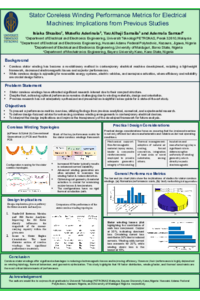
Coreless winding designs for stators have gained more interest in the field of electrical machine engineering because of their ability to deliver high-efficiency results, lower electromagnetic losses, and enhanced torque density. Coreless windings successfully reduce iron losses, cogging torque, and magnetic saturation effects by removing the ferromagnetic stator core, making them ideal for applications with low to high speeds and low torque ripple. This resaerch offers a detailed overview of performance metrics related to stator coreless windings, deriving insights from earlier documented analytical, numerical, and experimental research. The key performance indicators analyzed consist of electromagnetic torque capability, winding factor, harmonic distortion, copper loss, thermal behavior, power density, and overall efficiency. The impact of winding topology like toroidal, concentrated or non-concentrated, planar or flat, and printed and flexible PCB-based windings on these performance metrics is examined in depth. Moreover, practical issues concerning mechanical structural support, thermal control, insulation needs, and production tolerances are examined. Comparisons among various machine topologies and operational conditions are emphasized to uncover the inherent trade-offs between efficiency, torque density, and thermal performance. This study offers design-focused insights and highlights essential factors for enhancing stator-less machines by integrating current research results. The findings of this review aim to aid informed design choices for new applications, such as hydro or wind energy systems, electric vehicles, and aerospace propulsion and actuation systems.
Keywords
Application
Stator coreless
Winding configuration
Performance metric
Implication
Poster
Poster_presentation _Stator coreless review.pdf
Deep Learning-Based Detection of Shield Presence in Industrial Laser-Marking Applications
A Low-Cost Arduino Validation of a Nonlinear Control Technique for a Standalone Photovoltaic System