Event submissions
Published
This submission belongs to the session S4. Electrical Machines and Drives of the event The 3rd International Electronic Conference on Machines and Applications
Published date
07 May, 2026
Academic Editor
'%3e%3cpath%20d='M12.6657%2010.9104C12.4185%2010.325%2012.0599%209.79327%2011.6097%209.34482C11.1609%208.89508%2010.6293%208.5365%2010.0442%208.28888C10.0389%208.28626%2010.0337%208.28495%2010.0285%208.28233C10.8446%207.69279%2011.3752%206.73249%2011.3752%205.64904C11.3752%203.8542%209.92103%202.39999%208.1262%202.39999C6.33136%202.39999%204.87715%203.8542%204.87715%205.64904C4.87715%206.73249%205.40774%207.69279%206.22393%208.28364C6.21869%208.28626%206.21345%208.28757%206.20821%208.29019C5.62129%208.5378%205.09463%208.89284%204.64265%209.34613C4.1929%209.79493%203.83432%2010.3266%203.58671%2010.9117C3.34345%2011.4845%203.21226%2012.0987%203.20023%2012.7209C3.19988%2012.7349%203.20233%2012.7488%203.20744%2012.7619C3.21255%2012.7749%203.22022%2012.7867%203.22998%2012.7968C3.23975%2012.8068%203.25142%2012.8147%203.26431%2012.8202C3.2772%2012.8256%203.29105%2012.8284%203.30504%2012.8284H4.09109C4.14874%2012.8284%204.19459%2012.7825%204.1959%2012.7262C4.2221%2011.7148%204.62823%2010.7676%205.34617%2010.0497C6.08899%209.30683%207.0755%208.89808%208.1262%208.89808C9.17689%208.89808%2010.1634%209.30683%2010.9062%2010.0497C11.6242%2010.7676%2012.0303%2011.7148%2012.0565%2012.7262C12.0578%2012.7838%2012.1037%2012.8284%2012.1613%2012.8284H12.9474C12.9613%2012.8284%2012.9752%2012.8256%2012.9881%2012.8202C13.001%2012.8147%2013.0126%2012.8068%2013.0224%2012.7968C13.0322%2012.7867%2013.0398%2012.7749%2013.0449%2012.7619C13.0501%2012.7488%2013.0525%2012.7349%2013.0522%2012.7209C13.0391%2012.0947%2012.9094%2011.4855%2012.6657%2010.9104ZM8.1262%207.9024C7.52486%207.9024%206.9589%207.6679%206.53312%207.24211C6.10733%206.81633%205.87283%206.25037%205.87283%205.64904C5.87283%205.0477%206.10733%204.48174%206.53312%204.05596C6.9589%203.63018%207.52486%203.39567%208.1262%203.39567C8.72753%203.39567%209.29349%203.63018%209.71927%204.05596C10.1451%204.48174%2010.3796%205.0477%2010.3796%205.64904C10.3796%206.25037%2010.1451%206.81633%209.71927%207.24211C9.29349%207.6679%208.72753%207.9024%208.1262%207.9024Z'%20fill='%235D1EE1'/%3e%3c/g%3e%3c/svg%3e) Giacomo Scelba
Giacomo ScelbaCitation
Dário de Jesus Rodrigues António, João Serra, Hugo Antunes, Antonio J. Marques Cardoso, Enhanced SVPWM Strategy for Harmonic Suppression in Asymmetrical Six-Phase Induction Machines, in Proceedings of The 3rd International Electronic Conference on Machines and Applications, 12 May–14 May 2026, MDPI: Basel, Switzerland
Share
Email
Facebook
Twitter
LinkedIn
Enhanced SVPWM Strategy for Harmonic Suppression in Asymmetrical Six-Phase Induction Machines
'%3e%3cpath%20d='M12.6647%2010.9104C12.4176%2010.325%2012.0589%209.7933%2011.6088%209.34485C11.16%208.89511%2010.6283%208.53653%2010.0432%208.28891C10.038%208.28629%2010.0327%208.28498%2010.0275%208.28236C10.8437%207.69282%2011.3743%206.73252%2011.3743%205.64907C11.3743%203.85423%209.92005%202.40002%208.12522%202.40002C6.33038%202.40002%204.87618%203.85423%204.87618%205.64907C4.87618%206.73252%205.40677%207.69282%206.22296%208.28367C6.21772%208.28629%206.21248%208.2876%206.20724%208.29022C5.62031%208.53783%205.09365%208.89287%204.64167%209.34616C4.19192%209.79496%203.83334%2010.3266%203.58573%2010.9117C3.34247%2011.4846%203.21128%2012.0987%203.19925%2012.721C3.1989%2012.735%203.20135%2012.7489%203.20646%2012.7619C3.21157%2012.7749%203.21924%2012.7868%203.22901%2012.7968C3.23877%2012.8068%203.25045%2012.8148%203.26334%2012.8202C3.27623%2012.8256%203.29007%2012.8284%203.30406%2012.8284H4.09012C4.14776%2012.8284%204.19362%2012.7825%204.19493%2012.7262C4.22113%2011.7148%204.62726%2010.7676%205.34519%2010.0497C6.08802%209.30686%207.07452%208.89811%208.12522%208.89811C9.17592%208.89811%2010.1624%209.30686%2010.9052%2010.0497C11.6232%2010.7676%2012.0293%2011.7148%2012.0555%2012.7262C12.0568%2012.7839%2012.1027%2012.8284%2012.1603%2012.8284H12.9464C12.9604%2012.8284%2012.9742%2012.8256%2012.9871%2012.8202C13%2012.8148%2013.0117%2012.8068%2013.0214%2012.7968C13.0312%2012.7868%2013.0389%2012.7749%2013.044%2012.7619C13.0491%2012.7489%2013.0515%2012.735%2013.0512%2012.721C13.0381%2012.0947%2012.9084%2011.4856%2012.6647%2010.9104ZM8.12522%207.90243C7.52388%207.90243%206.95792%207.66793%206.53214%207.24215C6.10636%206.81636%205.87185%206.2504%205.87185%205.64907C5.87185%205.04773%206.10636%204.48177%206.53214%204.05599C6.95792%203.63021%207.52388%203.3957%208.12522%203.3957C8.72655%203.3957%209.29252%203.63021%209.7183%204.05599C10.1441%204.48177%2010.3786%205.04773%2010.3786%205.64907C10.3786%206.2504%2010.1441%206.81636%209.7183%207.24215C9.29252%207.66793%208.72655%207.90243%208.12522%207.90243Z'%20fill='%235D1EE1'/%3e%3c/g%3e%3c/svg%3e)
Dário de Jesus Rodrigues António 1

João Serra 1

Hugo Antunes 1

Antonio J. Marques Cardoso 1
1. CISE - Electromechatronic Systems Research Centre, University of Beira Interior, Calçada Fonte do Lameiro, P - 6201-001 Covilhã, Portugal
Abstract
Introduction:
Six-phase induction machines represent an evolution of conventional three-phase systems, offering enhanced reliability, efficiency, and fault tolerance. The additional degrees of freedom introduced by the six-phase configuration result in multiple orthogonal subspaces, namely the α–β plane responsible for torque production and the x–y subspace, which does not contribute to torque and is mainly associated with copper losses and harmonic components.
Methods:
This work proposes an enhanced space vector pulse width modulation (SVPWM) strategy specifically developed for asymmetrical six-phase induction machines. The proposed approach enables accurate synthesis of the reference voltage vector in the α–β plane while ensuring zero average voltage injection in the x–y subspace for any angular position. Unlike virtual-vector-based modulation techniques reported in the literature, the proposed strategy is not restricted to specific sectors or angular regions and is applicable over the entire range of reference voltage vector magnitudes.
Results:
The effectiveness of the proposed SVPWM strategy was first assessed through simulation and subsequently validated through experimental tests. The results demonstrate a significant reduction in stator current total harmonic distortion (THD) and a noticeable decrease in torque ripple when compared with conventional SVPWM approaches.
Conclusions:
By actively suppressing voltage components in the x–y subspace while preserving the desired voltage synthesis in the α–β plane, the proposed SVPWM strategy improves current quality and torque smoothness in six-phase induction machines. These features make the approach suitable for high-performance and high-reliability multiphase drive applications.
Keywords
Six-phase induction motor
space vector pulse width modulation
voltage source inverter
Field-oriented control
scalar voltage-to-frequency (V/f)
active and zero vectors
α–β plane
x–y subspace
Total harmonic distortion
injection.
Poster
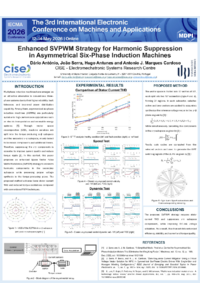
IECMA 2026_Electrical Machines and Drives_Dário António poster.pdf
A MATLAB Framework for Control and Experimental Research in Quadruped Robots
System Identification Applied to the Dynamic Modeling of a Robotic Joint with Elastic Transmission