Event submissions
Published
This submission belongs to the session S2. Urban Environments and Sustainability of the event The 1st International Online Conference on Urban Sciences
Published date
15 May, 2026
Academic Editor
'%3e%3cpath%20d='M12.6657%2010.9104C12.4185%2010.325%2012.0599%209.79327%2011.6097%209.34482C11.1609%208.89508%2010.6293%208.5365%2010.0442%208.28888C10.0389%208.28626%2010.0337%208.28495%2010.0285%208.28233C10.8446%207.69279%2011.3752%206.73249%2011.3752%205.64904C11.3752%203.8542%209.92103%202.39999%208.1262%202.39999C6.33136%202.39999%204.87715%203.8542%204.87715%205.64904C4.87715%206.73249%205.40774%207.69279%206.22393%208.28364C6.21869%208.28626%206.21345%208.28757%206.20821%208.29019C5.62129%208.5378%205.09463%208.89284%204.64265%209.34613C4.1929%209.79493%203.83432%2010.3266%203.58671%2010.9117C3.34345%2011.4845%203.21226%2012.0987%203.20023%2012.7209C3.19988%2012.7349%203.20233%2012.7488%203.20744%2012.7619C3.21255%2012.7749%203.22022%2012.7867%203.22998%2012.7968C3.23975%2012.8068%203.25142%2012.8147%203.26431%2012.8202C3.2772%2012.8256%203.29105%2012.8284%203.30504%2012.8284H4.09109C4.14874%2012.8284%204.19459%2012.7825%204.1959%2012.7262C4.2221%2011.7148%204.62823%2010.7676%205.34617%2010.0497C6.08899%209.30683%207.0755%208.89808%208.1262%208.89808C9.17689%208.89808%2010.1634%209.30683%2010.9062%2010.0497C11.6242%2010.7676%2012.0303%2011.7148%2012.0565%2012.7262C12.0578%2012.7838%2012.1037%2012.8284%2012.1613%2012.8284H12.9474C12.9613%2012.8284%2012.9752%2012.8256%2012.9881%2012.8202C13.001%2012.8147%2013.0126%2012.8068%2013.0224%2012.7968C13.0322%2012.7867%2013.0398%2012.7749%2013.0449%2012.7619C13.0501%2012.7488%2013.0525%2012.7349%2013.0522%2012.7209C13.0391%2012.0947%2012.9094%2011.4855%2012.6657%2010.9104ZM8.1262%207.9024C7.52486%207.9024%206.9589%207.6679%206.53312%207.24211C6.10733%206.81633%205.87283%206.25037%205.87283%205.64904C5.87283%205.0477%206.10733%204.48174%206.53312%204.05596C6.9589%203.63018%207.52486%203.39567%208.1262%203.39567C8.72753%203.39567%209.29349%203.63018%209.71927%204.05596C10.1451%204.48174%2010.3796%205.0477%2010.3796%205.64904C10.3796%206.25037%2010.1451%206.81633%209.71927%207.24211C9.29349%207.6679%208.72753%207.9024%208.1262%207.9024Z'%20fill='%235D1EE1'/%3e%3c/g%3e%3c/svg%3e) Eusébio Conceição
Eusébio ConceiçãoCitation
Rania Ajmi, Faiza Khebour Allouche, Aude Nuscia Taîbi, Urban Tree Heritage: Strategies for Conservation and Decision-Making in a Historic Maghreb City, in Proceedings of The 1st International Online Conference on Urban Sciences, 20 May–22 May 2026, MDPI: Basel, Switzerland
Share
Email
Facebook
Twitter
LinkedIn
Urban Tree Heritage: Strategies for Conservation and Decision-Making in a Historic Maghreb City

Rania Ajmi 1
'%3e%3cpath%20d='M12.6647%2010.9104C12.4176%2010.325%2012.0589%209.7933%2011.6088%209.34485C11.16%208.89511%2010.6283%208.53653%2010.0432%208.28891C10.038%208.28629%2010.0327%208.28498%2010.0275%208.28236C10.8437%207.69282%2011.3743%206.73252%2011.3743%205.64907C11.3743%203.85423%209.92005%202.40002%208.12522%202.40002C6.33038%202.40002%204.87618%203.85423%204.87618%205.64907C4.87618%206.73252%205.40677%207.69282%206.22296%208.28367C6.21772%208.28629%206.21248%208.2876%206.20724%208.29022C5.62031%208.53783%205.09365%208.89287%204.64167%209.34616C4.19192%209.79496%203.83334%2010.3266%203.58573%2010.9117C3.34247%2011.4846%203.21128%2012.0987%203.19925%2012.721C3.1989%2012.735%203.20135%2012.7489%203.20646%2012.7619C3.21157%2012.7749%203.21924%2012.7868%203.22901%2012.7968C3.23877%2012.8068%203.25045%2012.8148%203.26334%2012.8202C3.27623%2012.8256%203.29007%2012.8284%203.30406%2012.8284H4.09012C4.14776%2012.8284%204.19362%2012.7825%204.19493%2012.7262C4.22113%2011.7148%204.62726%2010.7676%205.34519%2010.0497C6.08802%209.30686%207.07452%208.89811%208.12522%208.89811C9.17592%208.89811%2010.1624%209.30686%2010.9052%2010.0497C11.6232%2010.7676%2012.0293%2011.7148%2012.0555%2012.7262C12.0568%2012.7839%2012.1027%2012.8284%2012.1603%2012.8284H12.9464C12.9604%2012.8284%2012.9742%2012.8256%2012.9871%2012.8202C13%2012.8148%2013.0117%2012.8068%2013.0214%2012.7968C13.0312%2012.7868%2013.0389%2012.7749%2013.044%2012.7619C13.0491%2012.7489%2013.0515%2012.735%2013.0512%2012.721C13.0381%2012.0947%2012.9084%2011.4856%2012.6647%2010.9104ZM8.12522%207.90243C7.52388%207.90243%206.95792%207.66793%206.53214%207.24215C6.10636%206.81636%205.87185%206.2504%205.87185%205.64907C5.87185%205.04773%206.10636%204.48177%206.53214%204.05599C6.95792%203.63021%207.52388%203.3957%208.12522%203.3957C8.72655%203.3957%209.29252%203.63021%209.7183%204.05599C10.1441%204.48177%2010.3786%205.04773%2010.3786%205.64907C10.3786%206.2504%2010.1441%206.81636%209.7183%207.24215C9.29252%207.66793%208.72655%207.90243%208.12522%207.90243Z'%20fill='%235D1EE1'/%3e%3c/g%3e%3c/svg%3e)
Faiza Khebour Allouche 2
Aude Nuscia Taîbi 3
1. Department of Horticulture Sciences and Landscape, High Institute of Agronomic Science of Chott Mariem (ISA-CM), Sousse University, Sousse, Tunisia
2. High Institute of Agronomic Science of Chott Mariem (Department of Engineering and Landscape Planning, Sousse University, Tunisia)
3. Espace SOciété (ESO) UMR 6590, University of Angers, Angers, 49100, France
Abstract
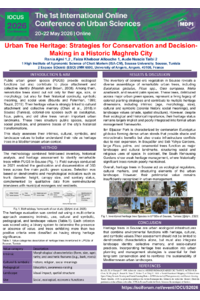
Urban vegetation plays a critical role in creating resilient and livable cities. Remarkable urban trees, particularly those from colonial periods, serve as ecological, cultural, and historical landmarks. They provide multiple benefits, including microclimate regulation, support for biodiversity, aesthetic and recreational value, and social well-being. In Tunisia, the patrimonial value of urban trees remains largely overlooked, highlighting the need for systematic assessment, conservation, and management strategies. This study focuses on colonial-era trees in Sousse, Tunisia, aiming to evaluate their patrimonial value and develop a decision-support tool for sustainable urban tree management. The study covered three districts of Sousse: Khzema, Jawhara, and Sidi Abd Elhamid. Trees were inventoried and georeferenced, and each tree was documented using an identity sheet containing location, species, vernacular name, dimensions, and site-specific constraints. Patrimonial values were assessed using a structured evaluation grid covering landscape (weighted ×2), cultural–symbolic, intrinsic, and functional values, scored from 0 to 5. Field surveys and landscape analysis were complemented by geospatial techniques to create thematic and summary maps supporting comparative assessment and planning. Trees located in organized parks and gardens exhibited significant patrimonial value, though they remain underappreciated. Trees in neglected or unplanned spaces scored lower, indicating a need for intervention and targeted conservation efforts. Visual representation of scores highlighted priorities for management and valorization. This study demonstrates that combining inventory, geospatial analysis, and structured evaluation provides an effective framework for urban tree conservation. Implementing such tools supports sustainable management, promotes ecological and social benefits, and fosters awareness of urban green heritage. Engaging local authorities and communities is essential to ensure long-term preservation and valorization of these living historical assets.
Keywords
Urban Tree Heritage
Sustainable Urban Management
Decision-Support Tool
Maghreb city
Poster
145973.pdf
Beyond Concrete: Reviving Urban Canals and Ecosystems for Climate-Resilient Futures
Green Space Dynamics in a Rapidly Urbanizing African City: A Spatial and Socio-Economic Study of Wolkite City, Ethiopia