Event submissions
Published
This submission belongs to the session S3. Urban Economies and Resource Management of the event The 1st International Online Conference on Urban Sciences
Published date
15 May, 2026
Academic Editor
'%3e%3cpath%20d='M12.6657%2010.9104C12.4185%2010.325%2012.0599%209.79327%2011.6097%209.34482C11.1609%208.89508%2010.6293%208.5365%2010.0442%208.28888C10.0389%208.28626%2010.0337%208.28495%2010.0285%208.28233C10.8446%207.69279%2011.3752%206.73249%2011.3752%205.64904C11.3752%203.8542%209.92103%202.39999%208.1262%202.39999C6.33136%202.39999%204.87715%203.8542%204.87715%205.64904C4.87715%206.73249%205.40774%207.69279%206.22393%208.28364C6.21869%208.28626%206.21345%208.28757%206.20821%208.29019C5.62129%208.5378%205.09463%208.89284%204.64265%209.34613C4.1929%209.79493%203.83432%2010.3266%203.58671%2010.9117C3.34345%2011.4845%203.21226%2012.0987%203.20023%2012.7209C3.19988%2012.7349%203.20233%2012.7488%203.20744%2012.7619C3.21255%2012.7749%203.22022%2012.7867%203.22998%2012.7968C3.23975%2012.8068%203.25142%2012.8147%203.26431%2012.8202C3.2772%2012.8256%203.29105%2012.8284%203.30504%2012.8284H4.09109C4.14874%2012.8284%204.19459%2012.7825%204.1959%2012.7262C4.2221%2011.7148%204.62823%2010.7676%205.34617%2010.0497C6.08899%209.30683%207.0755%208.89808%208.1262%208.89808C9.17689%208.89808%2010.1634%209.30683%2010.9062%2010.0497C11.6242%2010.7676%2012.0303%2011.7148%2012.0565%2012.7262C12.0578%2012.7838%2012.1037%2012.8284%2012.1613%2012.8284H12.9474C12.9613%2012.8284%2012.9752%2012.8256%2012.9881%2012.8202C13.001%2012.8147%2013.0126%2012.8068%2013.0224%2012.7968C13.0322%2012.7867%2013.0398%2012.7749%2013.0449%2012.7619C13.0501%2012.7488%2013.0525%2012.7349%2013.0522%2012.7209C13.0391%2012.0947%2012.9094%2011.4855%2012.6657%2010.9104ZM8.1262%207.9024C7.52486%207.9024%206.9589%207.6679%206.53312%207.24211C6.10733%206.81633%205.87283%206.25037%205.87283%205.64904C5.87283%205.0477%206.10733%204.48174%206.53312%204.05596C6.9589%203.63018%207.52486%203.39567%208.1262%203.39567C8.72753%203.39567%209.29349%203.63018%209.71927%204.05596C10.1451%204.48174%2010.3796%205.0477%2010.3796%205.64904C10.3796%206.25037%2010.1451%206.81633%209.71927%207.24211C9.29349%207.6679%208.72753%207.9024%208.1262%207.9024Z'%20fill='%235D1EE1'/%3e%3c/g%3e%3c/svg%3e) Lori Pennington-Gray
Lori Pennington-GrayCitation
Mariza Tzouvali, Adamantia Stamou, Nikolaos Koutantos, Georgios D. Stamoulis, Vlado Stankovski, Petar Kochovski, Pouriya Miri, Innovating DBL Business Models: Tokenomics, Smart Contract SLAs, Decentralised Knowledge Graphs and Smart Oracles, in Proceedings of The 1st International Online Conference on Urban Sciences, 20 May–22 May 2026, MDPI: Basel, Switzerland
Share
Email
Facebook
Twitter
LinkedIn
Innovating DBL Business Models: Tokenomics, Smart Contract SLAs, Decentralised Knowledge Graphs and Smart Oracles
'%3e%3cpath%20d='M12.6647%2010.9104C12.4176%2010.325%2012.0589%209.7933%2011.6088%209.34485C11.16%208.89511%2010.6283%208.53653%2010.0432%208.28891C10.038%208.28629%2010.0327%208.28498%2010.0275%208.28236C10.8437%207.69282%2011.3743%206.73252%2011.3743%205.64907C11.3743%203.85423%209.92005%202.40002%208.12522%202.40002C6.33038%202.40002%204.87618%203.85423%204.87618%205.64907C4.87618%206.73252%205.40677%207.69282%206.22296%208.28367C6.21772%208.28629%206.21248%208.2876%206.20724%208.29022C5.62031%208.53783%205.09365%208.89287%204.64167%209.34616C4.19192%209.79496%203.83334%2010.3266%203.58573%2010.9117C3.34247%2011.4846%203.21128%2012.0987%203.19925%2012.721C3.1989%2012.735%203.20135%2012.7489%203.20646%2012.7619C3.21157%2012.7749%203.21924%2012.7868%203.22901%2012.7968C3.23877%2012.8068%203.25045%2012.8148%203.26334%2012.8202C3.27623%2012.8256%203.29007%2012.8284%203.30406%2012.8284H4.09012C4.14776%2012.8284%204.19362%2012.7825%204.19493%2012.7262C4.22113%2011.7148%204.62726%2010.7676%205.34519%2010.0497C6.08802%209.30686%207.07452%208.89811%208.12522%208.89811C9.17592%208.89811%2010.1624%209.30686%2010.9052%2010.0497C11.6232%2010.7676%2012.0293%2011.7148%2012.0555%2012.7262C12.0568%2012.7839%2012.1027%2012.8284%2012.1603%2012.8284H12.9464C12.9604%2012.8284%2012.9742%2012.8256%2012.9871%2012.8202C13%2012.8148%2013.0117%2012.8068%2013.0214%2012.7968C13.0312%2012.7868%2013.0389%2012.7749%2013.044%2012.7619C13.0491%2012.7489%2013.0515%2012.735%2013.0512%2012.721C13.0381%2012.0947%2012.9084%2011.4856%2012.6647%2010.9104ZM8.12522%207.90243C7.52388%207.90243%206.95792%207.66793%206.53214%207.24215C6.10636%206.81636%205.87185%206.2504%205.87185%205.64907C5.87185%205.04773%206.10636%204.48177%206.53214%204.05599C6.95792%203.63021%207.52388%203.3957%208.12522%203.3957C8.72655%203.3957%209.29252%203.63021%209.7183%204.05599C10.1441%204.48177%2010.3786%205.04773%2010.3786%205.64907C10.3786%206.2504%2010.1441%206.81636%209.7183%207.24215C9.29252%207.66793%208.72655%207.90243%208.12522%207.90243Z'%20fill='%235D1EE1'/%3e%3c/g%3e%3c/svg%3e)
Mariza Tzouvali 1

Adamantia Stamou 1
Nikolaos Koutantos 1
Georgios D. Stamoulis 1

Vlado Stankovski 2

Petar Kochovski 2

Pouriya Miri 2
1. Department of Informatics, School of Information Sciences and Technology, Athens University of Economics and Business, Patision 76, Athens, Greece
2. Faculty of Computer and Information Science, University of Ljubljana, Ljubljana, Večna pot 113, SI-1000 Ljubljana, Slovenia
Abstract
Introduction
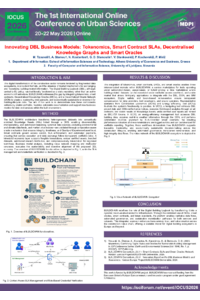
Digital transformation of the construction sector demands trustworthy, interoperable, and economically sustainable mechanisms for managing building‑related data and services. The Horizon-Europe project BUILDCHAIN addresses this need by extending the Digital Building Logbook (DBL) with Decentralized Knowledge Graphs (DKGs), Decentralized Oracle Networks (DONs), and token‑enabled business models to support continuous, verifiable, and machine‑actionable building‑lifecycle documentation.
Methods
BUILDCHAIN ecosystem tools and applications operate within a unified architecture supporting discoverability, access control and monetization. Datasets are transformed into Knowledge Assets (KAs), semantically linked with the DKGs, validated within the DONs by using a reputation‑based mechanism, and stored immutably, ensuring that data providers can confidently monetize their assets. Smart contracts, including Service Level Agreements (SLAs), manage access, payments, and service execution, supporting subscription‑based, usage‑based, or hybrid pricing. A tokenized economic layer enables seamless transactions, access control, automated regulatory compliance and verifiable ownership of digital assets. Economic sustainability is evaluated through multi-actor Business Model Canvases and Value Network mapping, identifying the cost structures and value propositions of urban economy chain stakeholders, demonstrating a win–win sustainable ecosystem.
Results
Three interconnected markets are suppoprted: a service marketplace for BUILDCHAIN tools, a data marketplace for monetizing building‑related datasets, and a side market enabling third‑party applications to integrate with the DBL, DONs, and Building Information Modeling (BIM) ecosystem. Digital wallets and token‑based remuneration streamline partner compensation, enabling transparent, traceable economic flows. The architecture’s viability is shown through a representative scenario where a building‑energy‑efficiency tool uses DBL data and DON weather feeds to optimize HVAC operation. Results demonstrate stakeholder benefits and building‑stock improvements that, when scaled, allow buildings to act as flexible grid resources and enhance city‑wide resource‑management efficiency.
Conclusions
BUILDCHAIN introduces a scalable, tokenized, Oracle‑enhanced business model that transforms DBLs from static repositories into dynamic economic infrastructures, enabling new forms of data monetization, service innovation, and cross‑sector value creation in built environments.
Keywords
Digital Building Logbook
Business Models
Tokenomics
Decentralised Knowledge Graphs
Smart Oracles
Poster
171086-DBL_Economy_poster.pdf
Urban Economic Spillover Networks: Micro-Level Evidence of Functional Urban–Rural Integration in Sri Lanka
A Systematic Review on the Effect of Urbanization on the Microbiome of Urban Blue Spaces