Event submissions
Published
This submission belongs to the session S2. Urban Environments and Sustainability of the event The 1st International Online Conference on Urban Sciences
Published date
15 May, 2026
Academic Editor
'%3e%3cpath%20d='M12.6657%2010.9104C12.4185%2010.325%2012.0599%209.79327%2011.6097%209.34482C11.1609%208.89508%2010.6293%208.5365%2010.0442%208.28888C10.0389%208.28626%2010.0337%208.28495%2010.0285%208.28233C10.8446%207.69279%2011.3752%206.73249%2011.3752%205.64904C11.3752%203.8542%209.92103%202.39999%208.1262%202.39999C6.33136%202.39999%204.87715%203.8542%204.87715%205.64904C4.87715%206.73249%205.40774%207.69279%206.22393%208.28364C6.21869%208.28626%206.21345%208.28757%206.20821%208.29019C5.62129%208.5378%205.09463%208.89284%204.64265%209.34613C4.1929%209.79493%203.83432%2010.3266%203.58671%2010.9117C3.34345%2011.4845%203.21226%2012.0987%203.20023%2012.7209C3.19988%2012.7349%203.20233%2012.7488%203.20744%2012.7619C3.21255%2012.7749%203.22022%2012.7867%203.22998%2012.7968C3.23975%2012.8068%203.25142%2012.8147%203.26431%2012.8202C3.2772%2012.8256%203.29105%2012.8284%203.30504%2012.8284H4.09109C4.14874%2012.8284%204.19459%2012.7825%204.1959%2012.7262C4.2221%2011.7148%204.62823%2010.7676%205.34617%2010.0497C6.08899%209.30683%207.0755%208.89808%208.1262%208.89808C9.17689%208.89808%2010.1634%209.30683%2010.9062%2010.0497C11.6242%2010.7676%2012.0303%2011.7148%2012.0565%2012.7262C12.0578%2012.7838%2012.1037%2012.8284%2012.1613%2012.8284H12.9474C12.9613%2012.8284%2012.9752%2012.8256%2012.9881%2012.8202C13.001%2012.8147%2013.0126%2012.8068%2013.0224%2012.7968C13.0322%2012.7867%2013.0398%2012.7749%2013.0449%2012.7619C13.0501%2012.7488%2013.0525%2012.7349%2013.0522%2012.7209C13.0391%2012.0947%2012.9094%2011.4855%2012.6657%2010.9104ZM8.1262%207.9024C7.52486%207.9024%206.9589%207.6679%206.53312%207.24211C6.10733%206.81633%205.87283%206.25037%205.87283%205.64904C5.87283%205.0477%206.10733%204.48174%206.53312%204.05596C6.9589%203.63018%207.52486%203.39567%208.1262%203.39567C8.72753%203.39567%209.29349%203.63018%209.71927%204.05596C10.1451%204.48174%2010.3796%205.0477%2010.3796%205.64904C10.3796%206.25037%2010.1451%206.81633%209.71927%207.24211C9.29349%207.6679%208.72753%207.9024%208.1262%207.9024Z'%20fill='%235D1EE1'/%3e%3c/g%3e%3c/svg%3e) Jianming Cai
Jianming CaiCitation
Eusébio Z.E. Conceição, Margarida I.L. Conceição, Mª Inês L. Conceição, Mª Manuela J.R. Lúcio, João Gomes, Hazim Awbi, Application of renewable energies in buildings with complex topologies, in Proceedings of The 1st International Online Conference on Urban Sciences, 20 May–22 May 2026, MDPI: Basel, Switzerland
Share
Email
Facebook
Twitter
LinkedIn
Application of renewable energies in buildings with complex topologies
'%3e%3cpath%20d='M12.6647%2010.9104C12.4176%2010.325%2012.0589%209.7933%2011.6088%209.34485C11.16%208.89511%2010.6283%208.53653%2010.0432%208.28891C10.038%208.28629%2010.0327%208.28498%2010.0275%208.28236C10.8437%207.69282%2011.3743%206.73252%2011.3743%205.64907C11.3743%203.85423%209.92005%202.40002%208.12522%202.40002C6.33038%202.40002%204.87618%203.85423%204.87618%205.64907C4.87618%206.73252%205.40677%207.69282%206.22296%208.28367C6.21772%208.28629%206.21248%208.2876%206.20724%208.29022C5.62031%208.53783%205.09365%208.89287%204.64167%209.34616C4.19192%209.79496%203.83334%2010.3266%203.58573%2010.9117C3.34247%2011.4846%203.21128%2012.0987%203.19925%2012.721C3.1989%2012.735%203.20135%2012.7489%203.20646%2012.7619C3.21157%2012.7749%203.21924%2012.7868%203.22901%2012.7968C3.23877%2012.8068%203.25045%2012.8148%203.26334%2012.8202C3.27623%2012.8256%203.29007%2012.8284%203.30406%2012.8284H4.09012C4.14776%2012.8284%204.19362%2012.7825%204.19493%2012.7262C4.22113%2011.7148%204.62726%2010.7676%205.34519%2010.0497C6.08802%209.30686%207.07452%208.89811%208.12522%208.89811C9.17592%208.89811%2010.1624%209.30686%2010.9052%2010.0497C11.6232%2010.7676%2012.0293%2011.7148%2012.0555%2012.7262C12.0568%2012.7839%2012.1027%2012.8284%2012.1603%2012.8284H12.9464C12.9604%2012.8284%2012.9742%2012.8256%2012.9871%2012.8202C13%2012.8148%2013.0117%2012.8068%2013.0214%2012.7968C13.0312%2012.7868%2013.0389%2012.7749%2013.044%2012.7619C13.0491%2012.7489%2013.0515%2012.735%2013.0512%2012.721C13.0381%2012.0947%2012.9084%2011.4856%2012.6647%2010.9104ZM8.12522%207.90243C7.52388%207.90243%206.95792%207.66793%206.53214%207.24215C6.10636%206.81636%205.87185%206.2504%205.87185%205.64907C5.87185%205.04773%206.10636%204.48177%206.53214%204.05599C6.95792%203.63021%207.52388%203.3957%208.12522%203.3957C8.72655%203.3957%209.29252%203.63021%209.7183%204.05599C10.1441%204.48177%2010.3786%205.04773%2010.3786%205.64907C10.3786%206.2504%2010.1441%206.81636%209.7183%207.24215C9.29252%207.66793%208.72655%207.90243%208.12522%207.90243Z'%20fill='%235D1EE1'/%3e%3c/g%3e%3c/svg%3e)
Eusébio Z.E. Conceição 1
Margarida I.L. Conceição 2
Mª Inês L. Conceição 2
Mª Manuela J.R. Lúcio 1

João Gomes 3
Hazim Awbi 4
1. FCT-Universidade do Algarve, Campus de Gambelas, 8005-139 Faro, Portugal
2. Instituto Superior Técnico, Universidade de Lisboa, 1049-001 Lisboa, Portugal
3. Universidade do Algarve, Campus de Gambelas, 8005-139 Faro, Portugal
4. School of Built Environment, University of Reading, RG6 6AW Reading, United Kingdom
Abstract
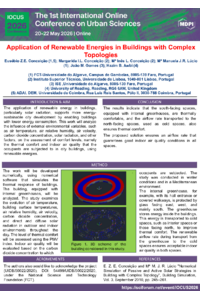
The application of renewable energy in buildings, particularly solar radiation (e.g., passive thermal solutions), supports more energy-sustainable city development by enabling buildings with lower energy consumption. This work will analyse the influence of external environmental variables, such as air temperature, air relative humidity, air velocity, carbon dioxide concentration, solar radiation, and other factors, on the assessment of comfort levels, namely the thermal comfort and indoor air quality that the occupants are subjected to in city buildings, using renewable energies.
The work will be developed numerically, using numerical software that simulates the thermal response of buildings. The building, equipped with internal greenhouses, will be analysed. The study examines the evolution of air temperature, building surface temperatures, air relative humidity, air velocity, carbon dioxide concentration, and direct and diffuse solar radiation in outdoor and indoor environments throughout the day. The level of thermal comfort will be assessed using the PMV index. The level of indoor air quality will be evaluated based on the carbon dioxide concentration to which occupants are subjected. The study was conducted in winter conditions and in a Mediterranean environment.
The internal greenhouse, for example, with its hall entrance or covered walkways, is protected by glass facing east, west, and mainly south. The greenhouse stores energy inside the buildings. This energy is transported to cold spaces, such as interior spaces or those facing north, to improve thermal comfort. The renewable airflow rate during transport from the greenhouse to the cold spaces ensures acceptable indoor air quality in both spaces.
The results indicate that the south-facing spaces, equipped with internal greenhouses, are thermally comfortable, and the airflow rate transported to the north-facing spaces, used as cold spaces, also ensures thermal comfort. The proposed solution ensures an airflow rate that guarantees good indoor air quality conditions in all spaces.
Keywords
Renewable Energy
Solar Radiation
External thermal conditions
Buildings
Thermal Comfort
Indoor Air Quality
Poster
Poster-sciforum-137143-final.pdf
Does Institutional Middleware Reduce Rent-Seeking in Smart Cities? Evidence from EU Digital Procurement
The political economy of localised privatism: Reconceptualising the urban informal economy in Namibia