Event submissions
Published
This submission belongs to the session S3. Urban Economies and Resource Management of the event The 1st International Online Conference on Urban Sciences
Published date
15 May, 2026
Academic Editor
'%3e%3cpath%20d='M12.6657%2010.9104C12.4185%2010.325%2012.0599%209.79327%2011.6097%209.34482C11.1609%208.89508%2010.6293%208.5365%2010.0442%208.28888C10.0389%208.28626%2010.0337%208.28495%2010.0285%208.28233C10.8446%207.69279%2011.3752%206.73249%2011.3752%205.64904C11.3752%203.8542%209.92103%202.39999%208.1262%202.39999C6.33136%202.39999%204.87715%203.8542%204.87715%205.64904C4.87715%206.73249%205.40774%207.69279%206.22393%208.28364C6.21869%208.28626%206.21345%208.28757%206.20821%208.29019C5.62129%208.5378%205.09463%208.89284%204.64265%209.34613C4.1929%209.79493%203.83432%2010.3266%203.58671%2010.9117C3.34345%2011.4845%203.21226%2012.0987%203.20023%2012.7209C3.19988%2012.7349%203.20233%2012.7488%203.20744%2012.7619C3.21255%2012.7749%203.22022%2012.7867%203.22998%2012.7968C3.23975%2012.8068%203.25142%2012.8147%203.26431%2012.8202C3.2772%2012.8256%203.29105%2012.8284%203.30504%2012.8284H4.09109C4.14874%2012.8284%204.19459%2012.7825%204.1959%2012.7262C4.2221%2011.7148%204.62823%2010.7676%205.34617%2010.0497C6.08899%209.30683%207.0755%208.89808%208.1262%208.89808C9.17689%208.89808%2010.1634%209.30683%2010.9062%2010.0497C11.6242%2010.7676%2012.0303%2011.7148%2012.0565%2012.7262C12.0578%2012.7838%2012.1037%2012.8284%2012.1613%2012.8284H12.9474C12.9613%2012.8284%2012.9752%2012.8256%2012.9881%2012.8202C13.001%2012.8147%2013.0126%2012.8068%2013.0224%2012.7968C13.0322%2012.7867%2013.0398%2012.7749%2013.0449%2012.7619C13.0501%2012.7488%2013.0525%2012.7349%2013.0522%2012.7209C13.0391%2012.0947%2012.9094%2011.4855%2012.6657%2010.9104ZM8.1262%207.9024C7.52486%207.9024%206.9589%207.6679%206.53312%207.24211C6.10733%206.81633%205.87283%206.25037%205.87283%205.64904C5.87283%205.0477%206.10733%204.48174%206.53312%204.05596C6.9589%203.63018%207.52486%203.39567%208.1262%203.39567C8.72753%203.39567%209.29349%203.63018%209.71927%204.05596C10.1451%204.48174%2010.3796%205.0477%2010.3796%205.64904C10.3796%206.25037%2010.1451%206.81633%209.71927%207.24211C9.29349%207.6679%208.72753%207.9024%208.1262%207.9024Z'%20fill='%235D1EE1'/%3e%3c/g%3e%3c/svg%3e) Lori Pennington-Gray
Lori Pennington-GrayCitation
GUILLERMINA BAUTISTA GOMEZ, Analysis of urban-tourism development trends on the North Pacific Coast of Mexico, in Proceedings of The 1st International Online Conference on Urban Sciences, 20 May–22 May 2026, MDPI: Basel, Switzerland
Share
Email
Facebook
Twitter
LinkedIn
Analysis of urban-tourism development trends on the North Pacific Coast of Mexico

GUILLERMINA BAUTISTA GOMEZ 1
1. Center for Research and Studies on Environment and Development (CIIEMAD)-National Polytechnic Institute (IPN), Mexico City, Mexico
Abstract
The City of Mazatlán, Sinaloa, located on Mexico’s North Pacific coast, has experienced accelerated urban growth over the past two decades. This expansion has occurred without adequate planning or effective sustainable development strategies, as the population increased from 327,989 inhabitants in 2000 to 441,975 in 2020. The city has a housing density of 2,188 units per km² and a Prosperous Cities Index (PCI) score of 56.8, which is considered moderately weak and highlights the need to strengthen urban policies.
The objective of this study was to construct contextual, trend, and desirable scenarios for Mazatlán in order to analyze patterns of urban-tourism development. The research employed a mixed, non-experimental methodological approach. The quantitative phase involved photographic surveys to describe and compare elements of the urban-tourist landscape, identifying causes and effects of landscape transformation. The qualitative phase focused on diagnosing environmental and economic challenges. Integrating findings from both stages, scenarios were developed based on General Systems Theory.
The main results reveal that the annual influx of tourists multiplies the resident population by seven, generating competition for food, goods, and services. The absence of urban management strategies has undermined the continuity and conservation of wetlands, which are increasingly threatened by irregular human settlements, marina and port infrastructure, beachfront hotels, and vacation properties. These pressures degrade the natural landscape and lead to economic losses in fishing and aquaculture, pollution, the spread of disease vectors, unpleasant odors, surface warming, and a diminished capacity to provide ecosystem services. In conclusion, the study emphasizes that the primary strategy for Mazatlán’s sustainable future must be rooted in conserving its existing landscape heritage.
Keywords
Scenarios
Conservation
Environmental Problems
Landscape.
Poster
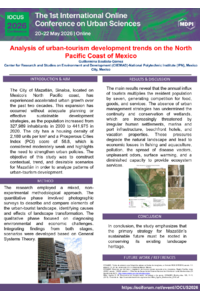
Poster sciforum-172672.pdf
Reframing Urban Ecological Space Toward Systemic Ecological Thinking
Feasibility study for solid waste management using smart waste bins in the municipality of Cuernavaca, Mexico