Event submissions
Published
This submission belongs to the session S1. Urban Planning and Design of the event The 1st International Online Conference on Urban Sciences
Published date
15 May, 2026
Academic Editor
'%3e%3cpath%20d='M12.6657%2010.9104C12.4185%2010.325%2012.0599%209.79327%2011.6097%209.34482C11.1609%208.89508%2010.6293%208.5365%2010.0442%208.28888C10.0389%208.28626%2010.0337%208.28495%2010.0285%208.28233C10.8446%207.69279%2011.3752%206.73249%2011.3752%205.64904C11.3752%203.8542%209.92103%202.39999%208.1262%202.39999C6.33136%202.39999%204.87715%203.8542%204.87715%205.64904C4.87715%206.73249%205.40774%207.69279%206.22393%208.28364C6.21869%208.28626%206.21345%208.28757%206.20821%208.29019C5.62129%208.5378%205.09463%208.89284%204.64265%209.34613C4.1929%209.79493%203.83432%2010.3266%203.58671%2010.9117C3.34345%2011.4845%203.21226%2012.0987%203.20023%2012.7209C3.19988%2012.7349%203.20233%2012.7488%203.20744%2012.7619C3.21255%2012.7749%203.22022%2012.7867%203.22998%2012.7968C3.23975%2012.8068%203.25142%2012.8147%203.26431%2012.8202C3.2772%2012.8256%203.29105%2012.8284%203.30504%2012.8284H4.09109C4.14874%2012.8284%204.19459%2012.7825%204.1959%2012.7262C4.2221%2011.7148%204.62823%2010.7676%205.34617%2010.0497C6.08899%209.30683%207.0755%208.89808%208.1262%208.89808C9.17689%208.89808%2010.1634%209.30683%2010.9062%2010.0497C11.6242%2010.7676%2012.0303%2011.7148%2012.0565%2012.7262C12.0578%2012.7838%2012.1037%2012.8284%2012.1613%2012.8284H12.9474C12.9613%2012.8284%2012.9752%2012.8256%2012.9881%2012.8202C13.001%2012.8147%2013.0126%2012.8068%2013.0224%2012.7968C13.0322%2012.7867%2013.0398%2012.7749%2013.0449%2012.7619C13.0501%2012.7488%2013.0525%2012.7349%2013.0522%2012.7209C13.0391%2012.0947%2012.9094%2011.4855%2012.6657%2010.9104ZM8.1262%207.9024C7.52486%207.9024%206.9589%207.6679%206.53312%207.24211C6.10733%206.81633%205.87283%206.25037%205.87283%205.64904C5.87283%205.0477%206.10733%204.48174%206.53312%204.05596C6.9589%203.63018%207.52486%203.39567%208.1262%203.39567C8.72753%203.39567%209.29349%203.63018%209.71927%204.05596C10.1451%204.48174%2010.3796%205.0477%2010.3796%205.64904C10.3796%206.25037%2010.1451%206.81633%209.71927%207.24211C9.29349%207.6679%208.72753%207.9024%208.1262%207.9024Z'%20fill='%235D1EE1'/%3e%3c/g%3e%3c/svg%3e) Bernhard Müller
Bernhard MüllerCitation
Miral Seneviratne, N.B.S Madusanka, Priyanwada I. Singhapathirana, From Self-Organization to Regulation: A Bio-Inspired Agent-Based Model for Integrated Urban Planning and Growth Management in Western Province, Sri Lanka, in Proceedings of The 1st International Online Conference on Urban Sciences, 20 May–22 May 2026, MDPI: Basel, Switzerland
Share
Email
Facebook
Twitter
LinkedIn
From Self-Organization to Regulation: A Bio-Inspired Agent-Based Model for Integrated Urban Planning and Growth Management in Western Province, Sri Lanka

Miral Seneviratne 1
'%3e%3cpath%20d='M12.6647%2010.9104C12.4176%2010.325%2012.0589%209.7933%2011.6088%209.34485C11.16%208.89511%2010.6283%208.53653%2010.0432%208.28891C10.038%208.28629%2010.0327%208.28498%2010.0275%208.28236C10.8437%207.69282%2011.3743%206.73252%2011.3743%205.64907C11.3743%203.85423%209.92005%202.40002%208.12522%202.40002C6.33038%202.40002%204.87618%203.85423%204.87618%205.64907C4.87618%206.73252%205.40677%207.69282%206.22296%208.28367C6.21772%208.28629%206.21248%208.2876%206.20724%208.29022C5.62031%208.53783%205.09365%208.89287%204.64167%209.34616C4.19192%209.79496%203.83334%2010.3266%203.58573%2010.9117C3.34247%2011.4846%203.21128%2012.0987%203.19925%2012.721C3.1989%2012.735%203.20135%2012.7489%203.20646%2012.7619C3.21157%2012.7749%203.21924%2012.7868%203.22901%2012.7968C3.23877%2012.8068%203.25045%2012.8148%203.26334%2012.8202C3.27623%2012.8256%203.29007%2012.8284%203.30406%2012.8284H4.09012C4.14776%2012.8284%204.19362%2012.7825%204.19493%2012.7262C4.22113%2011.7148%204.62726%2010.7676%205.34519%2010.0497C6.08802%209.30686%207.07452%208.89811%208.12522%208.89811C9.17592%208.89811%2010.1624%209.30686%2010.9052%2010.0497C11.6232%2010.7676%2012.0293%2011.7148%2012.0555%2012.7262C12.0568%2012.7839%2012.1027%2012.8284%2012.1603%2012.8284H12.9464C12.9604%2012.8284%2012.9742%2012.8256%2012.9871%2012.8202C13%2012.8148%2013.0117%2012.8068%2013.0214%2012.7968C13.0312%2012.7868%2013.0389%2012.7749%2013.044%2012.7619C13.0491%2012.7489%2013.0515%2012.735%2013.0512%2012.721C13.0381%2012.0947%2012.9084%2011.4856%2012.6647%2010.9104ZM8.12522%207.90243C7.52388%207.90243%206.95792%207.66793%206.53214%207.24215C6.10636%206.81636%205.87185%206.2504%205.87185%205.64907C5.87185%205.04773%206.10636%204.48177%206.53214%204.05599C6.95792%203.63021%207.52388%203.3957%208.12522%203.3957C8.72655%203.3957%209.29252%203.63021%209.7183%204.05599C10.1441%204.48177%2010.3786%205.04773%2010.3786%205.64907C10.3786%206.2504%2010.1441%206.81636%209.7183%207.24215C9.29252%207.66793%208.72655%207.90243%208.12522%207.90243Z'%20fill='%235D1EE1'/%3e%3c/g%3e%3c/svg%3e)
N.B.S Madusanka 1
Priyanwada I. Singhapathirana 1
1. Department of Town and Country Planning, University of Moratuwa, Moratuwa, Sri Lanka
Abstract
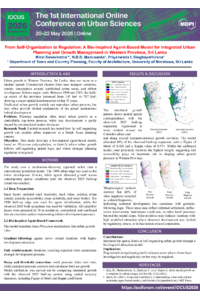
Contemporary urban planning and design must respond to the intertwined challenges of net-zero development, biodiversity conservation, efficient land use, and wider social and economic demands. In this context, a critical planning question is not only where urban growth occurs, but also where it may be accommodated through relatively stable self-organizing processes and where stronger strategic or statutory intervention is required. This study develops a bio-inspired agent-based model as a planning-support tool to address this question in Western Province, Sri Lanka. Drawing on the adaptive behavior of Physarum polycephalum, the model translates gradient-following, path reinforcement, and decay into a simulation of urban expansion. Using an Inverse Generative Social Science approach, the model is calibrated against the observed 2025 built-up pattern, with growth simulated from the 1990 urban edge until the observed 2025 urban extent is reached. Development probability is defined by an attraction surface combining road proximity, land value, existing density, amenity accessibility, and slope suitability. The calibrated model reproduces 49% of the observed 2025 built-up area (Figure of Merit = 0.428; Kappa = 0.574), with road proximity emerging as the strongest driver of expansion (w = 0.295). Spatial error analysis shows that 62% of false negatives occur as fragmented patches, indicating areas where self-organizing growth alone does not adequately explain development. These areas are likely to require stronger policy guidance, regulatory control, or targeted design intervention. The study demonstrates how bio-inspired urban modelling can support integrated planning by identifying where growth may be accommodated, where it should be guided, and where regulation is necessary to protect environmentally sensitive and high-conflict areas.
Keywords
bio-inspired urban modelling
self-organization
urban expansion
agent-based modelling
strategic planning
statutory planning
growth management
spatial decision support
Poster
From Self-Organization to Regulation_U.H.M.A. Seneviratne.pdf
Urban fragmentation and reconfiguration: a multi-scale analysis of post-socialist Oradea
Integrating Chaotic Optimization and Machine Learning Algorithms for Precise Remote Sensing Maps of Oakland, California, using Sentinel-2 Multispectral Imagery