Event submissions
Published
This submission belongs to the session S1. Urban Planning and Design of the event The 1st International Online Conference on Urban Sciences
Published date
15 May, 2026
Academic Editor
'%3e%3cpath%20d='M12.6657%2010.9104C12.4185%2010.325%2012.0599%209.79327%2011.6097%209.34482C11.1609%208.89508%2010.6293%208.5365%2010.0442%208.28888C10.0389%208.28626%2010.0337%208.28495%2010.0285%208.28233C10.8446%207.69279%2011.3752%206.73249%2011.3752%205.64904C11.3752%203.8542%209.92103%202.39999%208.1262%202.39999C6.33136%202.39999%204.87715%203.8542%204.87715%205.64904C4.87715%206.73249%205.40774%207.69279%206.22393%208.28364C6.21869%208.28626%206.21345%208.28757%206.20821%208.29019C5.62129%208.5378%205.09463%208.89284%204.64265%209.34613C4.1929%209.79493%203.83432%2010.3266%203.58671%2010.9117C3.34345%2011.4845%203.21226%2012.0987%203.20023%2012.7209C3.19988%2012.7349%203.20233%2012.7488%203.20744%2012.7619C3.21255%2012.7749%203.22022%2012.7867%203.22998%2012.7968C3.23975%2012.8068%203.25142%2012.8147%203.26431%2012.8202C3.2772%2012.8256%203.29105%2012.8284%203.30504%2012.8284H4.09109C4.14874%2012.8284%204.19459%2012.7825%204.1959%2012.7262C4.2221%2011.7148%204.62823%2010.7676%205.34617%2010.0497C6.08899%209.30683%207.0755%208.89808%208.1262%208.89808C9.17689%208.89808%2010.1634%209.30683%2010.9062%2010.0497C11.6242%2010.7676%2012.0303%2011.7148%2012.0565%2012.7262C12.0578%2012.7838%2012.1037%2012.8284%2012.1613%2012.8284H12.9474C12.9613%2012.8284%2012.9752%2012.8256%2012.9881%2012.8202C13.001%2012.8147%2013.0126%2012.8068%2013.0224%2012.7968C13.0322%2012.7867%2013.0398%2012.7749%2013.0449%2012.7619C13.0501%2012.7488%2013.0525%2012.7349%2013.0522%2012.7209C13.0391%2012.0947%2012.9094%2011.4855%2012.6657%2010.9104ZM8.1262%207.9024C7.52486%207.9024%206.9589%207.6679%206.53312%207.24211C6.10733%206.81633%205.87283%206.25037%205.87283%205.64904C5.87283%205.0477%206.10733%204.48174%206.53312%204.05596C6.9589%203.63018%207.52486%203.39567%208.1262%203.39567C8.72753%203.39567%209.29349%203.63018%209.71927%204.05596C10.1451%204.48174%2010.3796%205.0477%2010.3796%205.64904C10.3796%206.25037%2010.1451%206.81633%209.71927%207.24211C9.29349%207.6679%208.72753%207.9024%208.1262%207.9024Z'%20fill='%235D1EE1'/%3e%3c/g%3e%3c/svg%3e) Bernhard Müller
Bernhard MüllerCitation
Fatemeh Behfar, Roger Miralles-Jori, Yolanda Pérez‑Albert, Urban Green Space Satisfaction in an Extreme Industrial City: Evidence from Coastal Park, Asaluyeh, Iran, in Proceedings of The 1st International Online Conference on Urban Sciences, 20 May–22 May 2026, MDPI: Basel, Switzerland
Share
Email
Facebook
Twitter
LinkedIn
Urban Green Space Satisfaction in an Extreme Industrial City: Evidence from Coastal Park, Asaluyeh, Iran
Urban Green Space Satisfaction in an Extreme Industrial City: Evidence from Coastal Park, Asaluyeh, Iran
'%3e%3cpath%20d='M12.6647%2010.9104C12.4176%2010.325%2012.0589%209.7933%2011.6088%209.34485C11.16%208.89511%2010.6283%208.53653%2010.0432%208.28891C10.038%208.28629%2010.0327%208.28498%2010.0275%208.28236C10.8437%207.69282%2011.3743%206.73252%2011.3743%205.64907C11.3743%203.85423%209.92005%202.40002%208.12522%202.40002C6.33038%202.40002%204.87618%203.85423%204.87618%205.64907C4.87618%206.73252%205.40677%207.69282%206.22296%208.28367C6.21772%208.28629%206.21248%208.2876%206.20724%208.29022C5.62031%208.53783%205.09365%208.89287%204.64167%209.34616C4.19192%209.79496%203.83334%2010.3266%203.58573%2010.9117C3.34247%2011.4846%203.21128%2012.0987%203.19925%2012.721C3.1989%2012.735%203.20135%2012.7489%203.20646%2012.7619C3.21157%2012.7749%203.21924%2012.7868%203.22901%2012.7968C3.23877%2012.8068%203.25045%2012.8148%203.26334%2012.8202C3.27623%2012.8256%203.29007%2012.8284%203.30406%2012.8284H4.09012C4.14776%2012.8284%204.19362%2012.7825%204.19493%2012.7262C4.22113%2011.7148%204.62726%2010.7676%205.34519%2010.0497C6.08802%209.30686%207.07452%208.89811%208.12522%208.89811C9.17592%208.89811%2010.1624%209.30686%2010.9052%2010.0497C11.6232%2010.7676%2012.0293%2011.7148%2012.0555%2012.7262C12.0568%2012.7839%2012.1027%2012.8284%2012.1603%2012.8284H12.9464C12.9604%2012.8284%2012.9742%2012.8256%2012.9871%2012.8202C13%2012.8148%2013.0117%2012.8068%2013.0214%2012.7968C13.0312%2012.7868%2013.0389%2012.7749%2013.044%2012.7619C13.0491%2012.7489%2013.0515%2012.735%2013.0512%2012.721C13.0381%2012.0947%2012.9084%2011.4856%2012.6647%2010.9104ZM8.12522%207.90243C7.52388%207.90243%206.95792%207.66793%206.53214%207.24215C6.10636%206.81636%205.87185%206.2504%205.87185%205.64907C5.87185%205.04773%206.10636%204.48177%206.53214%204.05599C6.95792%203.63021%207.52388%203.3957%208.12522%203.3957C8.72655%203.3957%209.29252%203.63021%209.7183%204.05599C10.1441%204.48177%2010.3786%205.04773%2010.3786%205.64907C10.3786%206.2504%2010.1441%206.81636%209.7183%207.24215C9.29252%207.66793%208.72655%207.90243%208.12522%207.90243Z'%20fill='%235D1EE1'/%3e%3c/g%3e%3c/svg%3e)
Fatemeh Behfar 1
Roger Miralles-Jori 2
Yolanda Pérez‑Albert 3
1. Ph.D. program in City, Territory, and Sustainable Planning, Department of Tourism and Geography, Universitat Rovira i Virgili, 43480 Vila‑seca, Spain
2. Faculty of Architecture, Universitat Rovira i Virgili, 43204 Reus, Spain.
3. Research Group on Territorial Analysis and Tourism Studies (GRATET), Department of Tourism and Geography, Universitat Rovira i Virgili, 43480 Vila‑seca, Spain.
Abstract
Urban parks in rapidly industrializing cities of West Asia face a triple challenge: extreme climate, limited green space, and populations fragmented by labor migration. Planning decisions in such contexts are rarely guided by empirical evidence on what drives user satisfaction. This paper reports preliminary findings from a case study in Asaluyeh, a petrochemical city on Iran's Persian Gulf coast, where summer temperatures exceed 45°C and per capita green space is just 0.44 m², less than one-tenth of international recommendations. Analysis identifies park characteristics that most strongly influence visitor satisfaction and highlights underserved population segments. Vegetation quality emerges as the strongest predictor of overall satisfaction (r = 0.45, p < 0.001), surpassing demographic and socioeconomic variables. Gender disparity is evident, with female visitors reporting lower satisfaction than males (3.5 compared with 3.9 on a 5-point scale; t = 2.15, p = 0.045), despite equal or greater preference for public green space. Visits are temporally concentrated, with 76% occurring on weekend evenings and only 2% during weekday daytime hours. Access is constrained by transport dependency, as 84% of visitors arrive by private car. Although 43% of respondents have private gardens, 79% prefer public parks, emphasizing their social and collective value. These findings are translated into a prioritized intervention framework for urban managers, offering guidance for investment based on empirically demonstrated effects on user satisfaction. This abstract presents preliminary findings from an ongoing study, and the full manuscript is currently under review for journal publication.
Keywords
Urban park
User satisfaction
Vegetation quality
Industrial city
Evidence-based planning.
Poster
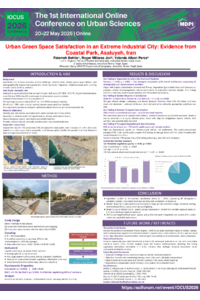
poster !th international online confrences.pdf
Impact of Urbanization on Green Spaces in Islamabad, Pakistan: A case study of sector D-12
Anthropogenic Amplification of Heat Waves Across CONUS: Detection, Attribution, and Urban Implications