Event submissions
Published
This submission belongs to the session S4. Urban Mobility and Transportation of the event The 1st International Online Conference on Urban Sciences
Published date
15 May, 2026
Academic Editor
'%3e%3cpath%20d='M12.6657%2010.9104C12.4185%2010.325%2012.0599%209.79327%2011.6097%209.34482C11.1609%208.89508%2010.6293%208.5365%2010.0442%208.28888C10.0389%208.28626%2010.0337%208.28495%2010.0285%208.28233C10.8446%207.69279%2011.3752%206.73249%2011.3752%205.64904C11.3752%203.8542%209.92103%202.39999%208.1262%202.39999C6.33136%202.39999%204.87715%203.8542%204.87715%205.64904C4.87715%206.73249%205.40774%207.69279%206.22393%208.28364C6.21869%208.28626%206.21345%208.28757%206.20821%208.29019C5.62129%208.5378%205.09463%208.89284%204.64265%209.34613C4.1929%209.79493%203.83432%2010.3266%203.58671%2010.9117C3.34345%2011.4845%203.21226%2012.0987%203.20023%2012.7209C3.19988%2012.7349%203.20233%2012.7488%203.20744%2012.7619C3.21255%2012.7749%203.22022%2012.7867%203.22998%2012.7968C3.23975%2012.8068%203.25142%2012.8147%203.26431%2012.8202C3.2772%2012.8256%203.29105%2012.8284%203.30504%2012.8284H4.09109C4.14874%2012.8284%204.19459%2012.7825%204.1959%2012.7262C4.2221%2011.7148%204.62823%2010.7676%205.34617%2010.0497C6.08899%209.30683%207.0755%208.89808%208.1262%208.89808C9.17689%208.89808%2010.1634%209.30683%2010.9062%2010.0497C11.6242%2010.7676%2012.0303%2011.7148%2012.0565%2012.7262C12.0578%2012.7838%2012.1037%2012.8284%2012.1613%2012.8284H12.9474C12.9613%2012.8284%2012.9752%2012.8256%2012.9881%2012.8202C13.001%2012.8147%2013.0126%2012.8068%2013.0224%2012.7968C13.0322%2012.7867%2013.0398%2012.7749%2013.0449%2012.7619C13.0501%2012.7488%2013.0525%2012.7349%2013.0522%2012.7209C13.0391%2012.0947%2012.9094%2011.4855%2012.6657%2010.9104ZM8.1262%207.9024C7.52486%207.9024%206.9589%207.6679%206.53312%207.24211C6.10733%206.81633%205.87283%206.25037%205.87283%205.64904C5.87283%205.0477%206.10733%204.48174%206.53312%204.05596C6.9589%203.63018%207.52486%203.39567%208.1262%203.39567C8.72753%203.39567%209.29349%203.63018%209.71927%204.05596C10.1451%204.48174%2010.3796%205.0477%2010.3796%205.64904C10.3796%206.25037%2010.1451%206.81633%209.71927%207.24211C9.29349%207.6679%208.72753%207.9024%208.1262%207.9024Z'%20fill='%235D1EE1'/%3e%3c/g%3e%3c/svg%3e) Sergio Nesmachnow
Sergio NesmachnowCitation
Marian Gaiceanu, George-Andrei Marin, Razvan Buhosu, Dan Ionut Ghiorghita, Ionut Marcu, Marius George Solomon, Real-Time Classification of Power Quality Disturbances using 1D-CNN on Raw Signal: Noise Robustness and Monitoring into a Smart City, in Proceedings of The 1st International Online Conference on Urban Sciences, 20 May–22 May 2026, MDPI: Basel, Switzerland
Share
Email
Facebook
Twitter
LinkedIn
Real-Time Classification of Power Quality Disturbances using 1D-CNN on Raw Signal: Noise Robustness and Monitoring into a Smart City

Marian Gaiceanu 1

George-Andrei Marin 2
'%3e%3cpath%20d='M12.6647%2010.9104C12.4176%2010.325%2012.0589%209.7933%2011.6088%209.34485C11.16%208.89511%2010.6283%208.53653%2010.0432%208.28891C10.038%208.28629%2010.0327%208.28498%2010.0275%208.28236C10.8437%207.69282%2011.3743%206.73252%2011.3743%205.64907C11.3743%203.85423%209.92005%202.40002%208.12522%202.40002C6.33038%202.40002%204.87618%203.85423%204.87618%205.64907C4.87618%206.73252%205.40677%207.69282%206.22296%208.28367C6.21772%208.28629%206.21248%208.2876%206.20724%208.29022C5.62031%208.53783%205.09365%208.89287%204.64167%209.34616C4.19192%209.79496%203.83334%2010.3266%203.58573%2010.9117C3.34247%2011.4846%203.21128%2012.0987%203.19925%2012.721C3.1989%2012.735%203.20135%2012.7489%203.20646%2012.7619C3.21157%2012.7749%203.21924%2012.7868%203.22901%2012.7968C3.23877%2012.8068%203.25045%2012.8148%203.26334%2012.8202C3.27623%2012.8256%203.29007%2012.8284%203.30406%2012.8284H4.09012C4.14776%2012.8284%204.19362%2012.7825%204.19493%2012.7262C4.22113%2011.7148%204.62726%2010.7676%205.34519%2010.0497C6.08802%209.30686%207.07452%208.89811%208.12522%208.89811C9.17592%208.89811%2010.1624%209.30686%2010.9052%2010.0497C11.6232%2010.7676%2012.0293%2011.7148%2012.0555%2012.7262C12.0568%2012.7839%2012.1027%2012.8284%2012.1603%2012.8284H12.9464C12.9604%2012.8284%2012.9742%2012.8256%2012.9871%2012.8202C13%2012.8148%2013.0117%2012.8068%2013.0214%2012.7968C13.0312%2012.7868%2013.0389%2012.7749%2013.044%2012.7619C13.0491%2012.7489%2013.0515%2012.735%2013.0512%2012.721C13.0381%2012.0947%2012.9084%2011.4856%2012.6647%2010.9104ZM8.12522%207.90243C7.52388%207.90243%206.95792%207.66793%206.53214%207.24215C6.10636%206.81636%205.87185%206.2504%205.87185%205.64907C5.87185%205.04773%206.10636%204.48177%206.53214%204.05599C6.95792%203.63021%207.52388%203.3957%208.12522%203.3957C8.72655%203.3957%209.29252%203.63021%209.7183%204.05599C10.1441%204.48177%2010.3786%205.04773%2010.3786%205.64907C10.3786%206.2504%2010.1441%206.81636%209.7183%207.24215C9.29252%207.66793%208.72655%207.90243%208.12522%207.90243Z'%20fill='%235D1EE1'/%3e%3c/g%3e%3c/svg%3e)
Razvan Buhosu 2
Dan Ionut Ghiorghita 2
Ionut Marcu 3
Marius George Solomon 3
1. Faculty of Automation, Computers, Electrical and Electronics Engineering, Department of Electrical Engineering and Energy Conversion Systems, Dunarea de Jos University of Galati, Galati, 800008, Romania
2. Doctoral School of Fundamental and Engineering Sciences, Department of Electrical Engineering and Energy Conversion Systems, Dunarea de Jos University of Galati, Galati, 800008, Romania
3. Doctoral School of Fundamental and Engineering Sciences, Dunarea de Jos University of Galati, Galati, 800008, Romania
Abstract
This paper addresses the problem of detecting and classifying power quality disturbances in modern urban networks, an essential aspect for the reliable operation of critical infrastructures. In the context of smart cities, where energy systems support public transport, digital infrastructure and urban services, power quality monitoring becomes a key factor for operational continuity and performance. The main objective of this work was to develop and evaluate an artificial intelligence-based framework for the automatic identification of the main types of disturbances: voltage sags, voltage swells, harmonics and transients. To this end, simulated signals with varying levels of Gaussian noise and overlap between classes were generated to reproduce realistic operating conditions. Three classification methods were compared: (i) a one-dimensional convolutional neural network (1D-CNN) trained directly on the raw signal, (ii) a multilayer perceptron based on extracted features such as RMS value and total harmonic distortion, and (iii) a Support Vector Machine classifier. The results show that the 1D-CNN model offers superior performance and high robustness to noise, maintaining high accuracy even under conditions of significant signal degradation. In addition, it allows for efficient detection of short-duration transients without requiring manual feature extraction. The main contributions of the paper include (1) the direct use of the raw signal for classification, eliminating intermediate processing steps; (2) the systematic evaluation of performance based on the signal-to-noise ratio; (3) the integration of a “2-of-2” decision logic to stabilize the results in real-time monitoring scenarios; and (4) the analysis of the model interpretability by visualizing the internal activations. The paper is addressed to electricity grid operators, smart infrastructure solution providers, local authorities, and researchers in the field of signal processing and machine learning. The results demonstrate that the proposed approach can contribute to the development of scalable and reliable systems for power quality monitoring, with direct applications in the management of modern urban infrastructures.
Keywords
Power quality fault detection Harmonics Transient Signals
SNR performance Confu-sion matrix analysis
1D-CNN
signal processing
noise and robustness
smart grids
Urban Resilience
Poster
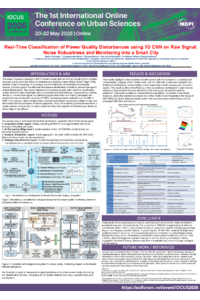
uk_templatePOSTER - MGv6_uk.pdf
The Influence of Temporal Variations on the Perception of High Street Soundscapes Across Grey, Green, and Blue Typologies
Urban Mobility, Demographic Change, and Spatial Mismatch in African Cities: Rethinking Transportation and Inclusive Development.