Event submissions
Published
This submission belongs to the session S2. Urban Environments and Sustainability of the event The 1st International Online Conference on Urban Sciences
Published date
15 May, 2026
Academic Editor
'%3e%3cpath%20d='M12.6657%2010.9104C12.4185%2010.325%2012.0599%209.79327%2011.6097%209.34482C11.1609%208.89508%2010.6293%208.5365%2010.0442%208.28888C10.0389%208.28626%2010.0337%208.28495%2010.0285%208.28233C10.8446%207.69279%2011.3752%206.73249%2011.3752%205.64904C11.3752%203.8542%209.92103%202.39999%208.1262%202.39999C6.33136%202.39999%204.87715%203.8542%204.87715%205.64904C4.87715%206.73249%205.40774%207.69279%206.22393%208.28364C6.21869%208.28626%206.21345%208.28757%206.20821%208.29019C5.62129%208.5378%205.09463%208.89284%204.64265%209.34613C4.1929%209.79493%203.83432%2010.3266%203.58671%2010.9117C3.34345%2011.4845%203.21226%2012.0987%203.20023%2012.7209C3.19988%2012.7349%203.20233%2012.7488%203.20744%2012.7619C3.21255%2012.7749%203.22022%2012.7867%203.22998%2012.7968C3.23975%2012.8068%203.25142%2012.8147%203.26431%2012.8202C3.2772%2012.8256%203.29105%2012.8284%203.30504%2012.8284H4.09109C4.14874%2012.8284%204.19459%2012.7825%204.1959%2012.7262C4.2221%2011.7148%204.62823%2010.7676%205.34617%2010.0497C6.08899%209.30683%207.0755%208.89808%208.1262%208.89808C9.17689%208.89808%2010.1634%209.30683%2010.9062%2010.0497C11.6242%2010.7676%2012.0303%2011.7148%2012.0565%2012.7262C12.0578%2012.7838%2012.1037%2012.8284%2012.1613%2012.8284H12.9474C12.9613%2012.8284%2012.9752%2012.8256%2012.9881%2012.8202C13.001%2012.8147%2013.0126%2012.8068%2013.0224%2012.7968C13.0322%2012.7867%2013.0398%2012.7749%2013.0449%2012.7619C13.0501%2012.7488%2013.0525%2012.7349%2013.0522%2012.7209C13.0391%2012.0947%2012.9094%2011.4855%2012.6657%2010.9104ZM8.1262%207.9024C7.52486%207.9024%206.9589%207.6679%206.53312%207.24211C6.10733%206.81633%205.87283%206.25037%205.87283%205.64904C5.87283%205.0477%206.10733%204.48174%206.53312%204.05596C6.9589%203.63018%207.52486%203.39567%208.1262%203.39567C8.72753%203.39567%209.29349%203.63018%209.71927%204.05596C10.1451%204.48174%2010.3796%205.0477%2010.3796%205.64904C10.3796%206.25037%2010.1451%206.81633%209.71927%207.24211C9.29349%207.6679%208.72753%207.9024%208.1262%207.9024Z'%20fill='%235D1EE1'/%3e%3c/g%3e%3c/svg%3e) Eusébio Conceição
Eusébio ConceiçãoCitation
Charles Nelson Oduor, Compounding Socio-Ecological Failure: How Governance Exclusion Converts Community Stewards into Accidental Polluters in the Nairobi River Basin, in Proceedings of The 1st International Online Conference on Urban Sciences, 20 May–22 May 2026, MDPI: Basel, Switzerland
Share
Email
Facebook
Twitter
LinkedIn
Compounding Socio-Ecological Failure: How Governance Exclusion Converts Community Stewards into Accidental Polluters in the Nairobi River Basin

Charles Nelson Oduor 1
1. Department of Urban and Regional Planning, School of Planning and Architecture, Maseno University, Maseno 40105, Kenya
Abstract
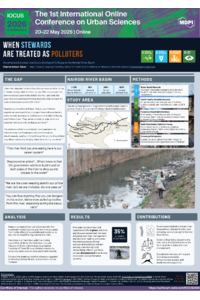
Urban river degradation is frequently framed as a technical failure of waste management or infrastructure. This study advances an alternative hypothesis: that governance exclusion itself functions as a structural driver of socio-ecological collapse. Using the Nairobi River Basin as a case, we examine how pollution gradients, ecosystem decline, and disease burden intersect with institutional marginalisation in riverside communities, with implications for SDGs 3, 6, 11, and 13.
A convergent mixed-methods design integrated four datasets covering the period 2018–2024: (1) secondary water quality records across thirteen parameters (BOD, DO, COD, heavy metals, microbial indicators) benchmarked against WHO standards; (2) outpatient morbidity records from health facilities serving Kibera, Mukuru, and Mathare; (3) purposive household interviews (n = 12 most-impacted households identified through community leadership networks); and (4) a multi-stakeholder validation forum involving residents, community leaders, waste operators, and municipal actors. Field observations were conducted from upstream catchment zones, including Ondiri Swamp, to downstream industrial and informal settlement corridors. Pearson correlation was used to test contamination–disease associations. Ethical approval and informed consent were obtained prior to primary data collection.
A pronounced downstream pollution gradient was observed. Peak E. coli concentrations reached 100,000 CFU/100 mL (≈800× WHO guideline), while lead exceeded permissible limits by up to 50×. E. coli levels were strongly associated with cholera incidence (r = 0.79, p < 0.01). Waterborne diseases accounted for approximately 35% of outpatient visits at Riverside facilities. Ecological assessment documented near-total loss of sensitive aquatic taxa downstream. Qualitative findings revealed high levels of localised ecological knowledge and active stewardship practices; however, residents reported zero formal representation within river governance structures.
Findings suggest that the basin’s degradation is not solely a technical deficit but a governance architecture that externalises responsibility while withholding infrastructure and decision-making power. Sustainable recovery requires institutionalising community stewardship within formal river management systems.
Keywords
urban river pollution
water quality
ecosystem degradation
public health
convergent mixed-methods
purposive sampling
participatory governance
community stewardship
informal settlements
SDGs
Nairobi
Sub-Saharan Africa
Poster
Oduor Charles_When Stewards are Treated as Polluters.pdf
Evaluating Ridership Forecast Accuracy in Indian Urban Transit Projects Using MAPE and Regression Analysis
GIS-Based Mapping of Slope-Dependent Energy Consumption and Recovery for Sustainable E-Bike Mobility