Event submissions
Published
This submission belongs to the session S4. Urban Mobility and Transportation of the event The 1st International Online Conference on Urban Sciences
Published date
15 May, 2026
Academic Editor
'%3e%3cpath%20d='M12.6657%2010.9104C12.4185%2010.325%2012.0599%209.79327%2011.6097%209.34482C11.1609%208.89508%2010.6293%208.5365%2010.0442%208.28888C10.0389%208.28626%2010.0337%208.28495%2010.0285%208.28233C10.8446%207.69279%2011.3752%206.73249%2011.3752%205.64904C11.3752%203.8542%209.92103%202.39999%208.1262%202.39999C6.33136%202.39999%204.87715%203.8542%204.87715%205.64904C4.87715%206.73249%205.40774%207.69279%206.22393%208.28364C6.21869%208.28626%206.21345%208.28757%206.20821%208.29019C5.62129%208.5378%205.09463%208.89284%204.64265%209.34613C4.1929%209.79493%203.83432%2010.3266%203.58671%2010.9117C3.34345%2011.4845%203.21226%2012.0987%203.20023%2012.7209C3.19988%2012.7349%203.20233%2012.7488%203.20744%2012.7619C3.21255%2012.7749%203.22022%2012.7867%203.22998%2012.7968C3.23975%2012.8068%203.25142%2012.8147%203.26431%2012.8202C3.2772%2012.8256%203.29105%2012.8284%203.30504%2012.8284H4.09109C4.14874%2012.8284%204.19459%2012.7825%204.1959%2012.7262C4.2221%2011.7148%204.62823%2010.7676%205.34617%2010.0497C6.08899%209.30683%207.0755%208.89808%208.1262%208.89808C9.17689%208.89808%2010.1634%209.30683%2010.9062%2010.0497C11.6242%2010.7676%2012.0303%2011.7148%2012.0565%2012.7262C12.0578%2012.7838%2012.1037%2012.8284%2012.1613%2012.8284H12.9474C12.9613%2012.8284%2012.9752%2012.8256%2012.9881%2012.8202C13.001%2012.8147%2013.0126%2012.8068%2013.0224%2012.7968C13.0322%2012.7867%2013.0398%2012.7749%2013.0449%2012.7619C13.0501%2012.7488%2013.0525%2012.7349%2013.0522%2012.7209C13.0391%2012.0947%2012.9094%2011.4855%2012.6657%2010.9104ZM8.1262%207.9024C7.52486%207.9024%206.9589%207.6679%206.53312%207.24211C6.10733%206.81633%205.87283%206.25037%205.87283%205.64904C5.87283%205.0477%206.10733%204.48174%206.53312%204.05596C6.9589%203.63018%207.52486%203.39567%208.1262%203.39567C8.72753%203.39567%209.29349%203.63018%209.71927%204.05596C10.1451%204.48174%2010.3796%205.0477%2010.3796%205.64904C10.3796%206.25037%2010.1451%206.81633%209.71927%207.24211C9.29349%207.6679%208.72753%207.9024%208.1262%207.9024Z'%20fill='%235D1EE1'/%3e%3c/g%3e%3c/svg%3e) Sergio Nesmachnow
Sergio NesmachnowCitation
Kachana Kasulu, Walking by Default, Not by Design: Evaluating Non-Motorised Transport Infrastructure Deficits and Transit-Oriented Development Potential along Kitwe’s Emerging Dual Carriageway Corridors, in Proceedings of The 1st International Online Conference on Urban Sciences, 20 May–22 May 2026, MDPI: Basel, Switzerland
Share
Email
Facebook
Twitter
LinkedIn
Walking by Default, Not by Design: Evaluating Non-Motorised Transport Infrastructure Deficits and Transit-Oriented Development Potential along Kitwe’s Emerging Dual Carriageway Corridors
'%3e%3cpath%20d='M12.6647%2010.9104C12.4176%2010.325%2012.0589%209.7933%2011.6088%209.34485C11.16%208.89511%2010.6283%208.53653%2010.0432%208.28891C10.038%208.28629%2010.0327%208.28498%2010.0275%208.28236C10.8437%207.69282%2011.3743%206.73252%2011.3743%205.64907C11.3743%203.85423%209.92005%202.40002%208.12522%202.40002C6.33038%202.40002%204.87618%203.85423%204.87618%205.64907C4.87618%206.73252%205.40677%207.69282%206.22296%208.28367C6.21772%208.28629%206.21248%208.2876%206.20724%208.29022C5.62031%208.53783%205.09365%208.89287%204.64167%209.34616C4.19192%209.79496%203.83334%2010.3266%203.58573%2010.9117C3.34247%2011.4846%203.21128%2012.0987%203.19925%2012.721C3.1989%2012.735%203.20135%2012.7489%203.20646%2012.7619C3.21157%2012.7749%203.21924%2012.7868%203.22901%2012.7968C3.23877%2012.8068%203.25045%2012.8148%203.26334%2012.8202C3.27623%2012.8256%203.29007%2012.8284%203.30406%2012.8284H4.09012C4.14776%2012.8284%204.19362%2012.7825%204.19493%2012.7262C4.22113%2011.7148%204.62726%2010.7676%205.34519%2010.0497C6.08802%209.30686%207.07452%208.89811%208.12522%208.89811C9.17592%208.89811%2010.1624%209.30686%2010.9052%2010.0497C11.6232%2010.7676%2012.0293%2011.7148%2012.0555%2012.7262C12.0568%2012.7839%2012.1027%2012.8284%2012.1603%2012.8284H12.9464C12.9604%2012.8284%2012.9742%2012.8256%2012.9871%2012.8202C13%2012.8148%2013.0117%2012.8068%2013.0214%2012.7968C13.0312%2012.7868%2013.0389%2012.7749%2013.044%2012.7619C13.0491%2012.7489%2013.0515%2012.735%2013.0512%2012.721C13.0381%2012.0947%2012.9084%2011.4856%2012.6647%2010.9104ZM8.12522%207.90243C7.52388%207.90243%206.95792%207.66793%206.53214%207.24215C6.10636%206.81636%205.87185%206.2504%205.87185%205.64907C5.87185%205.04773%206.10636%204.48177%206.53214%204.05599C6.95792%203.63021%207.52388%203.3957%208.12522%203.3957C8.72655%203.3957%209.29252%203.63021%209.7183%204.05599C10.1441%204.48177%2010.3786%205.04773%2010.3786%205.64907C10.3786%206.2504%2010.1441%206.81636%209.7183%207.24215C9.29252%207.66793%208.72655%207.90243%208.12522%207.90243Z'%20fill='%235D1EE1'/%3e%3c/g%3e%3c/svg%3e)
Kachana Kasulu 1
1. Independent Researcher, Kitwe, 10101, Zambia
Abstract
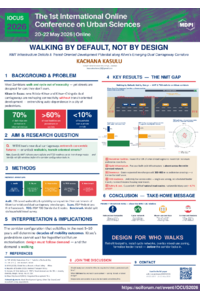
Introduction: In Zambian cities, over 70% of daily trips are on foot or in informal minibuses, yet pedestrians and cyclists account for over 60% of road fatalities, rooted in infrastructure designed for motorised vehicles. Kitwe exemplifies this: residents walk and cycle out of necessity while the built environment provides no dedicated non-motorised transport infrastructure. Meanwhile, corridor investments in Ndola–Kitwe and Kitwe–Chingola dual carriageways reshape connectivity without transit-oriented development, potentially entrenching car-centric spatial configurations in a city where fewer than 10% of households own private vehicles.
Methods: A two-stage methodology is applied. First, a GIS-based walkability and cyclability audit maps existing NMT infrastructure, including footpaths, pedestrian crossings, cycle lanes, and street lighting within two-kilometre catchments of Kitwe’s primary arterials and dual carriageway interchanges, scored against the ITDP Pedestrians First framework. Second, a transit-oriented development readiness assessment evaluates land use density, diversity, and design parameters at six interchange nodes using the TOD Standard, benchmarked against modal split data from household travel surveys.
Results: Fewer than 5% of arterial road segments incorporate dedicated pedestrian facilities meeting ITDP minimum standards, and purpose-built cycle infrastructure is absent across the entire surveyed network. Interchange grade separations extend pedestrian crossing distances by 300–800 metres, creating significant severance barriers for non-motorised users. TOD readiness scores remain uniformly low, constrained by single-use zoning, the absence of mixed-income housing near transit nodes, and the lack of scheduled public transport services to anchor development. Copperbelt Province accounts for 15% of national traffic crashes, and total annual economic losses from road injuries reach 4.7% of GDP nationwide.
Conclusions: Kitwe’s dual carriageway investments represent a rapidly closing window for NMT and TOD integration. Retroactive pedestrian infrastructure, mixed-use zoning overlays at interchanges, and formalised feeder transit services are essential to prevent reproduction of auto-dependent patterns that undermine mobility equity in resource-constrained cities.
Keywords
non-motorised transport
transit-oriented development
walkability
road safety
dual carriageway
Kitwe
urban mobility
Poster
Poster IOCUS2026 sciforum-172809.pdf
Cycling Is Not the Same for Everyone: Gender Inequality in the Cycling Mobility of PUCP Students
Sustainable Urban Mobility Transformation in Gwalior: Integrating Smart Infrastructure and Low-Emission Transport Systems