Event submissions
Published
This submission belongs to the session S4. Urban Mobility and Transportation of the event The 1st International Online Conference on Urban Sciences
Published date
15 May, 2026
Academic Editor
'%3e%3cpath%20d='M12.6657%2010.9104C12.4185%2010.325%2012.0599%209.79327%2011.6097%209.34482C11.1609%208.89508%2010.6293%208.5365%2010.0442%208.28888C10.0389%208.28626%2010.0337%208.28495%2010.0285%208.28233C10.8446%207.69279%2011.3752%206.73249%2011.3752%205.64904C11.3752%203.8542%209.92103%202.39999%208.1262%202.39999C6.33136%202.39999%204.87715%203.8542%204.87715%205.64904C4.87715%206.73249%205.40774%207.69279%206.22393%208.28364C6.21869%208.28626%206.21345%208.28757%206.20821%208.29019C5.62129%208.5378%205.09463%208.89284%204.64265%209.34613C4.1929%209.79493%203.83432%2010.3266%203.58671%2010.9117C3.34345%2011.4845%203.21226%2012.0987%203.20023%2012.7209C3.19988%2012.7349%203.20233%2012.7488%203.20744%2012.7619C3.21255%2012.7749%203.22022%2012.7867%203.22998%2012.7968C3.23975%2012.8068%203.25142%2012.8147%203.26431%2012.8202C3.2772%2012.8256%203.29105%2012.8284%203.30504%2012.8284H4.09109C4.14874%2012.8284%204.19459%2012.7825%204.1959%2012.7262C4.2221%2011.7148%204.62823%2010.7676%205.34617%2010.0497C6.08899%209.30683%207.0755%208.89808%208.1262%208.89808C9.17689%208.89808%2010.1634%209.30683%2010.9062%2010.0497C11.6242%2010.7676%2012.0303%2011.7148%2012.0565%2012.7262C12.0578%2012.7838%2012.1037%2012.8284%2012.1613%2012.8284H12.9474C12.9613%2012.8284%2012.9752%2012.8256%2012.9881%2012.8202C13.001%2012.8147%2013.0126%2012.8068%2013.0224%2012.7968C13.0322%2012.7867%2013.0398%2012.7749%2013.0449%2012.7619C13.0501%2012.7488%2013.0525%2012.7349%2013.0522%2012.7209C13.0391%2012.0947%2012.9094%2011.4855%2012.6657%2010.9104ZM8.1262%207.9024C7.52486%207.9024%206.9589%207.6679%206.53312%207.24211C6.10733%206.81633%205.87283%206.25037%205.87283%205.64904C5.87283%205.0477%206.10733%204.48174%206.53312%204.05596C6.9589%203.63018%207.52486%203.39567%208.1262%203.39567C8.72753%203.39567%209.29349%203.63018%209.71927%204.05596C10.1451%204.48174%2010.3796%205.0477%2010.3796%205.64904C10.3796%206.25037%2010.1451%206.81633%209.71927%207.24211C9.29349%207.6679%208.72753%207.9024%208.1262%207.9024Z'%20fill='%235D1EE1'/%3e%3c/g%3e%3c/svg%3e) Sergio Nesmachnow
Sergio NesmachnowCitation
NISHCHAY KUMAR, Sangeeta Bhawarlal Choudhary, Suraj Priyolkar, Gayathri SL, Amol Shankar Magdum, Renuka Wazalwar, Urban Traffic Congestion and Mobility Challenges in Rapidly Urbanizing Cities: Evidence from the Jogeshwari Vikhroli Link Road, Mumbai, in Proceedings of The 1st International Online Conference on Urban Sciences, 20 May–22 May 2026, MDPI: Basel, Switzerland
Share
Email
Facebook
Twitter
LinkedIn
Urban Traffic Congestion and Mobility Challenges in Rapidly Urbanizing Cities: Evidence from the Jogeshwari Vikhroli Link Road, Mumbai
'%3e%3cpath%20d='M12.6647%2010.9104C12.4176%2010.325%2012.0589%209.7933%2011.6088%209.34485C11.16%208.89511%2010.6283%208.53653%2010.0432%208.28891C10.038%208.28629%2010.0327%208.28498%2010.0275%208.28236C10.8437%207.69282%2011.3743%206.73252%2011.3743%205.64907C11.3743%203.85423%209.92005%202.40002%208.12522%202.40002C6.33038%202.40002%204.87618%203.85423%204.87618%205.64907C4.87618%206.73252%205.40677%207.69282%206.22296%208.28367C6.21772%208.28629%206.21248%208.2876%206.20724%208.29022C5.62031%208.53783%205.09365%208.89287%204.64167%209.34616C4.19192%209.79496%203.83334%2010.3266%203.58573%2010.9117C3.34247%2011.4846%203.21128%2012.0987%203.19925%2012.721C3.1989%2012.735%203.20135%2012.7489%203.20646%2012.7619C3.21157%2012.7749%203.21924%2012.7868%203.22901%2012.7968C3.23877%2012.8068%203.25045%2012.8148%203.26334%2012.8202C3.27623%2012.8256%203.29007%2012.8284%203.30406%2012.8284H4.09012C4.14776%2012.8284%204.19362%2012.7825%204.19493%2012.7262C4.22113%2011.7148%204.62726%2010.7676%205.34519%2010.0497C6.08802%209.30686%207.07452%208.89811%208.12522%208.89811C9.17592%208.89811%2010.1624%209.30686%2010.9052%2010.0497C11.6232%2010.7676%2012.0293%2011.7148%2012.0555%2012.7262C12.0568%2012.7839%2012.1027%2012.8284%2012.1603%2012.8284H12.9464C12.9604%2012.8284%2012.9742%2012.8256%2012.9871%2012.8202C13%2012.8148%2013.0117%2012.8068%2013.0214%2012.7968C13.0312%2012.7868%2013.0389%2012.7749%2013.044%2012.7619C13.0491%2012.7489%2013.0515%2012.735%2013.0512%2012.721C13.0381%2012.0947%2012.9084%2011.4856%2012.6647%2010.9104ZM8.12522%207.90243C7.52388%207.90243%206.95792%207.66793%206.53214%207.24215C6.10636%206.81636%205.87185%206.2504%205.87185%205.64907C5.87185%205.04773%206.10636%204.48177%206.53214%204.05599C6.95792%203.63021%207.52388%203.3957%208.12522%203.3957C8.72655%203.3957%209.29252%203.63021%209.7183%204.05599C10.1441%204.48177%2010.3786%205.04773%2010.3786%205.64907C10.3786%206.2504%2010.1441%206.81636%209.7183%207.24215C9.29252%207.66793%208.72655%207.90243%208.12522%207.90243Z'%20fill='%235D1EE1'/%3e%3c/g%3e%3c/svg%3e)
NISHCHAY KUMAR 1
Sangeeta Bhawarlal Choudhary 1
Suraj Priyolkar 1
Gayathri SL 1
Amol Shankar Magdum 1
Renuka Wazalwar 1
1. Amity School of Architecture and Planning, Amity University Mumbai, Mumbai, Maharashtra, India
Abstract
Rapid urbanization in large metropolitan cities worldwide has placed increasing pressure on urban transportation infrastructure, particularly along arterial corridors serving mixed uses and employment-intensive areas. In rapidly commercializing urban precincts, such pressures often lead to recurrent congestion, reduced travel efficiency, and increased pedestrian and vehicle conflicts, with implications for energy use, emissions, and urban sustainability. In this context, the present study assesses the traffic performance of the Jogeshwari Vikhroli Link Road in the Powai area of Mumbai, India, a key urban corridor connecting residential, commercial, and institutional zones to suburban railway stations. A road inventory survey and traffic volume count were conducted to analyze congestion at vehicle stressed nodes and links, including Gandhinagar Junction and the IIT Bombay Main Gate Road. The road inventory survey identified infrastructure deficiencies such as broken footpaths, faded lane markings, and the absence of adequate street hardware and furniture, which intensify pedestrian and vehicle conflicts. Traffic volume analysis revealed that out of 18 road stretches studied, six operate below the Indian average Level of Service C. Notably, the IIT Bombay Main Gate Road recorded a peak traffic flow of 2,307 passenger car units per hour per lane, corresponding to Level of Service E. Based on these findings, this study proposes context-sensitive geometric improvements, street infrastructure provisions, and maintenance measures to mitigate congestion and improve corridor performance. These include lane capacity optimization, installation of street hardware and furniture such as lighting, green buffers, and signage, and rehabilitation of existing infrastructure including kerb stones, lane markings, and pedestrian crossings. Due to the absence of Intelligent Transport Systems infrastructure and limited access to traffic surveillance data, the analysis relies on conventional traffic surveys. The findings nonetheless highlight the potential value of data-driven approaches in future urban mobility assessments.
Keywords
Urban Traffic Congestion
Urban Mobility
Arterial Road Performance
Level of Service
Sustainable Transport
Case Study
Poster
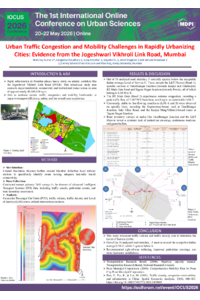
IOCUS2026_Poster.pdf
Microclimate-Sensitive Urbanism: A Method for Estimating Local Urban Heat Island Effect Impact on Building Energy Performance
City Birds: Negotiating with Pigeons, Sparrows, Seagulls, Vultures, Northern Cardinals, Oriental Pied Hornbills, and Other Avian Urban Dwellers