Event submissions
Published
This submission belongs to the session S6. Urbanization and Social Development of the event The 1st International Online Conference on Urban Sciences
Published date
15 May, 2026
Academic Editor
'%3e%3cpath%20d='M12.6657%2010.9104C12.4185%2010.325%2012.0599%209.79327%2011.6097%209.34482C11.1609%208.89508%2010.6293%208.5365%2010.0442%208.28888C10.0389%208.28626%2010.0337%208.28495%2010.0285%208.28233C10.8446%207.69279%2011.3752%206.73249%2011.3752%205.64904C11.3752%203.8542%209.92103%202.39999%208.1262%202.39999C6.33136%202.39999%204.87715%203.8542%204.87715%205.64904C4.87715%206.73249%205.40774%207.69279%206.22393%208.28364C6.21869%208.28626%206.21345%208.28757%206.20821%208.29019C5.62129%208.5378%205.09463%208.89284%204.64265%209.34613C4.1929%209.79493%203.83432%2010.3266%203.58671%2010.9117C3.34345%2011.4845%203.21226%2012.0987%203.20023%2012.7209C3.19988%2012.7349%203.20233%2012.7488%203.20744%2012.7619C3.21255%2012.7749%203.22022%2012.7867%203.22998%2012.7968C3.23975%2012.8068%203.25142%2012.8147%203.26431%2012.8202C3.2772%2012.8256%203.29105%2012.8284%203.30504%2012.8284H4.09109C4.14874%2012.8284%204.19459%2012.7825%204.1959%2012.7262C4.2221%2011.7148%204.62823%2010.7676%205.34617%2010.0497C6.08899%209.30683%207.0755%208.89808%208.1262%208.89808C9.17689%208.89808%2010.1634%209.30683%2010.9062%2010.0497C11.6242%2010.7676%2012.0303%2011.7148%2012.0565%2012.7262C12.0578%2012.7838%2012.1037%2012.8284%2012.1613%2012.8284H12.9474C12.9613%2012.8284%2012.9752%2012.8256%2012.9881%2012.8202C13.001%2012.8147%2013.0126%2012.8068%2013.0224%2012.7968C13.0322%2012.7867%2013.0398%2012.7749%2013.0449%2012.7619C13.0501%2012.7488%2013.0525%2012.7349%2013.0522%2012.7209C13.0391%2012.0947%2012.9094%2011.4855%2012.6657%2010.9104ZM8.1262%207.9024C7.52486%207.9024%206.9589%207.6679%206.53312%207.24211C6.10733%206.81633%205.87283%206.25037%205.87283%205.64904C5.87283%205.0477%206.10733%204.48174%206.53312%204.05596C6.9589%203.63018%207.52486%203.39567%208.1262%203.39567C8.72753%203.39567%209.29349%203.63018%209.71927%204.05596C10.1451%204.48174%2010.3796%205.0477%2010.3796%205.64904C10.3796%206.25037%2010.1451%206.81633%209.71927%207.24211C9.29349%207.6679%208.72753%207.9024%208.1262%207.9024Z'%20fill='%235D1EE1'/%3e%3c/g%3e%3c/svg%3e) Teodoro Georgiadis
Teodoro GeorgiadisCitation
Kachana Kasulu, From Equality to Equity in a Post-Industrial Mining City: Spatial Disparities in Service Access and Social Protection across Kitwe’s Formal–Informal Settlement Continuum, in Proceedings of The 1st International Online Conference on Urban Sciences, 20 May–22 May 2026, MDPI: Basel, Switzerland
Share
Email
Facebook
Twitter
LinkedIn
From Equality to Equity in a Post-Industrial Mining City: Spatial Disparities in Service Access and Social Protection across Kitwe’s Formal–Informal Settlement Continuum
'%3e%3cpath%20d='M12.6647%2010.9104C12.4176%2010.325%2012.0589%209.7933%2011.6088%209.34485C11.16%208.89511%2010.6283%208.53653%2010.0432%208.28891C10.038%208.28629%2010.0327%208.28498%2010.0275%208.28236C10.8437%207.69282%2011.3743%206.73252%2011.3743%205.64907C11.3743%203.85423%209.92005%202.40002%208.12522%202.40002C6.33038%202.40002%204.87618%203.85423%204.87618%205.64907C4.87618%206.73252%205.40677%207.69282%206.22296%208.28367C6.21772%208.28629%206.21248%208.2876%206.20724%208.29022C5.62031%208.53783%205.09365%208.89287%204.64167%209.34616C4.19192%209.79496%203.83334%2010.3266%203.58573%2010.9117C3.34247%2011.4846%203.21128%2012.0987%203.19925%2012.721C3.1989%2012.735%203.20135%2012.7489%203.20646%2012.7619C3.21157%2012.7749%203.21924%2012.7868%203.22901%2012.7968C3.23877%2012.8068%203.25045%2012.8148%203.26334%2012.8202C3.27623%2012.8256%203.29007%2012.8284%203.30406%2012.8284H4.09012C4.14776%2012.8284%204.19362%2012.7825%204.19493%2012.7262C4.22113%2011.7148%204.62726%2010.7676%205.34519%2010.0497C6.08802%209.30686%207.07452%208.89811%208.12522%208.89811C9.17592%208.89811%2010.1624%209.30686%2010.9052%2010.0497C11.6232%2010.7676%2012.0293%2011.7148%2012.0555%2012.7262C12.0568%2012.7839%2012.1027%2012.8284%2012.1603%2012.8284H12.9464C12.9604%2012.8284%2012.9742%2012.8256%2012.9871%2012.8202C13%2012.8148%2013.0117%2012.8068%2013.0214%2012.7968C13.0312%2012.7868%2013.0389%2012.7749%2013.044%2012.7619C13.0491%2012.7489%2013.0515%2012.735%2013.0512%2012.721C13.0381%2012.0947%2012.9084%2011.4856%2012.6647%2010.9104ZM8.12522%207.90243C7.52388%207.90243%206.95792%207.66793%206.53214%207.24215C6.10636%206.81636%205.87185%206.2504%205.87185%205.64907C5.87185%205.04773%206.10636%204.48177%206.53214%204.05599C6.95792%203.63021%207.52388%203.3957%208.12522%203.3957C8.72655%203.3957%209.29252%203.63021%209.7183%204.05599C10.1441%204.48177%2010.3786%205.04773%2010.3786%205.64907C10.3786%206.2504%2010.1441%206.81636%209.7183%207.24215C9.29252%207.66793%208.72655%207.90243%208.12522%207.90243Z'%20fill='%235D1EE1'/%3e%3c/g%3e%3c/svg%3e)
Kachana Kasulu 1
1. Independent Researcher, Kitwe, 10101, Zambia
Abstract
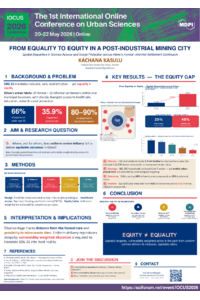
Introduction: SDG 11 mandates inclusive, safe, resilient, and sustainable cities, yet realisation requires distinguishing equality, uniform resource distribution from equity, calibrating support to differentiated needs. Kitwe’s urban fabric includes twenty-four formal and nineteen informal settlements that coexist within one municipal boundary, yet residents experience divergent access to healthcare, education, water, and social protection. With 66% of the population under 25, Copperbelt poverty at 35.9%, and the informal sector absorbing 80–90% of employment, the city constitutes a case for equity-oriented social development in Sub-Saharan Africa.
Methods: A stratified cross-sectional survey across six selected settlements (three formal, three informal) measures healthcare accessibility using a two-step floating catchment area method, education enrolment and completion rates, water and sanitation service levels, and social protection coverage, including the Social Cash Transfer Programme and NHIMA health insurance. A Spatial Equity Index weights indicators by vulnerability prevalence across the formal–informal continuum. Focus group discussions with women, youth, and persons with disabilities capture qualitative exclusion dimensions.
Results: Informal settlement residents travel 2.5–4 times further to access primary healthcare than their formal settlement counterparts, with the national 1:12,000 doctor-patient ratio masking far worse localised ratios in peri-urban zones. Cash transfer coverage, expanded to 880,000 households nationally, shows significant enrolment gaps among mobile urban populations who are ineligible under community-targeting criteria designed for rural contexts. Child stunting in low-income settlements reaches 48% versus 25% in planned areas. The Spatial Equity Index reveals consistent disadvantage gradients correlating with distance from the formal core and proximity to mine waste sites.
Conclusions: Equity-oriented urban social development in Kitwe necessitates spatially targeted, vulnerability-weighted resource allocation that transcends uniform municipal service delivery models. Priority interventions include extending NHIMA coverage to informal populations, establishing satellite health facilities within compound areas, and reformulating cash transfer targeting criteria for mobile urban households to close the persistent equity gap.
Keywords
social equity
informal settlements
service access
social protection
urban poverty
SDG 11
Kitwe
Poster
Poster IOCUS2026 sciforum-172811.pdf
Urbanisation and its Impact on the Landscape Transformation of East Kolkata Wetlands
Municipal governance and the 2030 Agenda: An analysis of public policies in São Cristóvão, Brazil (2019–2025)