Event submissions
Published
This submission belongs to the session S2. Urban Environments and Sustainability of the event The 1st International Online Conference on Urban Sciences
Published date
15 May, 2026
Academic Editor
'%3e%3cpath%20d='M12.6657%2010.9104C12.4185%2010.325%2012.0599%209.79327%2011.6097%209.34482C11.1609%208.89508%2010.6293%208.5365%2010.0442%208.28888C10.0389%208.28626%2010.0337%208.28495%2010.0285%208.28233C10.8446%207.69279%2011.3752%206.73249%2011.3752%205.64904C11.3752%203.8542%209.92103%202.39999%208.1262%202.39999C6.33136%202.39999%204.87715%203.8542%204.87715%205.64904C4.87715%206.73249%205.40774%207.69279%206.22393%208.28364C6.21869%208.28626%206.21345%208.28757%206.20821%208.29019C5.62129%208.5378%205.09463%208.89284%204.64265%209.34613C4.1929%209.79493%203.83432%2010.3266%203.58671%2010.9117C3.34345%2011.4845%203.21226%2012.0987%203.20023%2012.7209C3.19988%2012.7349%203.20233%2012.7488%203.20744%2012.7619C3.21255%2012.7749%203.22022%2012.7867%203.22998%2012.7968C3.23975%2012.8068%203.25142%2012.8147%203.26431%2012.8202C3.2772%2012.8256%203.29105%2012.8284%203.30504%2012.8284H4.09109C4.14874%2012.8284%204.19459%2012.7825%204.1959%2012.7262C4.2221%2011.7148%204.62823%2010.7676%205.34617%2010.0497C6.08899%209.30683%207.0755%208.89808%208.1262%208.89808C9.17689%208.89808%2010.1634%209.30683%2010.9062%2010.0497C11.6242%2010.7676%2012.0303%2011.7148%2012.0565%2012.7262C12.0578%2012.7838%2012.1037%2012.8284%2012.1613%2012.8284H12.9474C12.9613%2012.8284%2012.9752%2012.8256%2012.9881%2012.8202C13.001%2012.8147%2013.0126%2012.8068%2013.0224%2012.7968C13.0322%2012.7867%2013.0398%2012.7749%2013.0449%2012.7619C13.0501%2012.7488%2013.0525%2012.7349%2013.0522%2012.7209C13.0391%2012.0947%2012.9094%2011.4855%2012.6657%2010.9104ZM8.1262%207.9024C7.52486%207.9024%206.9589%207.6679%206.53312%207.24211C6.10733%206.81633%205.87283%206.25037%205.87283%205.64904C5.87283%205.0477%206.10733%204.48174%206.53312%204.05596C6.9589%203.63018%207.52486%203.39567%208.1262%203.39567C8.72753%203.39567%209.29349%203.63018%209.71927%204.05596C10.1451%204.48174%2010.3796%205.0477%2010.3796%205.64904C10.3796%206.25037%2010.1451%206.81633%209.71927%207.24211C9.29349%207.6679%208.72753%207.9024%208.1262%207.9024Z'%20fill='%235D1EE1'/%3e%3c/g%3e%3c/svg%3e) Eusébio Conceição
Eusébio ConceiçãoCitation
Stefania Anna Palermo, Michele Turco, Behrouz Pirouz, Patrizia Piro, Evaluating Rain Garden Efficacy for Sustainable Urban Stormwater Management, in Proceedings of The 1st International Online Conference on Urban Sciences, 20 May–22 May 2026, MDPI: Basel, Switzerland
Share
Email
Facebook
Twitter
LinkedIn
Evaluating Rain Garden Efficacy for Sustainable Urban Stormwater Management

Stefania Anna Palermo 1

Michele Turco 1

Behrouz Pirouz 1

Patrizia Piro 1
1. Department of Civil Engineering, University of Calabria, 87036 Rende, Italy
Abstract
The expansion of impervious surfaces, combined with ongoing climate change, has led to significant environmental impacts, most notably urban flooding. The rising frequency of these events underlines the inadequacy of conventional urban drainage systems, necessitating a strategic transition toward sustainable and resilient stormwater management. Within this framework, Nature-based Solutions (NbS) represent a key strategy, offering multifunctional and regenerative methods to strengthen urban resilience against intensifying environmental hazards. Among the several types of NbS, the Rain Garden (RG) is a bio-retention system designed to intercept, temporarily store, and treat stormwater runoff generated by surrounding impervious surfaces. However, despite a broad consensus on the advantages of RGs, their large-scale implementation remains limited. Thus, this study evaluates the hydrological efficiency of a rain garden proposed for a specific site in Cerisano, Southern Italy. By utilizing EPA-SWMM software to develop a predictive model across different RG configurations, the research explores how varying design parameters influence system performance. The findings confirm that RGs are a reliable strategy for urban stormwater control, highlighting that their hydrological performance is highly dependent on specific design variables. The demonstrated efficacy of this sustainable approach supports its widespread adoption as a tool for addressing the environmental pressures of modern urbanization.
Acknowledgements: This work was funded by the Next Generation EU - Italian NRRP, Mission 4, Component 2, Investment 1.5, call for the creation and strengthening of 'Innovation Ecosystems', building 'Territorial R&D Leaders' (Directorial Decree n. 2021/3277) - project Tech4You - Technologies for climate change adaptation and quality of life improvement, n. ECS0000009. This work reflects only the authors' views and opinions, neither the Ministry for University and Research nor the European Commission can be considered responsible for them. We would like to thank the Municipality of Cerisano for supporting these project activities as a stakeholder.
Keywords
Climate change adaptation
Sustainable Urban Drainage
Nature-based Solutions (NbS)
Hydrological Modeling
Poster
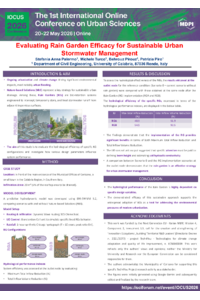
sciforum-181841_poster.pdf
Spatial Differentiation and Multi-Scale Drivers of County-Level Urbanization in China
An Urban Morphometrics Approach to Investigate the Quality of Urban Life in Saudi Arabia