Event submissions
Published
This submission belongs to the session S5. Urban Resilience and Adaptation of the event The 1st International Online Conference on Urban Sciences
Published date
15 May, 2026
Academic Editor
'%3e%3cpath%20d='M12.6657%2010.9104C12.4185%2010.325%2012.0599%209.79327%2011.6097%209.34482C11.1609%208.89508%2010.6293%208.5365%2010.0442%208.28888C10.0389%208.28626%2010.0337%208.28495%2010.0285%208.28233C10.8446%207.69279%2011.3752%206.73249%2011.3752%205.64904C11.3752%203.8542%209.92103%202.39999%208.1262%202.39999C6.33136%202.39999%204.87715%203.8542%204.87715%205.64904C4.87715%206.73249%205.40774%207.69279%206.22393%208.28364C6.21869%208.28626%206.21345%208.28757%206.20821%208.29019C5.62129%208.5378%205.09463%208.89284%204.64265%209.34613C4.1929%209.79493%203.83432%2010.3266%203.58671%2010.9117C3.34345%2011.4845%203.21226%2012.0987%203.20023%2012.7209C3.19988%2012.7349%203.20233%2012.7488%203.20744%2012.7619C3.21255%2012.7749%203.22022%2012.7867%203.22998%2012.7968C3.23975%2012.8068%203.25142%2012.8147%203.26431%2012.8202C3.2772%2012.8256%203.29105%2012.8284%203.30504%2012.8284H4.09109C4.14874%2012.8284%204.19459%2012.7825%204.1959%2012.7262C4.2221%2011.7148%204.62823%2010.7676%205.34617%2010.0497C6.08899%209.30683%207.0755%208.89808%208.1262%208.89808C9.17689%208.89808%2010.1634%209.30683%2010.9062%2010.0497C11.6242%2010.7676%2012.0303%2011.7148%2012.0565%2012.7262C12.0578%2012.7838%2012.1037%2012.8284%2012.1613%2012.8284H12.9474C12.9613%2012.8284%2012.9752%2012.8256%2012.9881%2012.8202C13.001%2012.8147%2013.0126%2012.8068%2013.0224%2012.7968C13.0322%2012.7867%2013.0398%2012.7749%2013.0449%2012.7619C13.0501%2012.7488%2013.0525%2012.7349%2013.0522%2012.7209C13.0391%2012.0947%2012.9094%2011.4855%2012.6657%2010.9104ZM8.1262%207.9024C7.52486%207.9024%206.9589%207.6679%206.53312%207.24211C6.10733%206.81633%205.87283%206.25037%205.87283%205.64904C5.87283%205.0477%206.10733%204.48174%206.53312%204.05596C6.9589%203.63018%207.52486%203.39567%208.1262%203.39567C8.72753%203.39567%209.29349%203.63018%209.71927%204.05596C10.1451%204.48174%2010.3796%205.0477%2010.3796%205.64904C10.3796%206.25037%2010.1451%206.81633%209.71927%207.24211C9.29349%207.6679%208.72753%207.9024%208.1262%207.9024Z'%20fill='%235D1EE1'/%3e%3c/g%3e%3c/svg%3e) Luis Hernández-Callejo
Luis Hernández-CallejoCitation
Iasmina Onescu, Multidisciplinary Seismic Vulnerability Assessment of Heritage Urban Centres: From Building Typologies to Urban Resilience, in Proceedings of The 1st International Online Conference on Urban Sciences, 20 May–22 May 2026, MDPI: Basel, Switzerland
Share
Email
Facebook
Twitter
LinkedIn
Multidisciplinary Seismic Vulnerability Assessment of Heritage Urban Centres: From Building Typologies to Urban Resilience

Iasmina Onescu 1
1. Department of Architecture, Faculty of Architecture and Town Planning Timisoara, Politehnica University of Timisoara, Timisoara, 300006, Romania
Abstract
Historic urban centres concentrate vulnerable building stocks, critical urban functions, and high cultural value within dense, morphologically complex fabrics. Yet, seismic risk assessment still focuses predominantly on single buildings or purely structural indicators, often underestimating systemic vulnerabilities and heritage significance. This contribution proposes a multidisciplinary framework for seismic vulnerability assessment at the scale of heritage urban centres, integrating structural fragility, urban morphology, exposure, and conservation value into a unified, map‑based methodology. The approach combines: (i) building‑by‑building survey and typological classification, (ii) empirical vulnerability indices, (iii) urban‑scale indicators such as street network configuration, parcel patterns, and (iv) weighting of cultural significance to support priority setting for risk‑mitigation measures. The methodology is applied to a historic city‑centre case study located in the western part of Romania, in an area with shallow earthquakes, producing spatial vulnerability scenarios that highlight critical clusters, potential damage distribution across the proposed cultural promenade, and conflicts between structural risk and heritage value. Results show that considering only structural aspects yields intervention priorities different from those when urban configuration and cultural importance are explicitly included, with direct implications for emergency planning and resource allocation. The author argues for closer collaboration between earthquake engineering, architecture, urban planning, conservation, and social sciences, and outlines how such integrated assessments can inform urban policies aimed at enhancing both seismic resilience and quality of life in heritage cities.
Keywords
vulnerability assessment
resilience
cultural value
earthquake
heritage
Poster
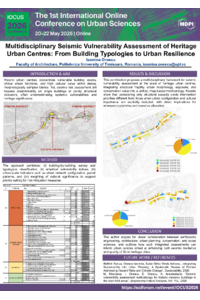
Poster Iasmina Onescu.pdf
ADAPTATION TO THE ABSENCE OF URBAN GREEN SPACES: A BEHAVIORAL RESEARCH ON THE RESIDENTS IN SAN PEDRO, LAGUNA
Towards a conceptual Urban Digital Twin (UDT) Framework for Urban Climate resilience: integrating Systems, People, and Policy