Event submissions
Published
This submission belongs to the session S5. Urban Resilience and Adaptation of the event The 1st International Online Conference on Urban Sciences
Published date
15 May, 2026
Academic Editor
'%3e%3cpath%20d='M12.6657%2010.9104C12.4185%2010.325%2012.0599%209.79327%2011.6097%209.34482C11.1609%208.89508%2010.6293%208.5365%2010.0442%208.28888C10.0389%208.28626%2010.0337%208.28495%2010.0285%208.28233C10.8446%207.69279%2011.3752%206.73249%2011.3752%205.64904C11.3752%203.8542%209.92103%202.39999%208.1262%202.39999C6.33136%202.39999%204.87715%203.8542%204.87715%205.64904C4.87715%206.73249%205.40774%207.69279%206.22393%208.28364C6.21869%208.28626%206.21345%208.28757%206.20821%208.29019C5.62129%208.5378%205.09463%208.89284%204.64265%209.34613C4.1929%209.79493%203.83432%2010.3266%203.58671%2010.9117C3.34345%2011.4845%203.21226%2012.0987%203.20023%2012.7209C3.19988%2012.7349%203.20233%2012.7488%203.20744%2012.7619C3.21255%2012.7749%203.22022%2012.7867%203.22998%2012.7968C3.23975%2012.8068%203.25142%2012.8147%203.26431%2012.8202C3.2772%2012.8256%203.29105%2012.8284%203.30504%2012.8284H4.09109C4.14874%2012.8284%204.19459%2012.7825%204.1959%2012.7262C4.2221%2011.7148%204.62823%2010.7676%205.34617%2010.0497C6.08899%209.30683%207.0755%208.89808%208.1262%208.89808C9.17689%208.89808%2010.1634%209.30683%2010.9062%2010.0497C11.6242%2010.7676%2012.0303%2011.7148%2012.0565%2012.7262C12.0578%2012.7838%2012.1037%2012.8284%2012.1613%2012.8284H12.9474C12.9613%2012.8284%2012.9752%2012.8256%2012.9881%2012.8202C13.001%2012.8147%2013.0126%2012.8068%2013.0224%2012.7968C13.0322%2012.7867%2013.0398%2012.7749%2013.0449%2012.7619C13.0501%2012.7488%2013.0525%2012.7349%2013.0522%2012.7209C13.0391%2012.0947%2012.9094%2011.4855%2012.6657%2010.9104ZM8.1262%207.9024C7.52486%207.9024%206.9589%207.6679%206.53312%207.24211C6.10733%206.81633%205.87283%206.25037%205.87283%205.64904C5.87283%205.0477%206.10733%204.48174%206.53312%204.05596C6.9589%203.63018%207.52486%203.39567%208.1262%203.39567C8.72753%203.39567%209.29349%203.63018%209.71927%204.05596C10.1451%204.48174%2010.3796%205.0477%2010.3796%205.64904C10.3796%206.25037%2010.1451%206.81633%209.71927%207.24211C9.29349%207.6679%208.72753%207.9024%208.1262%207.9024Z'%20fill='%235D1EE1'/%3e%3c/g%3e%3c/svg%3e) Gang Xu
Gang XuCitation
Adamantia Stamou, Noemi Friedman, Filippo Landi, Juan Chiachío, Nikolaos Koutantos, Mariza Tzouvali, Georgios D. Stamoulis, Vlado Stankovski, Jairis Alvarez Trujillo, Structural Health Monitoring and Earthquake/Climate Proofing by means of AI Sensor Fusion, Digital Twins and Smart Oracles, in Proceedings of The 1st International Online Conference on Urban Sciences, 20 May–22 May 2026, MDPI: Basel, Switzerland
Share
Email
Facebook
Twitter
LinkedIn
Structural Health Monitoring and Earthquake/Climate Proofing by means of AI Sensor Fusion, Digital Twins and Smart Oracles

Adamantia Stamou 1
'%3e%3cpath%20d='M12.6647%2010.9104C12.4176%2010.325%2012.0589%209.7933%2011.6088%209.34485C11.16%208.89511%2010.6283%208.53653%2010.0432%208.28891C10.038%208.28629%2010.0327%208.28498%2010.0275%208.28236C10.8437%207.69282%2011.3743%206.73252%2011.3743%205.64907C11.3743%203.85423%209.92005%202.40002%208.12522%202.40002C6.33038%202.40002%204.87618%203.85423%204.87618%205.64907C4.87618%206.73252%205.40677%207.69282%206.22296%208.28367C6.21772%208.28629%206.21248%208.2876%206.20724%208.29022C5.62031%208.53783%205.09365%208.89287%204.64167%209.34616C4.19192%209.79496%203.83334%2010.3266%203.58573%2010.9117C3.34247%2011.4846%203.21128%2012.0987%203.19925%2012.721C3.1989%2012.735%203.20135%2012.7489%203.20646%2012.7619C3.21157%2012.7749%203.21924%2012.7868%203.22901%2012.7968C3.23877%2012.8068%203.25045%2012.8148%203.26334%2012.8202C3.27623%2012.8256%203.29007%2012.8284%203.30406%2012.8284H4.09012C4.14776%2012.8284%204.19362%2012.7825%204.19493%2012.7262C4.22113%2011.7148%204.62726%2010.7676%205.34519%2010.0497C6.08802%209.30686%207.07452%208.89811%208.12522%208.89811C9.17592%208.89811%2010.1624%209.30686%2010.9052%2010.0497C11.6232%2010.7676%2012.0293%2011.7148%2012.0555%2012.7262C12.0568%2012.7839%2012.1027%2012.8284%2012.1603%2012.8284H12.9464C12.9604%2012.8284%2012.9742%2012.8256%2012.9871%2012.8202C13%2012.8148%2013.0117%2012.8068%2013.0214%2012.7968C13.0312%2012.7868%2013.0389%2012.7749%2013.044%2012.7619C13.0491%2012.7489%2013.0515%2012.735%2013.0512%2012.721C13.0381%2012.0947%2012.9084%2011.4856%2012.6647%2010.9104ZM8.12522%207.90243C7.52388%207.90243%206.95792%207.66793%206.53214%207.24215C6.10636%206.81636%205.87185%206.2504%205.87185%205.64907C5.87185%205.04773%206.10636%204.48177%206.53214%204.05599C6.95792%203.63021%207.52388%203.3957%208.12522%203.3957C8.72655%203.3957%209.29252%203.63021%209.7183%204.05599C10.1441%204.48177%2010.3786%205.04773%2010.3786%205.64907C10.3786%206.2504%2010.1441%206.81636%209.7183%207.24215C9.29252%207.66793%208.72655%207.90243%208.12522%207.90243Z'%20fill='%235D1EE1'/%3e%3c/g%3e%3c/svg%3e)
Noemi Friedman 2

Filippo Landi 3

Juan Chiachío 4
Nikolaos Koutantos 1
Mariza Tzouvali 1
Georgios D. Stamoulis 1

Vlado Stankovski 5
Jairis Alvarez Trujillo 6
1. Department of Informatics, School of Information Sciences and Technology, Athens University of Economics and Business, Patision 76, Athens, Greece
2. Artificial Intelligence Laboratory, HUN-REN Institute for Computer Science and Control (SZTAKI), Budapest, 1111 Budapest, Kende u. 13-17, Hungary, Hungary
3. Dipartimento di Ingegneria Civile e Industriale, University of Pisa, Pisa, LARGO LUCIO LAZZARINO 2, 56126 PISA, Italy
4. Departamento de Mecánica de Estructuras e Ingeniería Hidráulica, E.T.S. de Ingeniería de Caminos, Canales y Puertos, Campus Universitario de Fuentenueva (Edificio Politécnico), University of Granada, Granada, 18071, Spain
5. Faculty of Computer and Information Science, University of Ljubljana, Ljubljana, Večna pot 113, SI-1000 Ljubljana, Slovenia
6. RINA Consulting S.P.A, Genova, Via Antonio Cecchi 6, 16129, Italy
Abstract
Introduction
The rising intensity of climate and weather‑related extremes, coupled with seismic risks, threatens the resilience of the built environment. This paper presents an integrated framework for Structural Health Monitoring (SHM) and earthquake/climate proofing that unites AI‑driven sensor fusion, Digital Twins (DTs), and Smart Oracles within the blockchain‑enabled decentralized data and knowledge ecosystem developed by the Horizon Europe project BUILDCHAIN.
Methods
Heterogeneous structural, environmental, climatic, and meteorological data streams are merged into a unified analytical pipeline, where AI models process vibration, acceleration, temperature, humidity, and related signals to extract modal properties, detect anomalies, and update structural performance indicators. Trustworthy data flows are ensured through a Decentralized Oracle Network (DON) connected to InterPlanetary File System (IPFS)-based distributed storage. Climate and weather datasets—historical, real‑time, and forecasted—are transformed into Knowledge Assets (KAs), integrated into the Decentralized Knowledge Graph (DKG), validated through a reputation‑based oracle mechanism, and stored immutably on the IPFS. AI‑based fusion algorithms reconcile sensor observations with physics‑based (i.e., Finite Element) models, triggering automated updating routines that refine key structural parameters (i.e., masonry or timber elastic moduli), which critically influence predictive accuracy under seismic and climate‑induced loads.
Results
Pilot applications involving real buildings demonstrate the framework’s ability to reduce discrepancies between as‑designed and as‑built performance. In two tall cross‑laminated timber (CLT) buildings, AI‑driven fusion and DT‑based updating refined elastic modulus scaling factors derived from modal measurements, improving vibration‑serviceability predictions. Deployments in the Hospital Real of Granada and the Palazzo Poniatowski Guadagni validated the approach with open, scalable SHM architectures, enabling quasi‑real‑time operational modal analysis and dynamic DT generation.
Conclusions
Combining AI‑driven sensor fusion, DTs and Smart Oracles with decentralized data governance enhances SHM reliability, improves predictive performance, and supports real‑time assessment of structural condition and vulnerability under seismic and climate stressors.
Keywords
Digital Twin
Structural Health Monitoring
Earthquake/Climate Proofing
AI Sensor Fusion
Smart Oracles
Poster
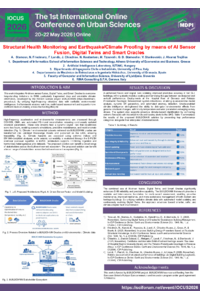
166857-Structural_Health_Monitoring_posterIOCUS_final.pdf
Towards a conceptual Urban Digital Twin (UDT) Framework for Urban Climate resilience: integrating Systems, People, and Policy
Landscape-Oriented Strategies for Integrated Urban Regeneration in Complex Cities