Event submissions
Published
This submission belongs to the session S5. Urban Resilience and Adaptation of the event The 1st International Online Conference on Urban Sciences
Published date
15 May, 2026
Academic Editor
'%3e%3cpath%20d='M12.6657%2010.9104C12.4185%2010.325%2012.0599%209.79327%2011.6097%209.34482C11.1609%208.89508%2010.6293%208.5365%2010.0442%208.28888C10.0389%208.28626%2010.0337%208.28495%2010.0285%208.28233C10.8446%207.69279%2011.3752%206.73249%2011.3752%205.64904C11.3752%203.8542%209.92103%202.39999%208.1262%202.39999C6.33136%202.39999%204.87715%203.8542%204.87715%205.64904C4.87715%206.73249%205.40774%207.69279%206.22393%208.28364C6.21869%208.28626%206.21345%208.28757%206.20821%208.29019C5.62129%208.5378%205.09463%208.89284%204.64265%209.34613C4.1929%209.79493%203.83432%2010.3266%203.58671%2010.9117C3.34345%2011.4845%203.21226%2012.0987%203.20023%2012.7209C3.19988%2012.7349%203.20233%2012.7488%203.20744%2012.7619C3.21255%2012.7749%203.22022%2012.7867%203.22998%2012.7968C3.23975%2012.8068%203.25142%2012.8147%203.26431%2012.8202C3.2772%2012.8256%203.29105%2012.8284%203.30504%2012.8284H4.09109C4.14874%2012.8284%204.19459%2012.7825%204.1959%2012.7262C4.2221%2011.7148%204.62823%2010.7676%205.34617%2010.0497C6.08899%209.30683%207.0755%208.89808%208.1262%208.89808C9.17689%208.89808%2010.1634%209.30683%2010.9062%2010.0497C11.6242%2010.7676%2012.0303%2011.7148%2012.0565%2012.7262C12.0578%2012.7838%2012.1037%2012.8284%2012.1613%2012.8284H12.9474C12.9613%2012.8284%2012.9752%2012.8256%2012.9881%2012.8202C13.001%2012.8147%2013.0126%2012.8068%2013.0224%2012.7968C13.0322%2012.7867%2013.0398%2012.7749%2013.0449%2012.7619C13.0501%2012.7488%2013.0525%2012.7349%2013.0522%2012.7209C13.0391%2012.0947%2012.9094%2011.4855%2012.6657%2010.9104ZM8.1262%207.9024C7.52486%207.9024%206.9589%207.6679%206.53312%207.24211C6.10733%206.81633%205.87283%206.25037%205.87283%205.64904C5.87283%205.0477%206.10733%204.48174%206.53312%204.05596C6.9589%203.63018%207.52486%203.39567%208.1262%203.39567C8.72753%203.39567%209.29349%203.63018%209.71927%204.05596C10.1451%204.48174%2010.3796%205.0477%2010.3796%205.64904C10.3796%206.25037%2010.1451%206.81633%209.71927%207.24211C9.29349%207.6679%208.72753%207.9024%208.1262%207.9024Z'%20fill='%235D1EE1'/%3e%3c/g%3e%3c/svg%3e) Teodoro Georgiadis
Teodoro GeorgiadisCitation
Harini Sawandi, Sachin Mamoru, Amila Jayasinghe, Pradeep Kalansooriya, Jasintha Jayasanka, Buddhika Amila Kumara, Choolaka Hewawasam, A Participatory Chatbot for Strengthening Urban Flood and Landslide Resilience: Integrating Community Awareness and Planning Decision Support, in Proceedings of The 1st International Online Conference on Urban Sciences, 20 May–22 May 2026, MDPI: Basel, Switzerland
Share
Email
Facebook
Twitter
LinkedIn
A Participatory Chatbot for Strengthening Urban Flood and Landslide Resilience: Integrating Community Awareness and Planning Decision Support
'%3e%3cpath%20d='M12.6647%2010.9104C12.4176%2010.325%2012.0589%209.7933%2011.6088%209.34485C11.16%208.89511%2010.6283%208.53653%2010.0432%208.28891C10.038%208.28629%2010.0327%208.28498%2010.0275%208.28236C10.8437%207.69282%2011.3743%206.73252%2011.3743%205.64907C11.3743%203.85423%209.92005%202.40002%208.12522%202.40002C6.33038%202.40002%204.87618%203.85423%204.87618%205.64907C4.87618%206.73252%205.40677%207.69282%206.22296%208.28367C6.21772%208.28629%206.21248%208.2876%206.20724%208.29022C5.62031%208.53783%205.09365%208.89287%204.64167%209.34616C4.19192%209.79496%203.83334%2010.3266%203.58573%2010.9117C3.34247%2011.4846%203.21128%2012.0987%203.19925%2012.721C3.1989%2012.735%203.20135%2012.7489%203.20646%2012.7619C3.21157%2012.7749%203.21924%2012.7868%203.22901%2012.7968C3.23877%2012.8068%203.25045%2012.8148%203.26334%2012.8202C3.27623%2012.8256%203.29007%2012.8284%203.30406%2012.8284H4.09012C4.14776%2012.8284%204.19362%2012.7825%204.19493%2012.7262C4.22113%2011.7148%204.62726%2010.7676%205.34519%2010.0497C6.08802%209.30686%207.07452%208.89811%208.12522%208.89811C9.17592%208.89811%2010.1624%209.30686%2010.9052%2010.0497C11.6232%2010.7676%2012.0293%2011.7148%2012.0555%2012.7262C12.0568%2012.7839%2012.1027%2012.8284%2012.1603%2012.8284H12.9464C12.9604%2012.8284%2012.9742%2012.8256%2012.9871%2012.8202C13%2012.8148%2013.0117%2012.8068%2013.0214%2012.7968C13.0312%2012.7868%2013.0389%2012.7749%2013.044%2012.7619C13.0491%2012.7489%2013.0515%2012.735%2013.0512%2012.721C13.0381%2012.0947%2012.9084%2011.4856%2012.6647%2010.9104ZM8.12522%207.90243C7.52388%207.90243%206.95792%207.66793%206.53214%207.24215C6.10636%206.81636%205.87185%206.2504%205.87185%205.64907C5.87185%205.04773%206.10636%204.48177%206.53214%204.05599C6.95792%203.63021%207.52388%203.3957%208.12522%203.3957C8.72655%203.3957%209.29252%203.63021%209.7183%204.05599C10.1441%204.48177%2010.3786%205.04773%2010.3786%205.64907C10.3786%206.2504%2010.1441%206.81636%209.7183%207.24215C9.29252%207.66793%208.72655%207.90243%208.12522%207.90243Z'%20fill='%235D1EE1'/%3e%3c/g%3e%3c/svg%3e)
Harini Sawandi 1
Sachin Mamoru 2
Amila Jayasinghe 3
Pradeep Kalansooriya 4
Jasintha Jayasanka 5
Buddhika Amila Kumara 6
Choolaka Hewawasam 1
1. Department of Civil and Environmental Technology, Faculty of Technology, University of Sri Jayewardenepura, Nugegoda, Sri Lanka
2. Faculty of Information Technology, University of Moratuwa, Nugegoda, Sri Lanka
3. Department of Town & Country Planning, University of Moratuwa, Nugegoda, Sri Lanka
4. Department of Computer Science , Faculty of Computing, KDU General Sir John Kotelawala Defence University, Nugegoda, Sri Lanka
5. Department of BioSystems Technology, Faculty of Technology, University of Sri Jayewardenepura, Nugegoda, Sri Lanka
6. Department of Materials and Mechanical Technology, Faculty of Technology, University of Sri Jayewardenepura, Nugegoda, Sri Lanka
Abstract
Urban communities are facing intensifying risks from floods and other disasters, creating a growing need to connect scientific knowledge with everyday community experience. The continuing increase in anthropogenic activities on the planet has intensified climate change, leading to a higher frequency and severity of natural hazard-related disasters. Digital technological advancements, including monitoring systems that integrate sensors and machine learning, are being implemented in disaster management practices, yielding beneficial outcomes, yet risk communication and preparedness mechanisms remain fragmented across institutions, limiting public literacy, regulatory compliance, and informed development decisions. This study presents a participatory, AI-driven WhatsApp-based chatbot designed to enhance urban adaptive capacity by translating institutional hazard knowledge into actionable, location-specific community guidance. The methodology is grounded in a hybrid architecture that combines a user-centred design approach, with a modular multi-agent system. Additionally, the architecture integrates a collection of modular agents: a language agent facilitating multilingual interaction, an API agent providing live weather updates, and a scheduler agent. Moreover, the system design is supported by measures for overall performance, including response speed, retrieval confidence, language detection accuracy, and system dependability. A full expert review will be undertaken for planning and engineering professionals to systematically assess the relevance, accuracy, understandability, and comprehensiveness of the responses from the user's perspective. For planners and developers, this chatbot supports risk-sensitive zoning interpretation and decision-making, contributing to improved regulatory adherence and safer land-use practices. For individuals, the chatbot provides fundamental disaster awareness, preparedness tips, relief information, and participatory reporting, thereby increasing awareness before and after the disasters. This study demonstrates how digital innovation can facilitate the operationalisation of Sustainable Development Goals, which directly address SDG 11 and 13—Sustainable Cities and Communities and Climate Action—and indirectly SDG 9 and 17—Industry, Innovation and Infrastructure and Partnerships for the Goals.
Keywords
Chatbot
Disaster Risk Reduction
Sustainable Development
Urban Resilience
Poster
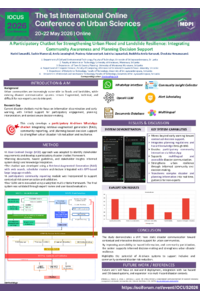
A Participatory Chatbot for Strengthening Urban Flood and Landslide Resilience Integrating Community Awareness and Planning Decision Support 171882(1).pdf
Institutional Decision-Gates in Pluvial Urban Flood Resilience: Fiscal Constraints and Fragmented Authority in Gowa Regency, Indonesia
AI-Based Segmentation of Heritage Urban Morphology for Urban Heat Vulnerability (UHV) Assessment in Mediterranean Historic Districts