Event submissions
Published
This submission belongs to the session S5. Urban Resilience and Adaptation of the event The 1st International Online Conference on Urban Sciences
Published date
15 May, 2026
Academic Editor
'%3e%3cpath%20d='M12.6657%2010.9104C12.4185%2010.325%2012.0599%209.79327%2011.6097%209.34482C11.1609%208.89508%2010.6293%208.5365%2010.0442%208.28888C10.0389%208.28626%2010.0337%208.28495%2010.0285%208.28233C10.8446%207.69279%2011.3752%206.73249%2011.3752%205.64904C11.3752%203.8542%209.92103%202.39999%208.1262%202.39999C6.33136%202.39999%204.87715%203.8542%204.87715%205.64904C4.87715%206.73249%205.40774%207.69279%206.22393%208.28364C6.21869%208.28626%206.21345%208.28757%206.20821%208.29019C5.62129%208.5378%205.09463%208.89284%204.64265%209.34613C4.1929%209.79493%203.83432%2010.3266%203.58671%2010.9117C3.34345%2011.4845%203.21226%2012.0987%203.20023%2012.7209C3.19988%2012.7349%203.20233%2012.7488%203.20744%2012.7619C3.21255%2012.7749%203.22022%2012.7867%203.22998%2012.7968C3.23975%2012.8068%203.25142%2012.8147%203.26431%2012.8202C3.2772%2012.8256%203.29105%2012.8284%203.30504%2012.8284H4.09109C4.14874%2012.8284%204.19459%2012.7825%204.1959%2012.7262C4.2221%2011.7148%204.62823%2010.7676%205.34617%2010.0497C6.08899%209.30683%207.0755%208.89808%208.1262%208.89808C9.17689%208.89808%2010.1634%209.30683%2010.9062%2010.0497C11.6242%2010.7676%2012.0303%2011.7148%2012.0565%2012.7262C12.0578%2012.7838%2012.1037%2012.8284%2012.1613%2012.8284H12.9474C12.9613%2012.8284%2012.9752%2012.8256%2012.9881%2012.8202C13.001%2012.8147%2013.0126%2012.8068%2013.0224%2012.7968C13.0322%2012.7867%2013.0398%2012.7749%2013.0449%2012.7619C13.0501%2012.7488%2013.0525%2012.7349%2013.0522%2012.7209C13.0391%2012.0947%2012.9094%2011.4855%2012.6657%2010.9104ZM8.1262%207.9024C7.52486%207.9024%206.9589%207.6679%206.53312%207.24211C6.10733%206.81633%205.87283%206.25037%205.87283%205.64904C5.87283%205.0477%206.10733%204.48174%206.53312%204.05596C6.9589%203.63018%207.52486%203.39567%208.1262%203.39567C8.72753%203.39567%209.29349%203.63018%209.71927%204.05596C10.1451%204.48174%2010.3796%205.0477%2010.3796%205.64904C10.3796%206.25037%2010.1451%206.81633%209.71927%207.24211C9.29349%207.6679%208.72753%207.9024%208.1262%207.9024Z'%20fill='%235D1EE1'/%3e%3c/g%3e%3c/svg%3e) Jianming Cai
Jianming CaiCitation
Maria Bostenaru-Dan, Nature-based Solutions as a Tool for Mitigating "Slow Disasters" in Marginalized Urban Heritage, in Proceedings of The 1st International Online Conference on Urban Sciences, 20 May–22 May 2026, MDPI: Basel, Switzerland
Share
Email
Facebook
Twitter
LinkedIn
Nature-based Solutions as a Tool for Mitigating "Slow Disasters" in Marginalized Urban Heritage

Maria Bostenaru-Dan 1
1. Department for Research Management, “Ion Mincu” University of Architecture and Urbanism, Bucharest, Romania
Abstract
Introduction: This research addresses the challenge of "slow disasters"—the chronic, incremental degradation of urban ecosystems and social fabrics—within marginalized residential areas. While Nature-based Solutions (NbS) are often applied to new developments, their role in rehabilitating early 20th-century urban heritage remains under-explored. This study examines how NbS can be integrated with cultural memory to foster resilience in the specific contexts of Budapest and Bucharest.
Methods: The study employs a multi-disciplinary approach combining circular economy principles with digital humanities. I utilize StoryMaps as a phenomenological mapping tool to overlay technical environmental data with narrative storytelling. This "Architecture of Convalescence" methodology treats the city as a recovering organism, using heritage documentation to identify sites where green interventions can repair both ecological and psychological "mental maps."
Results: The findings indicate that rehabilitating existing residential heritage through NbS (such as green courtyards and permeable surfaces) is more carbon-efficient than reconstruction. In the Budapest-Bucharest axis, marginalized spaces often coincide with high-density 20th-century housing. My mapping reveals that integrating "slow tourism" and cultural routes into these areas transforms them from isolated hazard zones into resilient, productive landscapes that mitigate urban heat and improve inhabitant well-being.
Conclusions: The research concludes that NbS are most effective when grounded in the "spirit of the place." By linking ecological restoration with cultural sustainability, cities can move beyond temporary fixes to long-term systemic resilience. This holistic framework provides a scalable model for Central and Eastern European cities to address the dual pressures of climate change and heritage decay.
Keywords
Nature-based Solutions (NbS)
slow disasters
cultural memory
marginalized spaces
urban resilience
circular economy
Poster
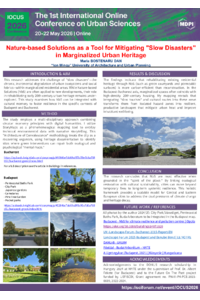
posterIOCUSbostenaru.pdf
Towards Climate-Resilient Urban Neighbourhoods: Evaluating Green Infrastructure Strategies through Environmental Simulations
Operationalizing Creative Diversity as a Multi-scale Diagnostic Framework for Urban Resilience