Event submissions
Published
This submission belongs to the session S5. Urban Resilience and Adaptation of the event The 1st International Online Conference on Urban Sciences
Published date
15 May, 2026
Academic Editor
'%3e%3cpath%20d='M12.6657%2010.9104C12.4185%2010.325%2012.0599%209.79327%2011.6097%209.34482C11.1609%208.89508%2010.6293%208.5365%2010.0442%208.28888C10.0389%208.28626%2010.0337%208.28495%2010.0285%208.28233C10.8446%207.69279%2011.3752%206.73249%2011.3752%205.64904C11.3752%203.8542%209.92103%202.39999%208.1262%202.39999C6.33136%202.39999%204.87715%203.8542%204.87715%205.64904C4.87715%206.73249%205.40774%207.69279%206.22393%208.28364C6.21869%208.28626%206.21345%208.28757%206.20821%208.29019C5.62129%208.5378%205.09463%208.89284%204.64265%209.34613C4.1929%209.79493%203.83432%2010.3266%203.58671%2010.9117C3.34345%2011.4845%203.21226%2012.0987%203.20023%2012.7209C3.19988%2012.7349%203.20233%2012.7488%203.20744%2012.7619C3.21255%2012.7749%203.22022%2012.7867%203.22998%2012.7968C3.23975%2012.8068%203.25142%2012.8147%203.26431%2012.8202C3.2772%2012.8256%203.29105%2012.8284%203.30504%2012.8284H4.09109C4.14874%2012.8284%204.19459%2012.7825%204.1959%2012.7262C4.2221%2011.7148%204.62823%2010.7676%205.34617%2010.0497C6.08899%209.30683%207.0755%208.89808%208.1262%208.89808C9.17689%208.89808%2010.1634%209.30683%2010.9062%2010.0497C11.6242%2010.7676%2012.0303%2011.7148%2012.0565%2012.7262C12.0578%2012.7838%2012.1037%2012.8284%2012.1613%2012.8284H12.9474C12.9613%2012.8284%2012.9752%2012.8256%2012.9881%2012.8202C13.001%2012.8147%2013.0126%2012.8068%2013.0224%2012.7968C13.0322%2012.7867%2013.0398%2012.7749%2013.0449%2012.7619C13.0501%2012.7488%2013.0525%2012.7349%2013.0522%2012.7209C13.0391%2012.0947%2012.9094%2011.4855%2012.6657%2010.9104ZM8.1262%207.9024C7.52486%207.9024%206.9589%207.6679%206.53312%207.24211C6.10733%206.81633%205.87283%206.25037%205.87283%205.64904C5.87283%205.0477%206.10733%204.48174%206.53312%204.05596C6.9589%203.63018%207.52486%203.39567%208.1262%203.39567C8.72753%203.39567%209.29349%203.63018%209.71927%204.05596C10.1451%204.48174%2010.3796%205.0477%2010.3796%205.64904C10.3796%206.25037%2010.1451%206.81633%209.71927%207.24211C9.29349%207.6679%208.72753%207.9024%208.1262%207.9024Z'%20fill='%235D1EE1'/%3e%3c/g%3e%3c/svg%3e) Teodoro Georgiadis
Teodoro GeorgiadisCitation
Mark Jesson Labarinto Ronquillo, Jose Adrian Jimenez, John Rey Briones, Revitalizing Nabao Creek as a Walkable Urban Spine: Applying the B.A.Y.A.N. Framework in Cabanatuan City, in Proceedings of The 1st International Online Conference on Urban Sciences, 20 May–22 May 2026, MDPI: Basel, Switzerland
Share
Email
Facebook
Twitter
LinkedIn
Revitalizing Nabao Creek as a Walkable Urban Spine: Applying the B.A.Y.A.N. Framework in Cabanatuan City
'%3e%3cpath%20d='M12.6647%2010.9104C12.4176%2010.325%2012.0589%209.7933%2011.6088%209.34485C11.16%208.89511%2010.6283%208.53653%2010.0432%208.28891C10.038%208.28629%2010.0327%208.28498%2010.0275%208.28236C10.8437%207.69282%2011.3743%206.73252%2011.3743%205.64907C11.3743%203.85423%209.92005%202.40002%208.12522%202.40002C6.33038%202.40002%204.87618%203.85423%204.87618%205.64907C4.87618%206.73252%205.40677%207.69282%206.22296%208.28367C6.21772%208.28629%206.21248%208.2876%206.20724%208.29022C5.62031%208.53783%205.09365%208.89287%204.64167%209.34616C4.19192%209.79496%203.83334%2010.3266%203.58573%2010.9117C3.34247%2011.4846%203.21128%2012.0987%203.19925%2012.721C3.1989%2012.735%203.20135%2012.7489%203.20646%2012.7619C3.21157%2012.7749%203.21924%2012.7868%203.22901%2012.7968C3.23877%2012.8068%203.25045%2012.8148%203.26334%2012.8202C3.27623%2012.8256%203.29007%2012.8284%203.30406%2012.8284H4.09012C4.14776%2012.8284%204.19362%2012.7825%204.19493%2012.7262C4.22113%2011.7148%204.62726%2010.7676%205.34519%2010.0497C6.08802%209.30686%207.07452%208.89811%208.12522%208.89811C9.17592%208.89811%2010.1624%209.30686%2010.9052%2010.0497C11.6232%2010.7676%2012.0293%2011.7148%2012.0555%2012.7262C12.0568%2012.7839%2012.1027%2012.8284%2012.1603%2012.8284H12.9464C12.9604%2012.8284%2012.9742%2012.8256%2012.9871%2012.8202C13%2012.8148%2013.0117%2012.8068%2013.0214%2012.7968C13.0312%2012.7868%2013.0389%2012.7749%2013.044%2012.7619C13.0491%2012.7489%2013.0515%2012.735%2013.0512%2012.721C13.0381%2012.0947%2012.9084%2011.4856%2012.6647%2010.9104ZM8.12522%207.90243C7.52388%207.90243%206.95792%207.66793%206.53214%207.24215C6.10636%206.81636%205.87185%206.2504%205.87185%205.64907C5.87185%205.04773%206.10636%204.48177%206.53214%204.05599C6.95792%203.63021%207.52388%203.3957%208.12522%203.3957C8.72655%203.3957%209.29252%203.63021%209.7183%204.05599C10.1441%204.48177%2010.3786%205.04773%2010.3786%205.64907C10.3786%206.2504%2010.1441%206.81636%209.7183%207.24215C9.29252%207.66793%208.72655%207.90243%208.12522%207.90243Z'%20fill='%235D1EE1'/%3e%3c/g%3e%3c/svg%3e)
Mark Jesson Labarinto Ronquillo 1
Jose Adrian Jimenez 1
John Rey Briones 1
1. School of Graduate Studies, Mapua University, Manila, 1002, Philippines
Abstract
Cabanatuan City, one of the Philippines' prime cities experiencing rapid urbanization, has contributed to the ecological degradation of Nabao Creek, an underutilized urban waterway with considerable potential for environmental restoration and public space activation. This study proposes revitalizing Nabao Creek as a walkable urban spine through the B.A.Y.A.N. Framework, which integrates five key dimensions: Bayanihan (Stakeholder Involvement), Accessibility (Movescape), Yaman Inprastraktura (Blue–Green Infrastructure), Adaptability (Governance and Policy Making), and Nature-Based Solutions. The framework aims to reconnect the waterway with surrounding communities while enhancing ecological performance and public accessibility. Drawing insights from Singapore’s Active, Beautiful, Clean (ABC) Waters Programme and the principles of Water-Sensitive Urban Design (WSUD), the research develops a context-sensitive WSUD–BAYAN. This combined framework is tailored to the conditions of rapidly urbanizing Philippine cities. The methodology uses comparative case analysis of international and local precedents to identify transferable strategies in ecological restoration, public space design, and water-sensitive planning. The proposed framework stresses blue–green infrastructure, nature-based solutions, and community- oriented governance to restore ecological functions, improve flood resilience, and encourage inclusive public spaces. By transforming Nabao Creek into a multifunctional ecological corridor, the project demonstrates how neglected waterways can support urban resilience, environmental sustainability, and active public life. Ultimately, the study positions Nabao Creek as a replicable model for sustainable urban waterway revitalization in rapidly urbanizing Philippine cities.
Keywords
Urban Waterway Revitalization
Blue–Green Infrastructure
Water-Sensitive Urban Design (WSUD)
Urban Resilience
Nature-Based Solutions
Walkable Urban Spine
Poster
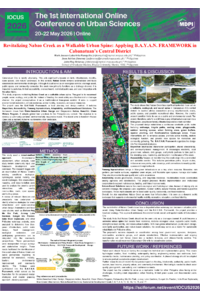
Revitalization of Nabao Creek (BAYAN Framework)_1.pdf
LAND USE TRANSFORMATION IN COASTAL SEAWEED FARMING VILLAGES: SPATIAL AND SOCIAL PERSPECTIVES
Adaptive Public Open Space Planning in A Cold-climate Ger District: A GIS and Participatory Study of Bilgekh Valley, Ulaanbaatar, Mongolia